






Ethereum is sitting at one of those awkward crossroads where the on-chain story sounds supportive, but the chart still feels heavy. More ETH is being locked into staking and fewer coins are lingering on exchanges, which usually helps tighten supply over time.
Supply tightens as more ETH leaves exchanges
A steady slide in exchange reserves suggests fewer coins are parked where they can be sold quickly. At the same time, the share of supply locked in staking has pushed above 30%, hitting a fresh record and reinforcing the idea of reduced liquid float. In this Ethereum price analysis, the takeaway is not “price must go up.” It is that moves can get sharper when supply is less available and sentiment flips fast.
Still, scarcity signals can be misleading in the moment. Coins can leave exchanges for cold storage and later return when price jumps, and staking flows often reflect long-term conviction rather than immediate buying. That is why this Ethereum price analysis pairs on-chain trends with execution data, so optimism does not outrun what the market is actually doing today.
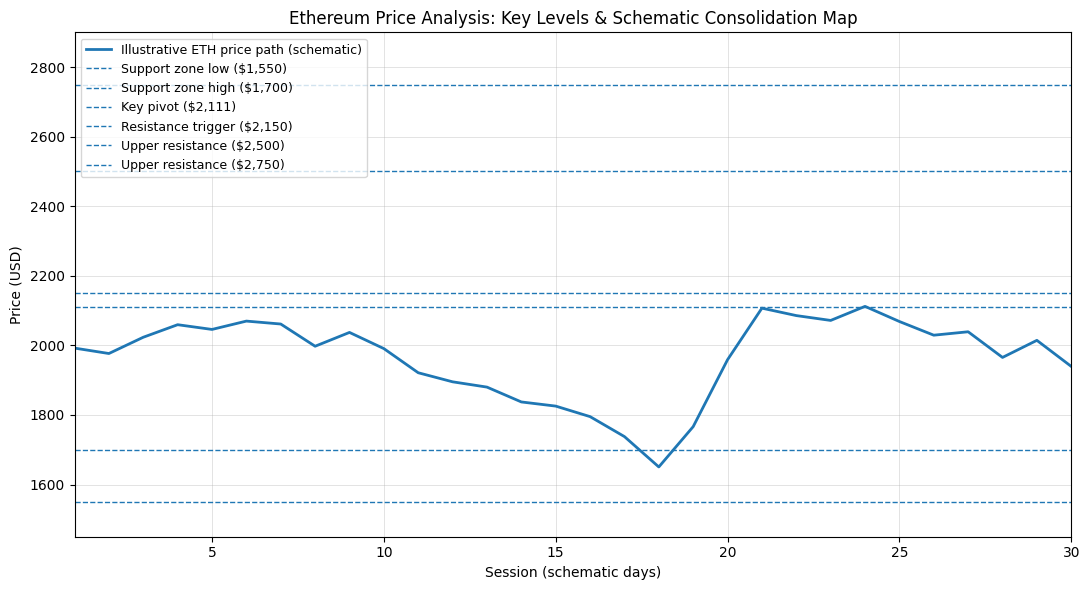
Ethereum price analysis: execution flow still favors sellers
The market tone has stayed defensive, as a falling taker buy-sell ratio points to more aggressive selling than buying, meaning traders are more often hitting bids than lifting offers. Large-holder deposits to centralized venues have also been observed, which tends to weigh on short-term price action when liquidity is thin. This Ethereum price analysis treats that as the reason rallies have felt heavy, even when supply metrics look constructive.
Structure matters too, as ETH slipped below a notable swing level near $2,111, a prior mid-2025 low that had acted as a reference point for months. When a level like that breaks, it often turns into resistance, because trapped buyers use the retest to exit. In this Ethereum price analysis, the $2,100 area is a sentiment checkpoint, not a magic number.
Indicators: what the chart is really saying
Momentum is trying to stabilize, but it is not clean. The MACD has improved from its worst readings, yet it remains below the zero line, which usually signals the broader trend has not flipped. Volume confirmation has also been shaky, with OBV struggling to rebuild a sequence of higher highs. Put simply, buyers have shown up, but they have not proved they can sustain pressure.
Derivatives positioning adds risk; when liquidation “hot zones” sit above and below price, the market can get pulled toward them, the way a crowded exit pulls a crowd. Recent liquidity clusters have been highlighted around $1,550 to $1,700 on the downside and roughly $2,150 to $2,550 on the upside. This Ethereum price analysis uses those ranges as volatility triggers rather than targets.

Key levels to watch over the next few weeks
The first hurdle is $2,100 to $2,150. ETH has struggled to reclaim that band, and a decisive close above it would improve the short-term picture. Above that, the next heavier supply zone sits near $2,500 to $2,750, where previous trading congestion can invite profit-taking. On the downside, a drift toward $1,700 would not be shocking in a weak market tape. This Ethereum price analysis views $1,550 to $1,700 as an area where buyers may attempt a defense, not a guaranteed floor.
Conclusion
Ethereum is not offering a single, neat narrative right now, as record staking and declining exchange reserves hint at longer-term scarcity, but the day-to-day market still behaves like sellers are setting the terms near $2,100. The next meaningful signal will come from whether ETH can reclaim $2,150 with follow-through, or whether it gets pulled toward lower liquidity near $1,700 first. Until that resolves, this Ethereum price analysis expects a range with sudden wicks and quick mood shifts.
Frequently Asked Questions (FAQs)
What does record staking change?
It reduces liquid supply and can support price over time, but it does not stop short-term selloffs. This Ethereum price analysis treats it as a backdrop, not a trigger.
Why focus on $2,111 to $2,150?
It is a prior swing area that flipped from support to resistance, and the reaction there often reveals whether buyers are truly back.
What does a taker buy-sell ratio below 1 imply?
It suggests sellers are more aggressive than buyers, because more trades are executing at the bid.
Glossary
Exchange reserves: ETH held on centralized exchanges, often used as a proxy for near-term sellable supply.
Staking: Locking ETH to help secure the network for rewards, reducing liquid circulating supply.
OBV: On-balance volume, a tool that checks whether volume confirms price direction.
MACD: A momentum indicator used to gauge trend shifts.
Liquidation zone: A price band where leveraged positions may be forced closed, increasing volatility.
Disclaimer: This article is for informational purposes only and does not constitute investment advice. Cryptocurrency markets are volatile, and readers should do their own research or consult a professional.
Sources