





In crypto, markets do not always need a crash to produce damage as sometimes all it takes is a technical mismatch, a pricing input that drifts just enough to look harmless at first glance, and a system built to react faster than any human can. That is what happened in the recent Aave episode, where an oracle configuration issue briefly pushed the effective value of wstETH lower than it should have been.
Positions that looked healthy a moment earlier were suddenly exposed, and automatic liquidations swept through accounts before borrowers had any realistic chance to respond. The event did not create protocol bad debt, but it did expose a fragile truth at the heart of decentralized finance. When price infrastructure stumbles, even slightly, trust gets tested in real time.
A Small Pricing Gap Became a Big Market Event
The core error was not a collapse in wstETH itself, nor a broader breakdown in Ether-linked assets. The issue came from a technical misalignment inside the CAPO risk oracle setup used on affected instances.
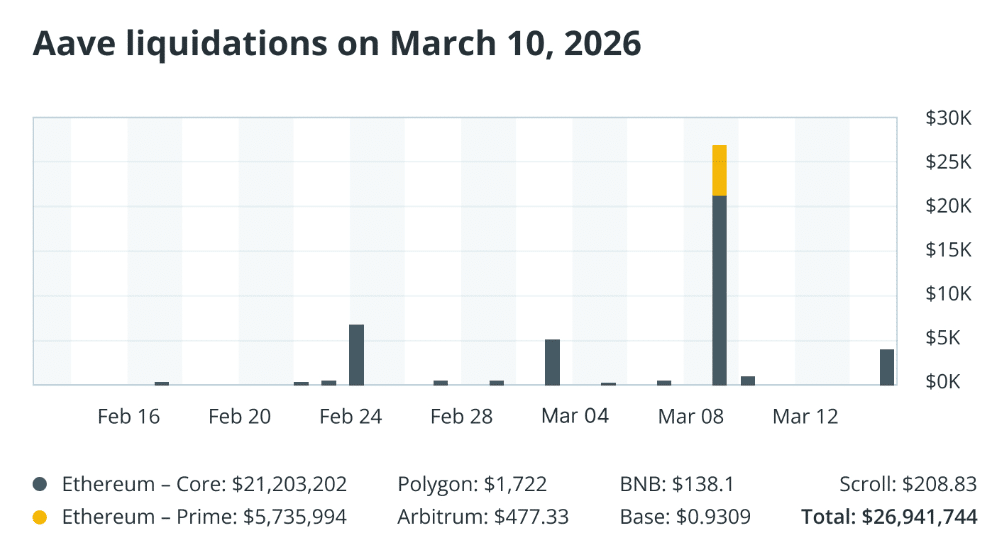
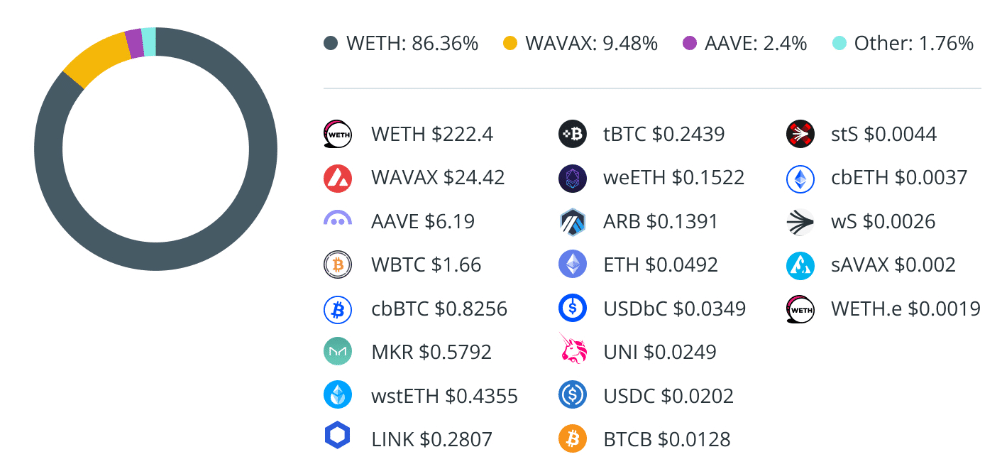
According to the post-mortem, the protocol applied an effective exchange rate that was roughly 2.85% lower than the valid market rate, which then triggered liquidations across 34 accounts involving about 10,938 wstETH. In dollar terms, the liquidation volume was placed at roughly $26 million to $27 million, depending on the pricing reference used at the time.
Lending markets operate on thresholds, not on feelings, and a position sitting close to its risk limit can fall apart from a move that would barely show up on a long-term chart. That is why Aave liquidations do not need a dramatic sell-off to start. They only need collateral values to slip below what the system requires.
Why the Oracle Error Hit So Hard
The post-mortem explains that the mismatch came from two linked CAPO parameters, snapshotRatio and snapshotTimestamp, falling out of sync during an update process constrained by smart contract rules. The ratio could not be increased quickly enough onchain, but the timestamp still reflected the intended 7-day reference point. That created a false ceiling for the allowed exchange rate, and the protocol ended up using an artificially low number.
That matters because DeFi lending is brutally literal as it does not ask whether a price move is fair, temporary, or caused by a configuration mistake. It checks the inputs, calculates the health factor, and acts. Once the health factor drops below 1, liquidation becomes fair game. In this case, the protocol functioned as coded, but the inputs guiding it were wrong. That is the uncomfortable part. The machine did its job, yet users still paid the price.
The Real Meaning of Aave Liquidations in This Incident
This episode showed that Aave liquidations are not only a market-risk story. They are also an infrastructure-risk story. In traditional finance, people worry about bad loans, leverage, and liquidity squeezes. In DeFi, those risks still matter, but they sit beside another layer that can be just as dangerous: oracle design, contract constraints, update logic, and the behavior of automated liquidators.
The protocol reported no bad debt, which is important because it means system solvency held up. Third-party liquidators captured around 512 ETH in bonuses and value linked to the deviation, while recovered funds and fees were later directed toward reimbursement efforts. A governance proposal said affected users should be refunded 512.19 ETH, with the net DAO cost reduced after recoveries.
Aave liquidations protected the protocol, but they still transferred losses to borrowers who were caught in a pricing event they did not cause. That is a strong reminder that protocol safety and user fairness are related, though they are not always the same thing.
The Key Indicators That Actually Mattered
For readers trying to understand the mechanics, several crypto lending indicators sat at the center of this story.
The first was the health factor, which is the clearest signal of how close a borrowing position is to liquidation. If it falls below 1, the position becomes vulnerable. In this incident, the post-mortem said positions with health factors lower than about 1.0288 were affected once the artificial price deviation hit.
The second was the liquidation threshold. This defines how much value a user can safely borrow against collateral before the system starts to liquidate. Higher leverage means less room for error.
The third was loan-to-value, often treated as a routine number during calm periods, but it becomes crucial when collateral pricing shifts. A 2.85% distortion may not sound dramatic, yet on a leveraged position it can be the difference between being safe and being forced out.
The fourth was oracle integrity. This is the quiet backbone of every lending market. Traders often obsess over token price charts, ETF flows, or macro headlines, but a lending protocol lives or dies by the quality of its price inputs.
The fifth was E-Mode exposure as efficiency Mode is designed for highly correlated assets, letting users borrow more aggressively because the assets are expected to move in similar ways. That works beautifully until the pricing relationship itself becomes the problem. Then the same efficiency becomes a risk amplifier.
What the Incident Says About DeFi Risk Design
There is a bigger lesson here, and it goes beyond one protocol. Aave liquidations became the headline, but the deeper issue is how DeFi guardrails behave under edge cases. CAPO was built to protect against upward manipulation of exchange rates and unbacked borrowing power. In ordinary conditions, that makes sense.
Yet the governance discussion after the incident showed that users and delegates are now asking a harder question: what safeguards exist when a protection mechanism itself creates a downward pricing distortion?
That is where the story becomes more mature as it is no longer just about whether decentralized systems are fast and efficient. It is about whether they are resilient when multiple smart assumptions collide. Aave liquidations in this case were not proof that DeFi failed outright. They were proof that DeFi still has operational weak points, especially where oracle logic, governance oversight, and liquidation design meet.
Conclusion
The recent wave of Aave liquidations was triggered by a pricing distortion, not by a collapse in the underlying asset, and that distinction matters. It showed how tightly wound DeFi lending systems have become, where a modest oracle-side deviation can set off millions in forced sales within minutes.
The protocol stayed solvent, recovery efforts began, and reimbursement moved into governance. Still, the episode left behind a more lasting message. In crypto lending, the most important number is not always the market price on a chart. Sometimes it is the number the protocol thinks it sees. When that number is wrong, even by 2.85%, the consequences can arrive all at once.
FAQs
What caused the recent Aave liquidations?
They were triggered by a CAPO oracle configuration mismatch that pushed the effective wstETH exchange rate about 2.85% below the valid market rate.
Did the protocol suffer bad debt?
No. The post-mortem said the protocol incurred no bad debt during the incident.
How many users were affected?
The reported impact covered 34 accounts.
Why did such a small error matter?
Because leveraged lending positions can be liquidated once their health factor falls below the required threshold, and even a small pricing deviation can push borderline accounts over the edge.
Were users compensated?
A governance reimbursement proposal said affected users should be refunded, with recovered funds and treasury support covering the losses.
Glossary of Key Terms
Health Factor
A risk score showing how safe a borrowing position is. Below 1 means liquidation risk becomes active.
Liquidation
The forced sale or seizure of collateral when a borrower no longer meets the platform’s safety requirements.
Loan-to-Value
A ratio showing how much can be borrowed against collateral.
Oracle
A system that feeds price data into a blockchain protocol.
E-Mode
A borrowing mode for correlated assets that allows higher capital efficiency, but can increase sensitivity to pricing errors.
wstETH
Wrapped staked Ether, a token representing staked ETH in a wrapped form that is commonly used in DeFi.
Sources