










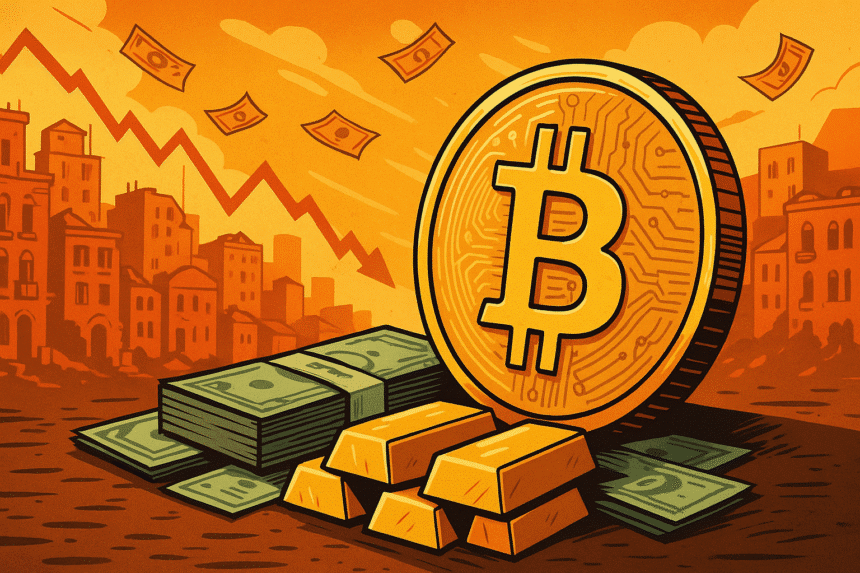

When prices go up too fast and money starts to lose its value, life becomes really hard for normal people. This problem is called inflation. In some countries inflation is small and slow, but in other places it grows very high, and people cannot trust their own money anymore. Argentina, Turkey, Venezuela and even some African countries face this problem for many years.
In such economies, families search for new ways to protect their savings. Some keep dollars under the mattress, others buy gold, but now many turn to crypto. Digital currencies like Bitcoin or stablecoins became a hope in countries where local money is weak.
Crypto adoption in high inflation economies is growing fast. It is not only about trading or making profit, it is about surviving. In this blog, we will look at how people in Argentina, Turkey, and other places use crypto to save their wealth, how governments respond, and what future may look like.

What Is High Inflation and Why It Matters for Everyday Life
High inflation means prices are rising too fast, and the money in the pocket buys less each week or even each day. For example, if a bread costs 1 peso today and 2 pesos next week, that is inflation. When it happens slowly it is normal, but when it goes up 50%, 100%, or more in a year, it becomes dangerous.
In countries like Argentina, inflation has been above 100% yearly. That means people’s salaries lost half their value in just one year. In Turkey, the lira also lost big value, and daily shopping became expensive. Families cannot plan for future, businesses struggle to set prices, and savings in local banks lose worth fast.
High inflation matters for everyday life because it destroys trust in the national money. People try to exchange their salaries for dollars as soon as they receive them, or buy goods quickly before prices rise again. In some cases, governments limit how much foreign money citizens can buy, which creates black markets.
Here is a table showing how fast local money loses value in high inflation economies.
| Country | Inflation Rate (2023-2024) | Local Currency Depreciation vs USD |
| Argentina | 110%+ | Lost more than 50% in 1 year |
| Turkey | 60%+ | Lira lost around 30% in 1 year |
| Venezuela | 200%+ | Currency almost worthless |
This table shows how people cannot trust local money when inflation is high. That is why many look at digital currencies, because they hope it gives more stability.
Why People in High Inflation Countries Look at Crypto
When local money keeps losing value, families and businesses search for other options. Crypto becomes one of the strongest alternatives. In fact, in places like Argentina and Turkey, it is normal for people to use stablecoins to save their salaries.
Crypto is not magic, it also has risk, but compared to national currencies that lose value daily, digital money looks safer to many.
Crypto as protection against inflation
Bitcoin is seen as digital gold. Even when price moves up and down, over the years it keeps value better than peso or lira. Stablecoins like USDT or USDC are linked to US dollar, which makes them stable compared to local currencies. Families use them to store savings and avoid losing everything when inflation grows.
Crypto as faster and safer way to send money abroad
In inflation-hit countries, people often depend on remittances. Workers abroad send money to families back home. Using banks can be slow and expensive. Crypto allows faster and sometimes cheaper transfers. For example, someone in Europe can send stablecoins to a family in Turkey within minutes, while a bank transfer may take days.
Here is another table that shows how Bitcoin performed compared to local currencies during high inflation.
| Year | Argentina Peso (ARS) vs USD | Bitcoin (BTC) vs USD | Turkey Lira (TRY) vs USD |
| 2020 | -25% | +300% | -20% |
| 2021 | -40% | +60% | -35% |
| 2022 | -45% | -65% (bear market) | -45% |
| 2023 | -50% | +150% | -30% |
This table shows that even when Bitcoin price falls sometimes, over a few years it still beats local money that only goes down.
Case Study – Crypto Adoption in Argentina
Argentina is one of the most popular examples of high inflation in the modern world. Inflation in Argentina has been over 100% per year in recent times. That means if someone saved money in pesos, after one year that money could buy only half of what it bought before. Because of this, trust in the peso is almost gone.
Many Argentinians started using crypto, especially stablecoins like USDT (Tether) and USDC. The reason is simple: stablecoins are tied to the US dollar, which is stronger and more reliable compared to the peso. People exchange pesos into stablecoins as soon as they get paid. Even merchants accept them because they hold value better than local money.
Stablecoin savings instead of local pesos
Argentinian families keep savings in stablecoins instead of local pesos. For example, a worker gets salary in pesos but quickly converts it into USDT to stop losing value.
Paying for goods and services in crypto
Crypto is not just for saving. In Argentina, some stores and online shops accept crypto payments. Freelancers who work for international clients often ask for payment in stablecoins so they don’t lose income because of peso depreciation.
Argentina’s crypto exchange growth
Crypto exchanges in Argentina have seen huge growth. Local platforms like Ripio and Lemon Cash are widely used. These apps allow people to convert pesos into crypto easily. International exchanges like Binance are also popular.
Case Study – Crypto Adoption in Turkey
Turkey has faced high inflation for many years too. The Turkish lira lost a large part of its value against the US dollar. Prices of daily items like bread, milk, and rent went up quickly, making life harder for ordinary people.
To protect their money, Turkish citizens started buying crypto. Both Bitcoin and stablecoins are popular. Turkey became one of the largest crypto markets in the world by trading volume.
Role of young population and tech awareness
Turkey has a very young population, and many are tech-savvy. This group adapted to crypto quickly. Mobile apps and online exchanges are popular in Turkey, and young people use them for trading and saving.
Crypto in cross-border trade
Some businesses in Turkey also use crypto for trade with other countries. When the lira keeps losing value, paying with stablecoins or Bitcoin becomes easier and safer.
Here is a table showing how crypto adoption grew in Turkey:
| Year | Turkish Lira Depreciation vs USD | Crypto Usage Growth in Turkey |
| 2020 | -20% | +35% |
| 2021 | -35% | +60% |
| 2022 | -45% | +80% |
| 2023 | -30% | +100% |
This shows that as lira goes down, crypto use goes up.
Other High Inflation Economies Turning to Crypto
Argentina and Turkey are not alone. Many other countries with high inflation are turning to crypto as well.
In Venezuela, inflation reached thousands of percent in some years. The local currency bolivar became almost worthless. Citizens used Bitcoin and even mined it as a way to survive. Crypto became part of daily life when shops and workers had no other option.
Nigeria is another important case. Inflation in Nigeria is high, and banks put restrictions on how much foreign currency people can buy. Because of this, many Nigerians turned to peer-to-peer crypto trading. Young Nigerians use stablecoins for saving and trading, while freelancers get paid in crypto from foreign clients.
Lebanon and Egypt also face rising demand for digital assets. In Lebanon, the banking crisis forced people to use crypto because they could not withdraw money from their bank accounts.
Shared reasons why crypto is chosen
Across these countries, the reasons for adoption are similar. People use crypto to protect savings, send and receive remittances faster, and trade across borders. Even though governments sometimes try to ban or restrict crypto, demand still grows because inflation destroys trust in local money.
Role of Stablecoins in High Inflation Countries
Stablecoins play the most important role in high inflation economies. While Bitcoin and Ethereum are popular, their prices go up and down too much. Stablecoins are different. They are tied to the US dollar or euro, so they stay more stable.
For example, if someone in Argentina has $100 worth of USDT, the value stays close to $100, even if peso keeps falling. This makes stablecoins more practical for savings and payments.
Benefits of stablecoins for savings and payments
Stablecoins allow families to hold their savings in a digital wallet without worrying about local money depreciation. They also help with everyday payments. Some people even pay rent or shop groceries using stablecoins through local apps.
Here is a table showing the most used stablecoins in high inflation countries:
| Country | Most Used Stablecoin | Reason for Popularity |
| Argentina | USDT, USDC | Easy access and tied to USD |
| Turkey | USDT | Used for both trading and saving |
| Nigeria | USDT, BUSD | P2P trading and freelance income |
| Venezuela | USDT, DAI | Protection against hyperinflation |
Stablecoins make crypto more accessible to normal people. They remove the risk of volatility while still giving protection against inflation.
Challenges of Crypto Adoption in Inflation-Hit Countries
Even if crypto brings many benefits, there are still big challenges for people living in high inflation nations. Adoption is not smooth, and there are many problems on the way.
One main problem is government restrictions. In some countries like Nigeria or Venezuela, the government placed limits on how crypto can be used. They sometimes block exchanges or force banks to stop working with crypto companies. This makes it harder for normal citizens to buy or sell crypto in official ways.
Another challenge is internet and technical barriers. Many people in rural areas do not have stable internet. Without internet, it is hard to use digital wallets or send transactions. Also, some people don’t have enough knowledge of how blockchain works, so they are afraid to use it.
Scams and fraud are another big issue. In many countries without strong regulations, fake investment schemes appear and trick people into giving away money. Families that already suffer from inflation may lose more money in scams.
Fear of losing money in scams
Because people do not always understand how crypto works, they can be tricked by fraudsters. Fake exchanges, Ponzi schemes, and false promises are common. This fear makes some people stay away from crypto even if they know their local money is weak.
Lack of knowledge about how crypto works
Education is another challenge. Crypto adoption is faster among young and educated populations. But older generations or rural citizens often don’t trust it. They prefer cash or gold because they know it better.
So even though crypto is growing, these challenges slow down adoption.
Global Exchanges and Local Startups Helping Adoption
Even with all the challenges, global crypto exchanges and local startups play a huge role in spreading crypto in high inflation economies.
Big exchanges like Binance and Coinbase attract many users in Turkey, Argentina, and Nigeria. These platforms allow people to buy stablecoins or Bitcoin easily, even when local money is weak. Peer-to-peer marketplaces like Paxful and LocalBitcoins also became popular. On these platforms, people trade directly with each other without a bank in the middle.
At the same time, local startups are growing. In Argentina, apps like Ripio and Lemon Cash give easy access to stablecoins. In Nigeria, startups built strong P2P markets that connect users. In Turkey, young entrepreneurs started wallet apps that allow daily payments in crypto.
All these companies help people protect their money and find safer alternatives to local banks.
Here is a table comparing the role of global exchanges vs local startups:
| Type | Example Countries | Role in Adoption |
| Global Exchange | Binance (Turkey, Argentina) | Provides easy access to stablecoins and Bitcoin |
| Local Startup | Ripio (Argentina), Lemon Cash | Makes crypto saving and payments easy |
| Peer-to-Peer | Paxful, LocalBitcoins (Nigeria, Venezuela) | Allows trading without banks |
How Crypto Is Changing Daily Life in Inflation-Heavy Nations
Crypto is not just an investment in these countries. It is changing how people live daily life.
Workers in Argentina, Nigeria, and Turkey sometimes ask their companies to pay salaries in stablecoins. This way, they can avoid losing money overnight when inflation strikes. Families use crypto wallets as a savings account. Instead of putting money in a bank, they store stablecoins in apps or hardware wallets.
Merchants also benefit. Some shops accept crypto payments for groceries, electronics, and even rent. This helps them keep value in USDT instead of the local peso or lira. In online marketplaces, freelancers working for international clients often prefer being paid in crypto. This avoids expensive bank fees and keeps their income stable.
Crypto also changes remittances. Families abroad can send stablecoins quickly and without high fees. In countries with strict banking controls, this becomes the only option to get money in and out of the country.
In short, crypto became part of survival strategy in high inflation economies. It’s not only for traders or rich investors. It is used by normal families who want to save their income.
Will Crypto Replace Local Currencies in Inflation Economies?
The big question is: will crypto replace local currencies in countries with high inflation?
Experts say it is unlikely that Bitcoin or stablecoins will fully replace local currencies soon. Governments still control financial systems and they want to keep power over money. Central banks in many countries are even working on their own digital currencies called CBDCs (Central Bank Digital Currencies). These may compete with stablecoins in the future.
But even if full replacement does not happen, crypto adoption will continue to grow. More families will keep savings in stablecoins, more merchants will accept Bitcoin, and more freelancers will use crypto for payments.
In Argentina, many already say that crypto is the “real dollar” for the new generation. In Turkey, surveys show that nearly half of young adults used crypto at least once. In Venezuela, some communities already rely on stablecoins for daily life.
The future will likely be mixed: people will use crypto alongside local money. Governments may regulate it more, but high inflation will continue pushing people toward digital alternatives.
Here is a table showing predictions for crypto adoption in high inflation countries:
| Country | Current Adoption (2024 est.) | Expected Adoption by 2030 |
| Argentina | 25% of population | 45%+ |
| Turkey | 20% of population | 40%+ |
| Nigeria | 30% of population | 55%+ |
| Venezuela | 35% of population | 60%+ |
This shows that in the future, crypto use may double as inflation continues.
Final Thoughts on Crypto Adoption in High Inflation Economies
Crypto adoption in high inflation economies is not just a trend, it is a necessity. When money loses value too fast, people must find ways to protect their savings and their families. Argentina and Turkey are clear examples, where millions use crypto and stablecoins daily. Venezuela and Nigeria also show that even when governments restrict crypto, people still find ways to use it because the need is real.
Stablecoins play the biggest role because they give stability in unstable times. Bitcoin and Ethereum are also used, but their prices can swing a lot. For survival, stablecoins connected to the US dollar give the most safety.
The future will not be perfect. There are challenges like scams, government bans, and lack of education. But the movement is strong. As long as inflation exists, crypto adoption in these countries will keep growing. Digital money has become a lifeline for many, and it looks like this lifeline will only get stronger in the coming years.
FAQ Section
What is inflation in simple words?
Inflation means when the prices of goods and services go up and the value of money goes down. For example, if bread costs $1 today but $2 next month, that is inflation. In high inflation countries, this happens very fast and destroys savings.
Why is crypto popular in Argentina and Turkey?
Crypto is popular because local money loses value too quickly. People in Argentina and Turkey use stablecoins and Bitcoin to protect their savings. Stablecoins are safer since they are tied to the US dollar, which is more stable than peso or lira.
Is crypto safer than keeping money in local banks?
In high inflation economies, many feel crypto is safer. Local banks hold money in national currency, which loses value daily. With crypto, especially stablecoins, people can store value that stays closer to the US dollar. But crypto has risks too, like scams or losing passwords.
Which coins are most used in inflation economies?
Stablecoins like USDT (Tether) and USDC are the most used. People also use Bitcoin for savings, and sometimes Ethereum. But for daily life, stablecoins are preferred because their value does not jump up and down as much.
Can governments ban crypto completely?
Governments can make it hard to use crypto by banning exchanges or restricting banks. But it is very hard to ban it completely because people can still trade peer-to-peer and use wallets. In places like Nigeria and Venezuela, bans exist but crypto adoption is still growing.
Glossary Section
Inflation
When prices rise and money loses value over time.
Stablecoin
A digital currency that is tied to the value of a real-world currency, often the US dollar, to keep it stable.
Remittance
Money sent by someone working abroad to their family back home.
Hyperinflation
Extremely high inflation where money loses value so fast it becomes almost worthless.
Crypto Exchange
A platform where people can buy, sell, or trade cryptocurrencies like Bitcoin and stablecoins.
Short Summary
In countries with high inflation, local money loses value so quickly that families cannot save or plan for the future. This is why crypto adoption in high inflation economies like Argentina, Turkey, Venezuela, and Nigeria is growing fast. People turn to digital currencies, especially stablecoins such as USDT and USDC, to protect their income. Stablecoins are tied to the US dollar, which makes them more stable than local currencies. Bitcoin is also used as a store of value, but its price changes too much for everyday savings.
Governments sometimes restrict crypto, but people continue using it through peer-to-peer trading and mobile apps. For workers, families, and merchants in these nations, crypto is more than an investment, it is a survival tool. As inflation continues, the role of digital money will only increase, showing how technology is reshaping the way people handle money in unstable economies.