








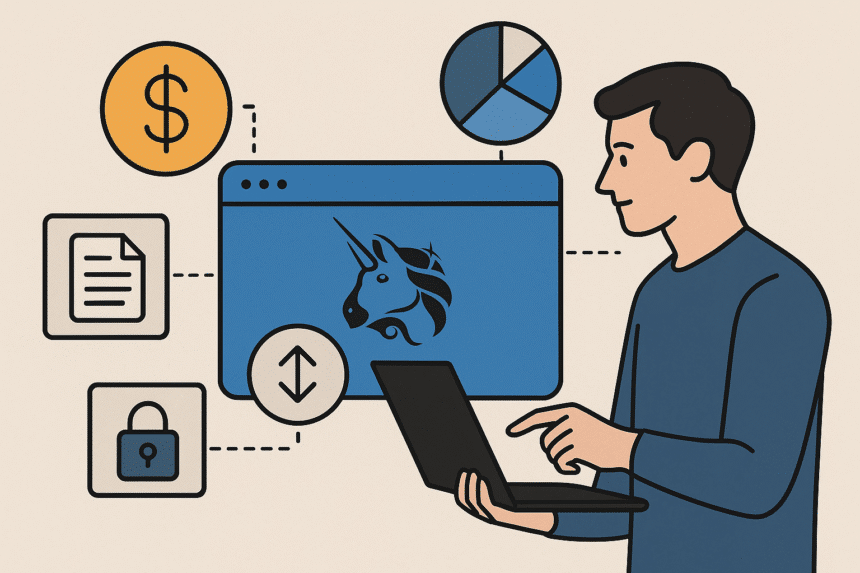

Crypto users want control. A Decentralized Exchange (DEX) gives that control. A DEX lets traders swap tokens from their own wallet. No account. No custodian. Just a wallet, a network, and a trade.
This guide shows clear steps. It explains fees, risks, and safety. It also covers the rules that shape DEX use today. It walks through wallet setup, approvals, slippage, and gas. By the end, a user can trade on a Decentralized Exchange (DEX) with confidence.
What is a Decentralized Exchange (DEX)?
A Decentralized Exchange (DEX) is an on-chain marketplace. It matches buyers and sellers through code. That code is a smart contract. Most DEXs use automated market makers. These AMMs hold token pools. Prices move as traders swap in and out of the pools. Some DEXs use on-chain order books. These work like classic markets. Orders rest on-chain and fill when prices meet.
How a Decentralized Exchange (DEX) Works
A user connects a wallet. The wallet talks to smart contracts. The contract pulls tokens from the wallet only when the user signs. Two fees matter. The swap fee goes to liquidity providers. The network fee pays for the blockchain transaction.
On Uniswap v3, pools use fee tiers. Common tiers are 0.01%, 0.05%, 0.30%, and 1.00%. Uniswap v4 adds flexible and dynamic fees. Pool creators can set more options.
DEX vs CEX: Quick Comparison
| Topic | DEX | CEX |
| Custody | User holds keys | Exchange holds assets |
| KYC | Often not required for swaps | Usually required |
| Access | Wallet + internet | Account + approval |
| Fees | Pool fee + network gas | Trading fee + hidden spreads |
| Speed | Varies by chain | Centralized, often fast |
| Risk | Smart contracts, approvals, phishing | Custodial risk, platform hacks |
| Support | Community docs, forums | Customer support, tickets |
The Market in 2025: Why DEX Skills Matter
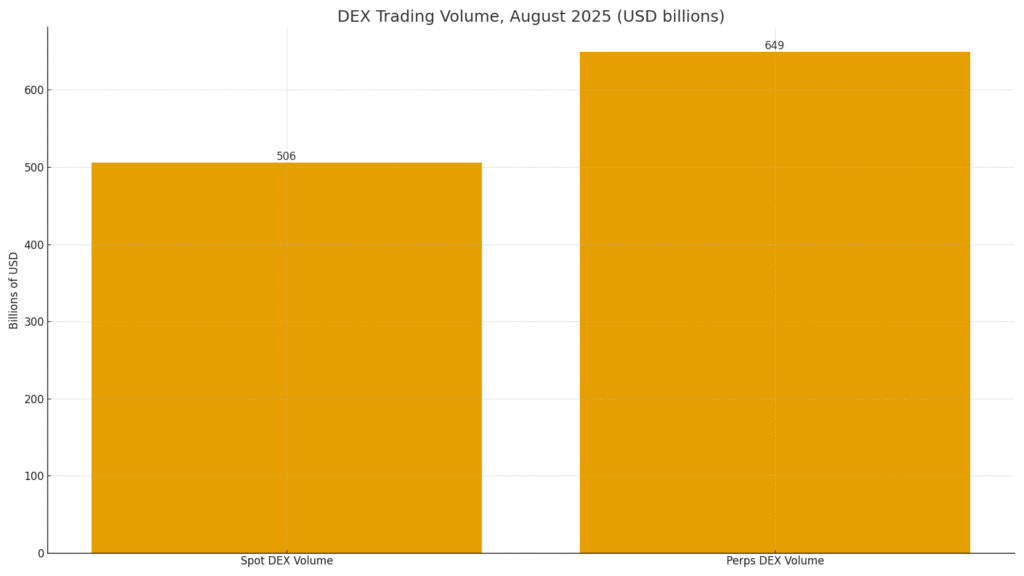
DEX activity keeps rising. In August 2025, DEXs handled about $1.15 trillion when combining spot and decentralized perps. Spot DEX volume was about $506 billion. Perps added about $649 billion. These figures draw on DeFiLlama data reported by reputable industry media.
Thirty-day DEX volume often sits in the hundreds of billions. Traders move size on-chain each day. Liquidity is real and deep on major networks and L2s.
Step-by-Step: Make a First Swap on a DEX
1) Pick a network
Choose a chain that fits the token. Ethereum, Arbitrum, Base, Solana, or BSC are common picks. Check gas costs and speed first.
2) Set up a wallet
Use a trusted wallet. Popular choices are browser wallets and mobile wallets. Write down the seed phrase. Store it offline. Never share it.
3) Fund the wallet
Send the base gas token to the wallet. ETH on Ethereum or Arbitrum. SOL on Solana. Keep extra for gas.
4) Choose a DEX
Start with proven platforms. Check audits, docs, and volume. If a token only lives on one DEX, verify the token contract first.
5) Connect the wallet
Open the DEX site. Click Connect. Confirm in the wallet. The site should show the wallet address.
6) Select tokens
Pick the token to sell and the token to buy. Paste the contract address for safety. Scams often use look-alike tickers.
7) Review route and price
Many DEXs auto-route across pools. Check the expected output, price impact, and minimum received.
8) Set slippage and deadline
Use tight slippage for liquid pairs. Two percent is high for majors. Keep a deadline of a few minutes for safety.
9) Approve the token (if needed)
First-time swaps often need an approval. Approve only the needed amount. Avoid unlimited approvals.
10) Confirm the swap
Sign the transaction. Wait for confirmation. Check the explorer link. Verify the correct token landed.
11) Revoke old approvals
Visit an approval tool later. Revoke approvals you no longer need. This reduces attack surface.
Fees, Slippage, and Price Impact
- Swap fee. This is the pool fee. It pays liquidity providers. On Uniswap, the pool sets the tier.
- Gas fee. This is the network fee. It varies with demand. L2 networks often cost far less than L1.
- Slippage. Slippage is the allowed price move during the trade. Tight slippage reduces surprises. It can also cause failed trades.
- Price impact. This is the pool’s reaction to trade size. Large trades in small pools move the price more.
Liquidity Pools: How Earning Works
Liquidity providers deposit token pairs into a pool. Traders pay fees to the pool. The fees go to liquidity providers.
Pools rebalance as prices move. This creates “impermanent loss.” If one token moves a lot, the pool ends up with more of the weaker token. Fees can offset this loss, but not always.
Concentrated liquidity lets providers pick ranges. Narrow ranges earn more fees when in-range. They also carry more risk if price leaves the range.
Choosing the Right DEX
- For majors: Stick with battle-tested pools that offer deep liquidity and proven track records. This reduces slippage and execution risk.
- For new tokens: Do your homework. Verify smart contracts, review token holder distribution, check for audits, and ensure there are active maintainers supporting the project. Avoid contracts with opaque code or suspicious wallet activity.
- For perpetuals: Trade only on reputable decentralized derivatives venues. Learn the mechanics—funding rates, leverage, liquidation rules—before diving in. Start with low leverage until you’re confident in risk management.
Security Basics for DEX Users
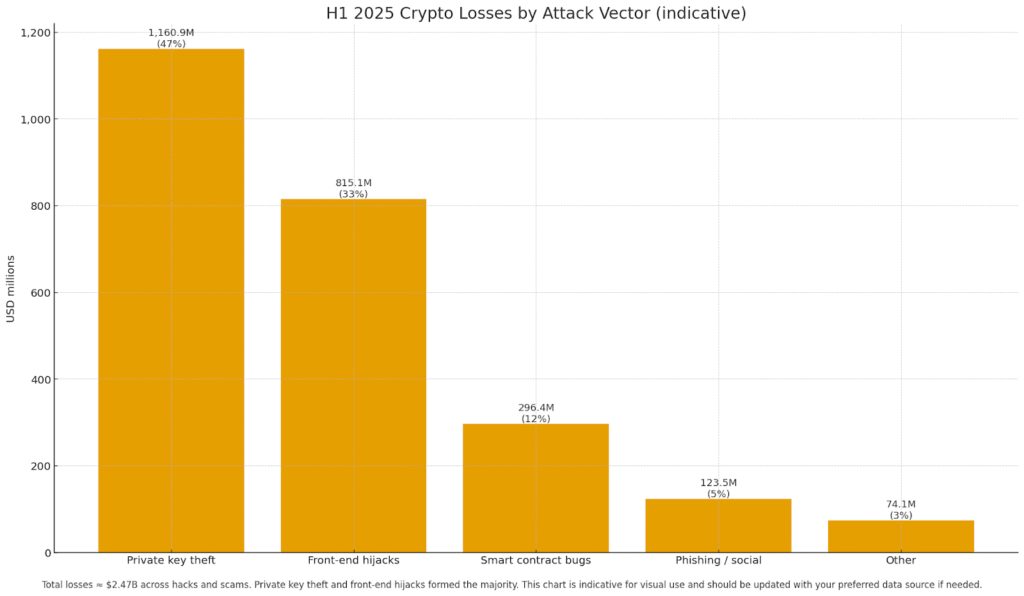
Crypto losses stay high. In the first half of 2025, attackers stole over $2.47 billion across hacks and scams. A single exchange hack made up the bulk of that number. Users should treat approvals, wallets, and links with care.
Attackers keep shifting tactics. Private key theft and front-end hijacks drove most losses in early 2025. Users should verify sites, lock down devices, and use hardware wallets for size.
A few habits go a long way:
- Use hardware wallets for large balances.
- Verify token contracts from official project links.
- Favor exact-amount approvals over unlimited ones.
- Revoke old approvals on a set schedule.
- Bookmark official DEX URLs. Avoid search ads.
- Keep seed phrases offline. Never type them on a website.
- Update wallets and browser extensions.
Note: Big hacks hit centralized venues too. The largest crypto theft ever happened in February 2025 and involved a major exchange wallet. Security is a shared duty across the stack.
Regulatory Context in 2025
European Union (MiCA). Stablecoin rules took effect on June 30, 2024. The main rules for crypto-asset service providers started on December 30, 2024. Member states can allow a transition period for existing firms until July 1, 2026. Firms must seek authorization to passport services across the EU.
ESMA continues to release guidance and warn on marketing claims. Firms must not blur regulated and unregulated products in one app.
U.S. developments. In 2024, the SEC sent Uniswap Labs a Wells notice. In early 2025, reports said the SEC closed that investigation without action. This outcome does not set formal policy, but it matters to builders and users.
Global AML. The FATF Travel Rule applies to virtual asset service providers. Many countries push compliance for transfers. DEX front ends and aggregators may face rules if they qualify as service providers. Supervisors published fresh guidance in June 2025.
What this means for users. Expect clearer rules in the EU with MiCA. Expect ongoing case-by-case actions in the U.S. Expect stricter AML checks at fiat ramps. DEX use still needs good record-keeping for taxes.
Common Mistakes to Avoid
- Swapping the wrong token due to a fake contract.
- Using unlimited approvals by default.
- Setting wide slippage on thin pairs.
- Trading during volatile news without a plan.
- Forgetting gas for future actions like revokes.
- Bridging to the wrong chain or address.
- Chasing new coins without checking liquidity locks.
Best Practices Checklist
- Test first: Always run a small trial trade before committing larger amounts.
- Verify authenticity: Confirm contract addresses only from official websites or trusted announcements.
- Protect your capital: Store significant holdings in a hardware wallet, not in hot wallets.
- Stay on top of activity: Use a portfolio tracker to monitor swaps, approvals, and balances in real time.
- Control permissions: Revoke token approvals regularly—ideally once a month or right after large trades.
- Trade efficiently: Stick to reputable routers and aggregators to avoid bad fills and hidden risks.
- Keep records clean: Save block explorer transaction links for transparency, audits, or tax reporting.
- Manage slippage: Keep tight slippage settings unless trading in pools with deep liquidity.
- Understand liquidity provision: Learn fee tiers and pool mechanics before deploying funds as a liquidity provider.
Advanced Tips: Routing, Perps, and L2s
- Smart routing. Many apps split orders across pools for a better price. This helps reduce price impact.
- Perps on-chain. Perp DEXs use oracles, funding, and margin. Liquidations can move fast. Use small size and clear stops.
- Layer 2s. L2s cut gas costs and speed up trades. They also add bridge steps. Keep bridge safety in mind.
Typical Uniswap Fee Tiers (Pool-Set, Not Global)
| Fee tier | Typical use case |
| 0.01% | Very stable pairs |
| 0.05% | Stable or correlated pairs |
| 0.30% | Most volatile pairs |
| 1.00% | Exotic or high-risk pairs |
These tiers exist in v3. v4 expands fee options and can enable dynamic fees. Always check the actual pool before swapping.
Security & Regulatory Context: Key Stats
- H1 2025 stolen funds exceeded $2.47 billion, per CertiK’s mid-year data, with one centralized breach driving most losses.
- TRM Labs reported over $2.1 billion stolen in H1 2025. Private key and front-end attacks led the losses.
- In August 2025, DEXs processed about $1.15 trillion across spot and decentralized perps. Spot DEX volume was about $506 billion.
- MiCA’s core CASP rules apply from December 30, 2024. Member states can allow firms to operate under transition until July 1, 2026.
- The SEC closed its Uniswap probe without enforcement in early 2025, according to industry reporting.
- FATF issued fresh Travel Rule supervision guidance in June 2025.
Conclusion
A Decentralized Exchange (DEX) puts users in control. It offers direct on-chain trading with clear rules in code. It also demands careful habits. Use secure wallets. Verify contracts. Keep approvals tight. Understand fees and slippage.
Stay aware of rules in the places where one lives. With these steps, a DEX can serve daily swaps with confidence. Users can trade, provide liquidity, and learn as markets grow.
FAQs About Decentralized Exchange (DEX)
Do users need KYC to trade on a DEX?
Most swaps do not use KYC. Fiat ramps and some front ends may require it due to local rules.
How do DEX fees compare with CEX fees?
DEXs charge a pool fee plus gas. CEXs charge trading fees and may include hidden spreads. On DEXs, the pool picks the fee tier.
What is a safe slippage setting?
For liquid pairs, try 0.1% to 0.5%. For thin pairs, set higher but watch price impact.
Are DEXs safe?
Smart contracts can fail. Front ends can get spoofed. Large losses hit the industry in 2025. Use hardware wallets, verify URLs, and revoke approvals often.
What tax records should users keep?
Save transaction hashes and times. Keep notes on cost basis. Local tax rules vary. Check a tax advisor if unsure.
Glossary
- AMM: Automated market maker. A smart contract that prices swaps with a formula.
- Approval: Permission a token gives a contract to move tokens from a wallet.
- CASP: Crypto-asset service provider under EU MiCA rules.
- Gas: The network fee paid to run a transaction on a blockchain.
- Impermanent loss: Value drift LPs face when prices move in a pool.
- Liquidity pool: A pair of tokens locked in a contract to enable swaps.
- Perps: Perpetual futures with no expiry. They use funding to track price.
- Slippage: The allowed price change between submit and confirmation.
- Smart contract: Code that runs on a blockchain without human control.
- Travel Rule: Global AML rule that requires sender and receiver info for transfers.
Summary
This guide explains how to use a Decentralized Exchange (DEX) in clear steps. It covers wallets, approvals, slippage, gas, and pool fees. It includes a DEX vs CEX table and a Uniswap fee tier table. It outlines best practices, common mistakes, and advanced tips for routing, perps, and L2s. The security section cites recent data showing over $2.47 billion in industry losses in H1 2025, driven by private key and front-end attacks, and notes the record DEX volumes seen in August 2025. The regulatory section highlights MiCA dates and a reported closure of the SEC’s Uniswap probe. The glossary defines key terms. The FAQs answer common questions on KYC, fees, safety, and records.