





The future of work in Web3 is no longer a distant trend. It is a set of habits that people use every day. Teams hire across borders. Talent ships on-chain. Payment moves at network speed. The tone is practical, not sci-fi. Web3 jobs look like normal jobs with new rails. Web3 careers use wallets, smart contracts, and open repos. Remote work in web3 is common because tools are open and global. Decentralized work lowers gatekeeping and raises access. The shift rewards skill, proof of work, and public reputation.
This space also asks harder questions. Who owns the output? Who votes on budgets? Who gets paid when a team is a DAO. The answers shape DAO governance and work. They also define risk, taxes, and security. The goal of this guide is clear. Map the opportunity. Flag real frictions. Show how to build a durable path as a contributor or founder in Web3.
Why Web3 Changes Work
Web3 rewires trust and payment. Work does not wait for a local bank or a legal entity. A wallet can be enough to start. That speed draws freelancers and startup teams. Web3 freelancing rises because tasks can be scoped as bounties. Crypto payroll clears across time zones with no wire delays. Web3 talent marketplaces help match skills to open repos and grants. The path from idea to paid task gets shorter.
The code side also matters. Public repos, on-chain actions, and open roadmaps make proof of skill easy to see. A strong pull request or on-chain action becomes a resume. That favors people who ship and document. It also favors teams that can break work into clear tasks. The result is a labor market that moves fast, yet still needs simple rules and clear scopes.
The Market Backdrop That Matters
Remote and hybrid work are now normal. Studies show that hybrid is a long-term fixture. Many firms still use hybrid setups, and workers want flexible models. This supports global hiring and async teams that web3 projects use.
Crypto use keeps spreading. Chainalysis tracks strong grassroots adoption and renewed activity in core regions. That means more users, more apps, and more demand for talent.
DAOs manage large treasuries. Estimates put DAO treasuries in the tens of billions. That scale funds grants, bounties, and full-time roles. It is a signal that DAO governance and work will keep hiring.
Developer supply remains deep. Electric Capital reports a large active pool of crypto developers across repos. That supports a cycle of tools, infra, and jobs.
Where The Jobs Are
Most roles look familiar. Product, engineering, design, legal, and community. The twist is the stack. Wallet UX, token design, and on-chain data add new tasks. Protocols need core devs and auditors. dApps need full-stack engineers and growth. DAOs need treasury managers and governance leads. Studios need storytellers who can explain a new tool in simple words.
Non-dev paths are strong. Writers, analysts, and operations leads do well. Web3 careers in research and policy are growing. Partnerships and BD connect projects to exchanges, wallets, and brands. Support and success roles help new users join and stay. The mix fits remote work in web3 because most tasks are async and tool-driven.
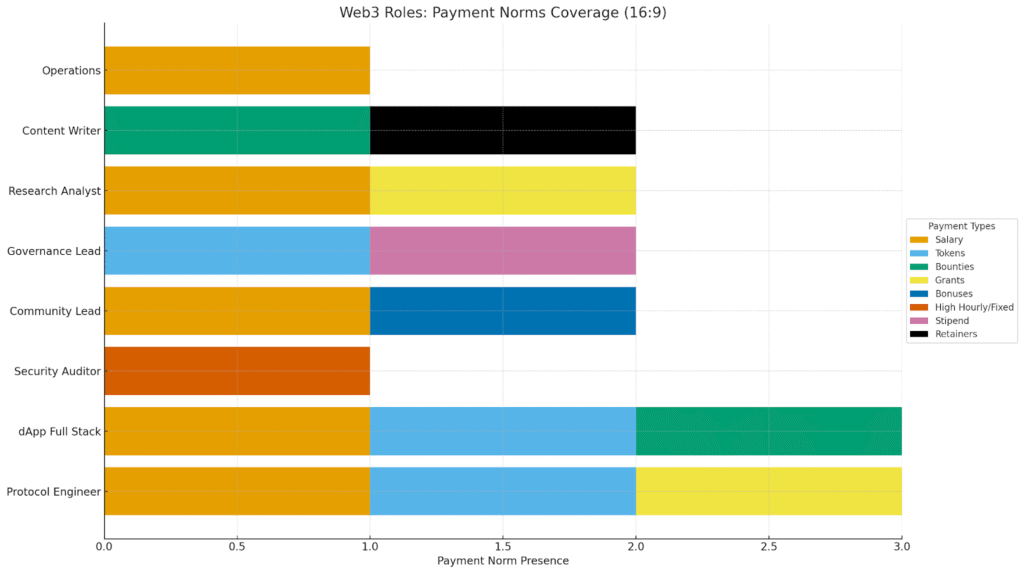
Web3 Roles, Core Tasks, And Payment Norms
| Role Category | Typical Tasks | Payment Norms | Hiring Mode |
| Protocol Engineer | Core contracts, audits, infra | Salary plus token grants | Full-time or contract |
| dApp Full Stack | Frontend, API, wallet flows | Salary, tokens, or bounties | Full-time or grant |
| Security Auditor | Reviews, threat models, tests | High hourly or fixed audits | Firm or freelance |
| Community Lead | Onboarding, content, socials | Salary plus bonuses | Full time or bounty |
| Governance Lead | Drafts, votes, treasury ops | Stipend plus tokens | DAO delegate or role |
| Research Analyst | On-chain data, reports | Salary or grant | Full-time or bounty |
| Content Writer | Guides, docs, SEO | Bounties or retainers | Freelance or agency |
| Operations | Vendor, compliance, payroll | Salary | Full time |
How Work Gets Organized In DAOs
DAOs vote on budgets, elect stewards, and fund teams. Work flows through proposals and workstreams. The best DAOs ship like product orgs. They set goals, publish metrics, and use multisig controls. The risk is slow votes and unclear scope. The fix is simple: charters and small budgets with renewals. Delegation helps. So does a clear role for domain stewards who own delivery.
Dao governance and work thrives when people know how to draft, comment, and vote. Tools for forums, voting, and treasury are now mature. Treasuries in the billions prove staying power. Yet token ownership can skew voting power. Projects should design checks so that small holders still have a voice.
Freelancing, Bounties, And Grants
Web3 freelancing grows with the broader freelance trend. Studies show a large share of skilled workers now use non-traditional models. Projections for the next few years show high freelance participation in the United States. This supports a large supply of flexible talent for web3.
Bounties and grants are the main rails. A good bounty has a crisp scope, a fixed budget, and a simple review path. Grants fund larger ideas like tools or research. Web3 talent marketplaces curate these tasks. The best marketplaces verify projects, show escrow, and settle in stablecoins.
How Teams Pay: Crypto Payroll In Practice
Teams often use stablecoins for payroll and bounties. This reduces FX friction and speeds payouts. Global HR platforms report steady growth in cross-border hiring and new pay options. Reports also show wide adoption of remote hires and compliance services for payroll and taxes. These trends lower the barrier for small teams to hire fast.
Teams should match assets to needs. Stablecoins for payroll. Native tokens for long-term incentives. Fiat where law or vendors require it. Clear grants with vesting help align teams and reduce churn.
Security And Regulatory Context With Real Stats
Risk is real and must be managed. Chainalysis reports that crypto scams reached high levels in 2024 and early 2025. The rise of social engineering and high-yield fraud played a major role. Teams must train staff and set wallet rules. Individuals must learn to spot fake sites and drainer links.
Remote is here to stay, yet needs guardrails. Surveys show hybrid work as a durable model across advanced economies. Teams report ideal patterns of two to three remote days per week. Policies that allow input from teams have better outcomes. Web3 outfits can mirror this by mixing async work with planned in-person sprints.
Adoption supports real demand. Grassroots crypto use remains high across key regions. This is not a fad. It is a user base that pays, saves, and builds with crypto. Talent follows users.
DAO budgets are large. DeepDAO tracking and industry updates place total DAO treasuries in the tens of billions. That means real paid work through grants, bounties, and roles. It also means fiduciary duty for stewards who move funds. Teams need policies for conflicts, disclosures, and audits.
Simple Frameworks For Candidates
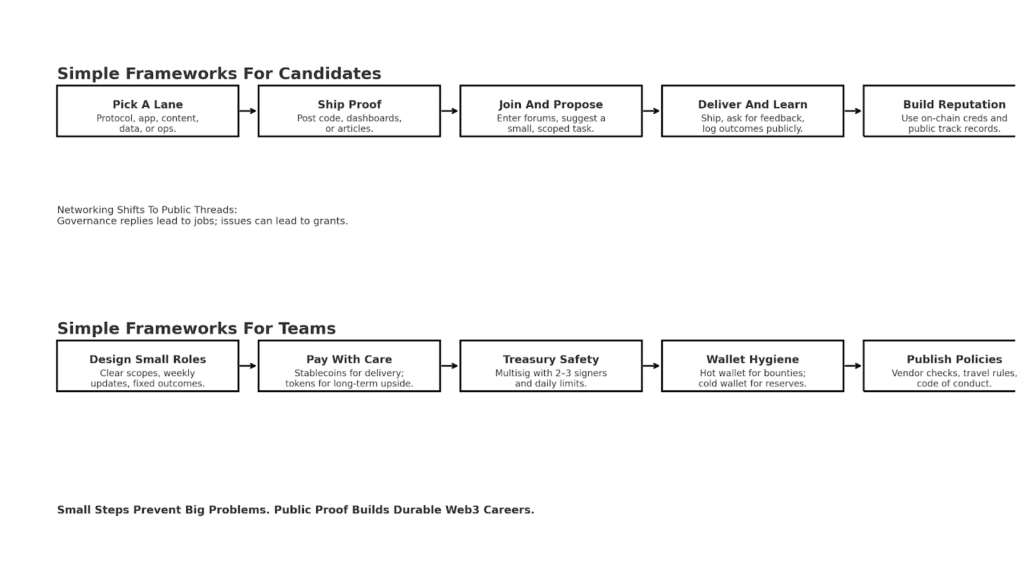
An effective path uses four steps. First, pick a lane. Protocol, app, content, data, or ops. Second, ship proof. Post code, dashboards, or articles. Third, join a forum and propose a small task. Fourth, deliver and ask for feedback. Each loop builds a public track record. That track record feeds web3 careers across teams and chains.
Networking shifts from private chats to public threads. A reply on a governance post can start a job. A repo issue can lead to a grant. Reputation systems and on-chain credentials help. These create portable proof that a person did the work.
Simple Frameworks For Teams
Teams should design roles in small units. Clear scopes, weekly updates, and fixed outcomes. Pay with stablecoins for delivery and tokens for upside. Use multisig with two or three signers and daily limits. Keep a hot wallet for bounties and a cold wallet for reserves. Publish policies for vendor due diligence and travel. Set a code of conduct for calls and forums. Small steps like these prevent big problems later.
How To Evaluate A Web3 Offer
Candidates should look for four signals. First, the runway. Ask how many months of stablecoin reserves are on hand. Second, governance. Check how budgets get approved and renewed. Third, code. Public repos and audits show quality. Fourth, compliance. Ask how payroll and taxes are handled for your country. These checks reduce surprises and keep focus on delivery.
Skills That Pay Today
The list is clear. Smart contract skills, secure frontend, and data skills. Growth teams that know affiliates, attribution, and SEO. Governance writing that turns ideas into votes. Legal and compliance that balance speed and duty. Content teams that explain in plain words. People who can turn a roadmap into a sprint and a sprint into a release will always be in demand.
The Future Of Work In Web3 Needs Clear Rules
The future of work in Web3 will not scale without simple rules. Teams must set scopes, budgets, and reviews. DAOs must publish handbooks and term sheets for grants. Marketplaces must vet projects and hold funds in escrow. Wallet hygiene is non-negotiable. Two-factor on admin accounts. Hardware wallets for treasuries. Phishing drills for staff. These steps reduce scam risk and protect users and funds.
On the people’s side, fair pay and clear titles matter. Remote work in web3 should not mean vague roles or forever gigs. Set ranges. Publish paths to full-time. Use tokens for long-term alignment, not as the only pay. These norms help the market move from hype to steady craft.
Regional Notes And Time Zone Strategy
Global teams work across time zones. The best teams carve overlap blocks for daily decisions. They reserve deep work time for hard tasks. They hold in-person sprints when a feature needs speed. This blends the best of remote and office. Data suggests two to three days in person is often ideal for complex work. Web3 can use that pattern for planning.
Education, Upskilling, And Entry Paths
New talent can enter through hackathons, grants, and docs. Early work can be unpaid learning, but paid work should follow fast. The market is big enough to support this move. As crypto adoption grows, the need for onboarding, support, and local content rises. That is a path for writers, designers, and community leads to build a web3 career without deep code.
Risk, Bias, And How To Keep Work Human
Automation and AI tools will change many tasks. The human edge remains in judgment, care, and taste. Web3 culture must reward those who write clear specs, handle support with care, and design UIs that feel simple. Governance must protect users and keep core values in view. The future of work in web3 should lift more people than it leaves behind.
Closing The Opportunity Gap
Access is the best part of this shift. People can work from towns far from tech hubs. Payment can land in minutes. Portfolios are public. Still, not everyone has the same tools. Projects should fund grants for learning and provide starter kits. Small investments in docs and mentorship can unlock large outcomes. A fair market is also a larger market.
Conclusion
The signal is strong. The future of work in web3 blends old craft with new rails. The model works in small scopes, is paid fast, and is judged in public. It runs on remote work, simple rules, and open proof. It funds roles through DAOs and hires across borders. The same forces bring new risks in scams and governance. The projects that win will set clear rules, train people, and pay with care. The people who win will ship often, learn fast, and build public proof. The result is a labor market that is more open, more global, and more resilient than before.
Security And Regulation Snapshot
Governments keep shaping crypto rules. Teams should track tax guidance and payroll law in each country. HR partners can help file and pay the right amounts. People should keep records of on-chain pay and convert funds when needed. Good habits and clear records make audits boring, which is the goal.
FAQs About the Future of Work in Web3
What Is The Future Of Work In Web3 In Simple Terms?
It is normal work that uses wallets, smart contracts, and public repos. Teams hire across borders and pay in stablecoins or fiat. Output and trust are on-chain and online.
How Do DAOs Pay Contributors?
They use budgets approved by token holders. Funds move from a treasury to a multisig and then to a wallet after delivery. Stipends and bounties are common.
Are Crypto Salaries Legal And Taxable?
Yes in many places, with the right records. People must report income and gains. Teams should use payroll tools that support local tax rules.
Where Do People Find Web3 Jobs?
They search web3 talent marketplaces, DAO forums, and project Discords. They also watch grant hubs and hackathons. Proof of work is the best resume.
What Skills Help A Non-Developer Break In?
Writing, design, data, and operations. Governance and community work also help. Clear documents that teach or guide users stand out.
Glossary
- DAO: A decentralized group that uses tokens to vote on budgets and rules.
- Multisig: A wallet that needs more than one key to move funds.
- Stablecoin: A token that tracks a fiat value, often the US dollar.
- On-Chain Credentials: Proof of skill or activity stored on a blockchain.
- Bounty: A fixed scope task with a set reward.
- Grant: Funds to build a tool, feature, or study with milestones.
- Delegate: A person voted in to vote or manage budgets on behalf of others.
- Treasury: Funds held by a DAO to support work and growth.
- Gas Fees: Network fees paid to process a transaction.
- Token Vesting: A schedule that releases tokens over time to align incentives.
Summary
The article explains how the future of work in web3 blends familiar jobs with new rails. It shows how wallets, DAOs, and stablecoins change hiring and pay. It highlights roles in engineering, content, governance, research, and ops. It covers web3 freelancing, crypto payroll, and web3 talent marketplaces. It uses current stats on hybrid work, DAO treasuries, and adoption to show real demand. It offers steps for candidates and teams. It details security, scam risks, and simple rules for treasuries and payroll. The takeaway is that clear scopes, public proof, and fair pay drive durable web3 careers and jobs across borders.