





Crypto attracts bright ideas and loud opinions, sometimes in the same tweet. That noise is exactly why a clear plan helps. A balanced approach is not about guessing the next winner. It is about building a system that can handle both a fast rally and a sudden drop without forcing impulsive decisions.
This article is educational and does not provide personal financial advice.
This guide shows how an investor can build a crypto portfolio that stays diversified, risk-aware, and manageable. It focuses on practical steps, and it explains the indicators that matter when selecting assets.
Define the job of the money
Before picking assets, the investor should name the purpose of the allocation. Is it long-term wealth building, a medium-term goal, or a high-risk sleeve that could be lost without changing daily life? When the purpose is vague, a crypto portfolio tends to drift into whatever is trending.
Sizing follows purpose. If total investable savings are $10,000 and crypto exposure is capped at 10%, the maximum allocation is $1,000. A crypto portfolio that is sized this way can survive discomfort without creating panic.
Set risk rules first
Crypto can move faster than most asset classes. That speed is exciting on the way up and brutal on the way down. A balanced plan starts by defining how much volatility is acceptable and how much loss is tolerable over a year.
Position sizing does most of the work. Smaller, riskier tokens should have smaller weights. If an investor cannot explain why a position belongs in the crypto portfolio, the position is usually too large or should not exist.
Correlation deserves attention. Many assets move together because they share the same liquidity and the same leverage cycles. When the market deleverages, most charts look similar. Spreading exposure across different roles, and limiting overlapping bets, can reduce the chance that one shock hits every holding at once.
Use a core-and-satellite structure
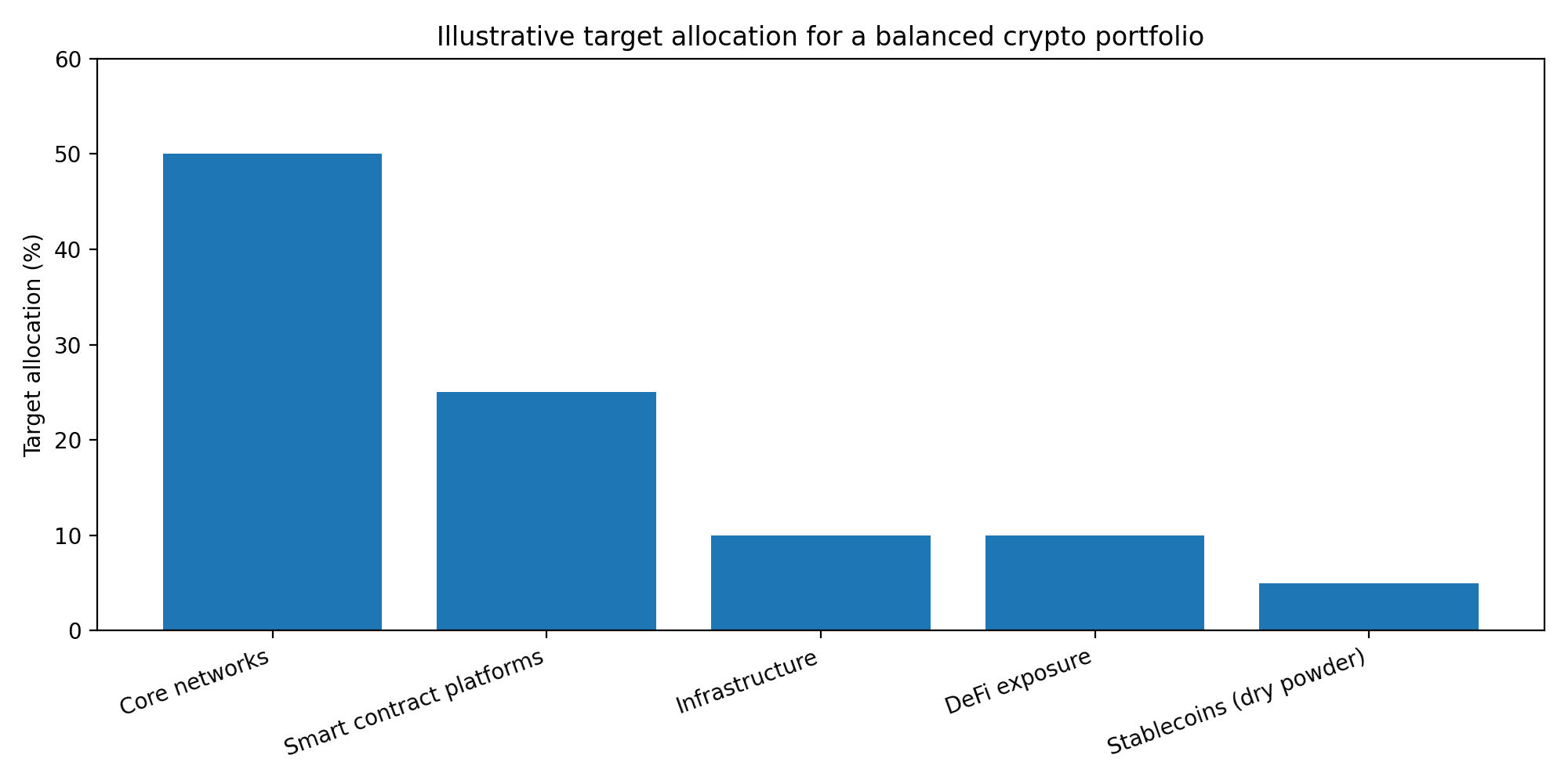
Many experienced allocators separate holdings into core and satellite positions. The core is built from the most established networks, typically those with deep liquidity, long operating history, and broad market access. These assets often anchor a crypto portfolio because they tend to be easier to trade and harder to break.
Satellites are smaller allocations to higher-risk themes such as smart contract ecosystems, infrastructure tokens, and selective decentralized finance exposure. Satellites can add upside, but if they dominate, the allocation behaves like a speculative bundle.
Diversify by function, not by ticker count
Owning many tokens does not automatically reduce risk. If the holdings depend on the same market mood and the same liquidity cycle, they can crash together. Real diversification spreads exposure across different functions.
A balanced crypto portfolio often includes a settlement or store-of-value network, 1 or 2 smart contract platforms, and a limited set of supporting infrastructure such as oracles or scaling tools. When decentralized finance exposure is included, the investor should understand what creates yield and what can fail during stress.
Stablecoins can support rebalancing and provide dry powder, but they are not risk-free. Issuer risk, custody risk, and depeg events are real. If stablecoins are used, the investor should keep the exposure intentional and avoid treating it as a permanent substitute for cash.
Key indicators that help evaluate crypto assets
Research does not need to be complicated, but it should be consistent. A simple checklist can filter out many weak projects.
Liquidity is a first check. Higher liquidity usually means tighter spreads and less slippage, and it reduces the chance of getting trapped in a position. Thin liquidity is a common weakness in a crypto portfolio that is built from hype.
Token supply design matters because dilution can overwhelm good product progress. Circulating supply, maximum supply, inflation rate, and unlock schedules shape what holders experience over time. Unlock calendars and vesting terms deserve a careful read.
Usage adds reality. If a network has sustained activity, it often shows up in transaction volume, fee revenue, and demand for block space. Developer activity is another durability signal. Regular releases, active repositories, and real integrations suggest that builders are still there when the market mood shifts.

On-chain behavior can provide context when narratives do not match price action. Exchange inflows and outflows, long-term holder behavior, and activity trends can help explain whether moves look like accumulation, distribution, or pure volatility. These metrics do not predict the future, but they can keep a crypto portfolio grounded.
Rebalancing turns volatility into a routine
Even a sensible allocation drifts after big moves. Rebalancing brings holdings back to target weights. It is one of the few habits that forces profit-taking during rallies and disciplined buying during drawdowns.
Many investors rebalance monthly or quarterly, and they also adjust when an asset moves far from its target weight, such as 20% above or below. Taxes and fees should shape the schedule. In many jurisdictions, each sale can trigger a taxable event, so recordkeeping should start on day 1.
Security belongs in the plan
The best allocation can still fail if custody is weak. Exchanges are useful for buying and selling, but long-term holdings are often safer in self-custody with a properly stored seed phrase and hardware protection.
Operational habits matter. Two-factor authentication, unique passwords, device hygiene, and cautious link behavior reduce phishing risk. A crypto portfolio should be built with the assumption that attackers are persistent.
How to treat news and regulation
Policy headlines can move crypto quickly because they affect market access and liquidity. The investor does not need to react to every rumor, but they should track whether a development changes fundamentals, liquidity, or the ability to hold and transfer an asset.
When news does not change those basics, the rules should stay in control. When it does, the investor can deliberate rather than rebuild the crypto portfolio in a rush.
Conclusion
A durable allocation is built on simple choices that are repeated consistently: clear purpose, realistic sizing, real diversification, and routine maintenance. With a core-and-satellite structure, a checklist focused on liquidity, supply design, usage, and builders, and a calm rebalancing rhythm that respects taxes and security, an investor can build a crypto portfolio that seeks growth without turning every dip into a crisis.
Frequently Asked Questions
How large should a crypto allocation be?
Many investors start small relative to total investable assets so that a sharp drawdown does not derail long-term goals. The right size is one that can be held through volatility.
How many assets are needed for diversification?
Diversification comes from different risk types, not a long list. A smaller group that covers core networks and a few research themes can be enough.
How often should rebalancing happen?
Monthly or quarterly schedules are common. Some investors also rebalance when weights drift materially from targets. Taxes, fees, and personal bandwidth should guide the choice.
Are stablecoins safe long term?
They reduce price volatility, but they can face issuer, custody, and depeg risk. They fit best as a tool for rebalancing and liquidity management, not as a risk-free asset.
What is the most overlooked research step?
Many investors skip supply analysis. Unlock schedules and inflation can weigh on price even when the product improves.
Glossary of key terms
Asset allocation: How capital is split across assets based on goals and risk tolerance.
Liquidity: How easily an asset can be traded without moving its price.
Slippage: The gap between expected and executed trade price, often worse in thin markets.
Tokenomics: Supply rules such as issuance, unlocks, and incentives.
Vesting: A schedule that releases tokens to insiders or early investors over time.
Rebalancing: Adjusting holdings back to target weights after price moves.
Self-custody: Holding assets in a wallet controlled by the holder rather than an exchange.
Depeg: A stablecoin moving away from its intended peg, often $1.
On-chain metrics: Blockchain data such as flows, activity, and transfers.
References