





Artificial intelligence is moving from novelty to utility across finance, handling tasks such as monitoring risk and spotting fraud. Crypto adds a different ingredient: open networks where money can move by code, 24/7. Where those two trends overlap, a new category has formed that markets call AI Crypto Tokens.
The label is broad for a reason. Some projects use tokens to pay for decentralized computing power. Others use tokens to reward data contributors and verification. A smaller but growing group uses tokens to coordinate software agents that interact with smart contracts under strict rules. The common thread is that intelligence is part of the product’s core function, not a decorative slogan.
What makes a token “AI-powered” in the first place
A token earns an AI label when artificial intelligence is essential to what the network does. In practice, AI Crypto Tokens usually play one of three roles.
They can pay for resources that AI needs, especially compute and storage. They can reward contributors who provide clean datasets, labels, or verification that improves model quality. They can also govern parameters that matter for an AI network, such as reward rates, service standards, and which models can be deployed.
If a project cannot explain the token’s job in one clear sentence, that is a warning sign. A real network uses the token as a tool, not as a substitute for product demand.
Where the intelligence actually lives: data, models, and execution
Most systems can be understood as inputs, decision logic, and actions. Inputs may include on-chain activity, liquidity conditions, and application usage. Decision logic can be a model that detects anomalies, scores risk, or ranks opportunities. Action happens through smart contracts, which can enforce permissions and settlement.
A model can suggest an action anywhere, but a blockchain system can constrain execution, log what happened, and settle predictably. That combination sits at the heart of what builders describe as intelligent finance.
Use cases already shaping digital finance
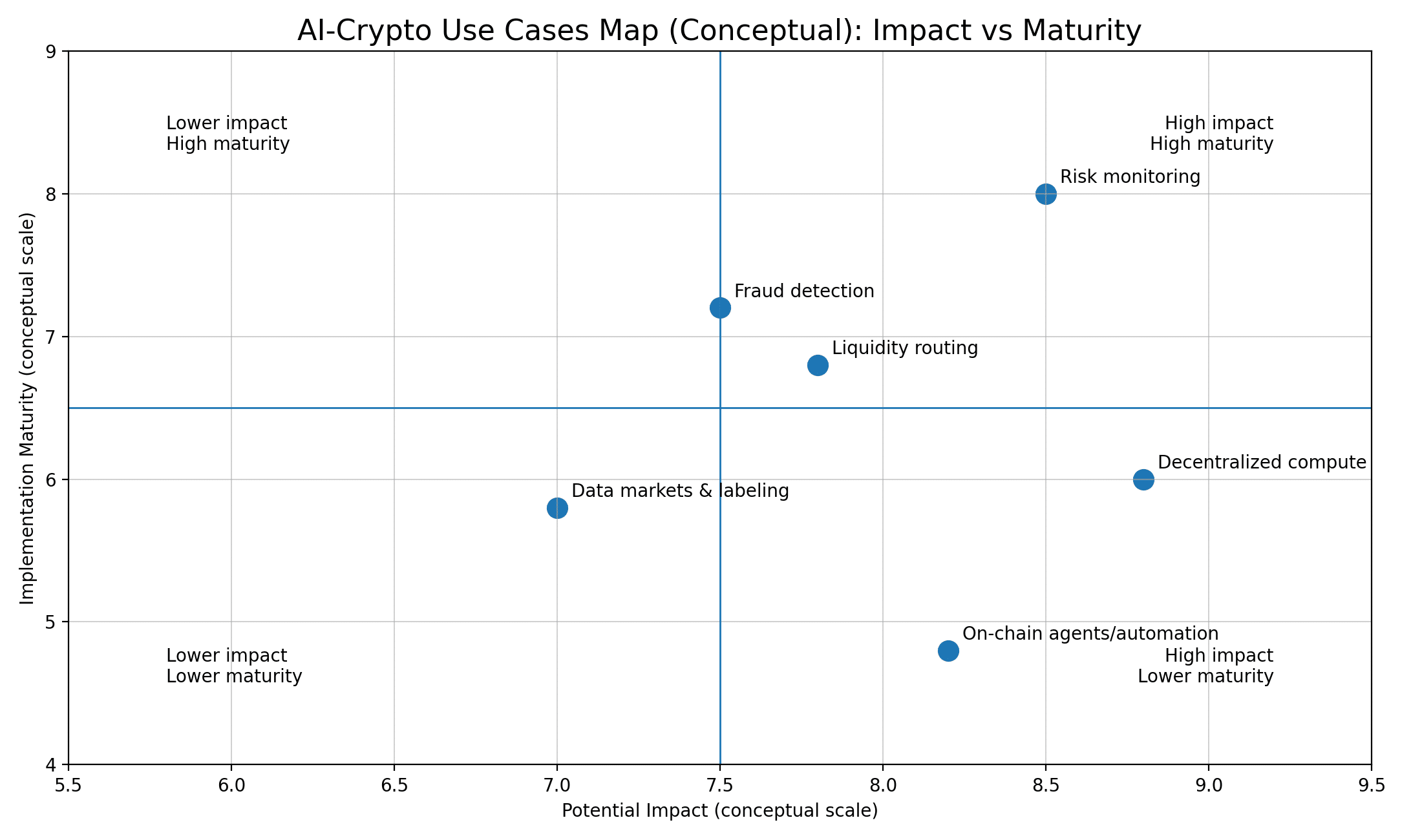
The most believable use cases are the practical ones that reduce friction. Risk monitoring is a clear example. Models can watch collateral health, liquidation thresholds, and price gaps, then trigger alerts or conservative actions. Fraud detection and bot filtering also fit naturally, especially for applications that need to protect users without endless manual reviews.
Liquidity routing is another realistic lane. Crypto markets are fragmented, and routing matters when fees, slippage, and depth vary across venues. When AI is paired with transparent execution rules, it can help optimize routes while keeping guardrails in place. In those settings, AI Crypto Tokens are less about prediction theater and more about paying for and securing the plumbing.
Why has this started to read like a news story
Crypto turns AI into a public experiment. Strategies can be deployed transparently, performance can be observed live, and failures are visible to everyone. That visibility pushes projects to explain how models are trained, how data is sourced, and how updates are governed.
It also arrives as the industry is trying to professionalize. Institutions care about controls, auditability, and predictable operations. That pressure can make the strongest AI Crypto Tokens look like early infrastructure, even while the category still attracts imitators.
The crypto indicators that still decide whether a project holds up
AI narratives can distract from basic asset reality, so analysis starts with indicators that matter for any token.
Liquidity is the first filter. Thin markets can exaggerate price moves and create misleading signals. Ownership distribution matters too, because extreme concentration can distort governance and increase exit risk. Supply schedules matter because large unlocks can overwhelm organic demand, even when a product improves.
On-chain usage is often more revealing than social attention. A credible project shows activity tied to its purpose, such as payments for compute, rewards for verified work, or fees generated by real users. Security is non-negotiable. Smart contract design, key management, and permission systems determine whether automation is safe, and AI Crypto Tokens should be evaluated with the same rigor applied to DeFi protocols.

Risks that deserve more attention than hype cycles
AI introduces failure modes that are easy to underestimate. Models can overfit past conditions and fail when regimes shift. Data can be manipulated through poisoned inputs that degrade performance. Many projects also claim decentralization while relying on a small group to update models or manage infrastructure, which creates a gap between branding and reality.
Regulatory and governance risk also matter. If marketing implies profit expectations based on managerial work, scrutiny can rise. If an automated product behaves like an investment adviser, additional rules may apply. The safest AI Crypto Tokens tend to be the ones that document assumptions, limit permissions, and treat oversight as part of the product.
A grounded view of the future of intelligent finance
Intelligent finance is not a world where software replaces accountability. It is a world where monitoring improves, routine decisions are automated, and risk is surfaced earlier. Over time, the projects most likely to last will be the ones with feedback loops: usage improves models or datasets, improved quality attracts more usage, and token demand grows because the network is doing work that is expensive or difficult to centralize.
When those pieces click, AI Crypto Tokens become less of a trend and more of a coordination layer for digital finance.
Conclusion
This category will produce failed experiments, because it mixes two fast-moving fields and invites storytelling. Yet the underlying idea is straightforward: use tokens to coordinate intelligence as a shared resource, so data, compute, and controlled automation can be accessed without handing the entire system to a single gatekeeper. When projects connect the token to verifiable work, transparent performance, and safe controls, AI Crypto Tokens can look like early infrastructure rather than a short-lived narrative.
Frequently Asked Questions
What are these tokens in one sentence?
They are digital assets connected to networks that provide AI-driven services such as decentralized compute, data coordination, or constrained automation, and AI Crypto Tokens are typically used to pay, secure, or incentivize that network.
Do they guarantee better returns than other crypto sectors?
No. Token prices can move for reasons unrelated to model quality, including liquidity conditions, broader risk appetite, and speculative rotations, so performance claims require skepticism.
What is the clearest real-world use case today?
Risk monitoring remains one of the most practical, because it reduces operational burden and can be tested against measurable outcomes rather than promises.
How can a reader tell if the “AI” is real?
A serious project describes inputs, model goals, update processes, and failure handling, and the best AI Crypto Tokens also show on-chain activity that matches those claims.
How should this sector be approached responsibly?
It is approached as high-risk technology investing, with attention to token utility, supply schedules, security posture, and the specific way AI Crypto Tokens capture value from real usage.
Glossary of key terms
Artificial intelligence: Software techniques that enable systems to classify, predict, or generate outputs that resemble human decision-making.
Training: The process of adjusting a model with data so it performs a task more accurately, often requiring significant compute.
Inference: Running a trained model to produce an output, such as a risk score or anomaly flag.
Smart contract: Blockchain code that executes rules automatically, enabling programmable settlement and constrained automation.
Token utility: The functional role of a token in a network, such as paying fees, staking for security, governance, or incentives.
Data poisoning: The insertion of misleading or harmful data into training or input streams to degrade model performance.
References
Bank for International Settlements