




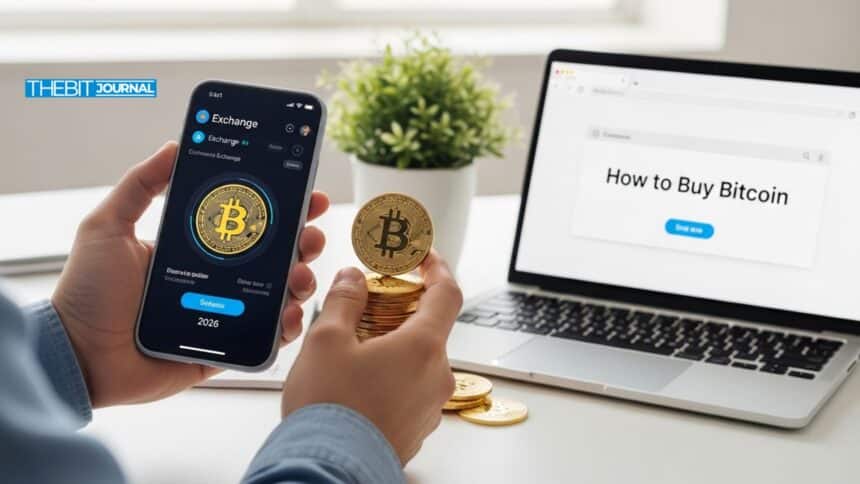

For newcomers planning to buy Bitcoin for the first time in 2026, knowing where to begin and how to do so securely; would mean everything. Now with stricter regulations; changing exchanges and more security threats than ever before, newcomers need more than a just a quick tutorial; they need a clear step-by-step roadmap.
It is important to know certain things like KYC and funding options before signing up; how to take a pick between the big exchanges like Coinbase; Binance and Kraken and how to make the first trade using market or limit orders.
What You Need Before You Buy: KYC, ID, Bank Account
Most exchanges need some kind of verification like KYC (Know Your Customer) before one can purchase Bitcoin. This typically means providing:
Government ID: A passport, driver’s license or national I.D. card. Some platforms like Coinbase might also require proof of address such as utility bill, bank statement. Kraken requires photo ID as well as proof of address in some cases.
Bank account or card: You’ll need a payment method to fund your purchase. For instance, Coinbase permits connection with a bank account, debit card or wire transfer. Binance and Kraken also accept bank transfers, debit cards and sometimes credit cards though fees can vary. If you’re using a global exchange, check that your account is set up for international transfers.
Phone and Email: To secure your account (2FA codes, alerts), a valid email and phone number are used.
In short, you will need your ID documents along with proof of address and banking details to sign up. This allows faster verification, so you can get started with trading. Also, only pick exchanges that are available in your country to avoid unsupported issues.
Choosing the Right Exchange: Coinbase, Binance, Kraken Compared
One needs a crypto exchange or broker to buy Bitcoin. Coinbase; Binance and Kraken are the three most beginner-friendly options. Here’s how they stack up:
Coinbase: US-based; new user-friendly interface and high regulatory compliance. Offers about 250+ coins and staking options (Ethereum staking, etc.) Coinbase is the first major crypto exchange to go public and has a high level of transparency. It’s frequently suggested to beginners, but fees may be higher on the plain “Buy/Sell” platform. Verification is easy, and it can accept bank accounts, cards and PayPal in some areas. Daily trading volume is comparatively less than that of Binance but still strong.
Binance: Largest exchange in the world by volume. Has hundreds of coins offer and low trading fees (0.1% or less with BNB). Binance has more complex features (futures, staking, many altcoins), which might not be suitable for newbies. Although Binance struggled with regulators back in 2023-2025, as of 2026; it is compliant around the globe. Binance is a solid choice if you have many coin options and low fees as top priorities, but only use the official local entity for your country.
Kraken: Established in 2011, Kraken is know for being secure (there have been no serious hacks in its history). Offers about 200+ coins and high liquidity in EUR/GBP fiat pairs. Kraken’s fees across the board are comparatively mid-range (roughly 0.16%-0.26%). For basic levels, verification can be quite fast. Kraken also offers margin products and futures for more advanced users. It’s a strong option for people who prioritize trust and a good range of fiat currencies (especially if you’re in Europe).
Below is a quick comparison table:
| Feature | Coinbase | Binance | Kraken |
| Ease of Use | Very beginner-friendly | More advanced interface | User-friendly, moderate complexity |
| Fees (Spot) | 0.5%-4% (buy/sell) | 0.1% spot (maker/taker) | 0.16%-0.26% (maker/taker) |
| Supported Fiat | USD, EUR, GBP, etc. | USD (via Binance.US), EUR, many | USD, EUR, GBP, AUD, CAD, JPY, etc. |
| Coins Available | 250+ | 600+ (Binance.com); 150 (US) | 200+ |
| Security | High (public company) | High (large resources) | Very high (no hacks) |
| Regulation | Very regulated (US focus) | Evolving (global licenses) | Regulated (US/EU, etc.) |
The KYC steps above are required for all three. Most new users start at Coinbase for convenience; but if you want lower fees and a wider range of coins, try Binance or Kraken. Make sure you are using the correct domain (i.e. Binance.us for USA, kraken.com); to avoid phishing scams.
Market Order vs Limit Order: Which to Use as a Beginner
When you buy Bitcoin, you need to select an order type. The two simplest are market orders and limit orders:
Market order: This helps buy Bitcoin immediately at the current price meaning that if BTC is $50,000; a market order will be executed immediately (maybe a couple of dollars off depending on liquidity). Market orders are for when one wants to buy instantly without delay. The danger here is price slippage because the final price may be somehow higher if the order book thins.
Limit order: This allows you to set a price. If you think BTC will fall, then you can set up a limit order to buy, for example at $49,000. Your order will only be carried out if that the price reaches $49,000 or lower. Usually, limit orders give you price control and also protect you from sudden jumps but they may not fill at all if the price does not get to your level.
For new investors; a market order is a good place to start. It guarantees execution immediately. Just keep an eye on recent price action in order to avoid overpaying due to wild fluctuations. Once you get the hang of it, try using limit orders to see if you can save both money and impulse buys.
Market orders provide speed and certainty of execution, while limit orders allow price control.
How Much Bitcoin Should You Buy First?
Bitcoin is expensive and volatile, so it is advisable to begin small and cautious. Financial experts caution novices to lose only what they can afford, often 1-5% of their portfolio. You don’t have to purchase a whole Bitcoin as even a fraction will do.
New investors often start with $10-$50 just to feel comfortable. A wise approach is dollar-cost averaging, for example purchasing $100-$500 worth of Bitcoin over the course of several months.
For some context; let’s say you have $5,000 to invest; opening a Bitcoin account with $100-$200 will help you learn the basics of buying, selling and checking prices without significant risk. Only increase slowly as you get to understand the market. This conservative method can prevent panic selling during dips.
Moving Your BTC from the Exchange to a Wallet
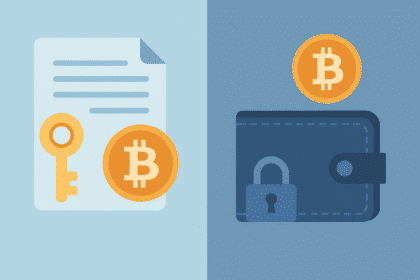
Once you buy Bitcoin, think about transferring it off of the exchange into a wallet where you own the private keys. Why? This is because exchanges can be hacked or shut down; a wallet (especially a hardware one) puts one in control of their private keys. There are two types of wallets, the custodial (where the exchange stores your keys) and non-custodial (where you store your keys). The safest approach is non-custodial.
For transferring; generate a new Bitcoin address in your wallet and withdraw the BTC from an exchange to that address. For small amounts, you can use software wallets ( mobile apps like Exodus, Mycelium; MetaMask for ETH based assets) which are easy. For bigger holdings, utilize a hardware wallet (e.g., Ledger or Trezor), which saves keys offline.
Always verify the address you’re sending to, and consider doing a small test transfer first. After sending; the Bitcoin network will process the transaction (this may take minutes to an hour). Once confirmed; your BTC is safely seated in your own wallet, and you have more possibilities like using DeFi or simply keeping for longterm.
Dollar-Cost Averaging: The Smarter Way to Buy Over Time
Dollar cost averaging (DCA) means investing a set dollar amount in Bitcoin over a consistent schedule regardless of price. For example, you could buy Bitcoin worth $100 every month. DCA avoids the perils of timing the market. Sometimes you buy high and some times low; but with time, your average cost evens out.
DCA’s purpose is to minimize the effects of volatility. Spread purchases rather than doing it all at once can help lessen the regret and emotional trading. For example, for a crypto newbie, a practical strategy could be: “Buy $50/week of Bitcoin” or “$200/month”. When prices go down, your fixed buy amount gives you more BTC and when they go up you end up buying a slight bit less.
Over many months, this can improve returns compared to lump-sum entry.
Investors should keep in mind that DCA doesn’t prevent loss; if Bitcoin drops long-term, it still loses. But it enforces discipline and is consistent with a long-term mentality. DCA beats guesswork and keeps new investors from panic buying or selling.
Tax Implications of Buying Bitcoin in the UK / US
Taxes on Bitcoin vary by country:
United States: The IRS classifies cryptocurrency as property. The most important part is that buying Bitcoin is not a taxable event. Investors owe tax only when they “dispose” of it (sell, trade or use it). IRS guidance says that just buying and holding crypto has no immediate tax implications. Investors need to declare any capital gain or loss when they eventually sell or trade Bitcoin.
Thus, short-term profits (held <1 year) are taxed like work income (10%-37% depending on tax bracket), whereas long-term gains (≥1 year) are taxed much less severely (0%-20%).
United Kingdom: HMRC treats crypto in the same manner. To buy Bitcoin itself isn’t taxed; but selling or spending it will usually incur Capital Gains Tax (CGT). Investors only pay CGT on the profit above the annual allowance (£3,000 in 2024/25). The applicable rate is either 10 percent or 20 percent, depending on how much income is made.
Income derived from Bitcoin (i.e. through mining or work) is taxable under income tax; but simple buying at an exchange for investment purposes is not taxed until disposal. Investors have to declare crypto profits on their self-assessment, if HMRC requires it. Investors can be penalized for not reporting.
For both countries, tracking is important. Maintain an account of dates, amounts and prices for each transaction. Reporting can be automated with tools such as CoinTracker or CoinLedger. Always consult the most up-to-date tax documentation or a tax professional; as crypto tax laws can change.
What to Do After You Buy Bitcoin: Portfolio Tracking and Security
Once you buy your first Bitcoin, establish a strategy to track and safeguard it:
Track Your Portfolio: Use a portfolio tracker app (CoinGecko, Blockfolio/Fanzy, CoinTracker) to get an overview of your Bitcoin balance and all your crypto holdings in one place. This gets you to see gains/losses and rebalance if required. Using tax/software tools like CoinTracker, Koinly for compliance and tracking is also recommended.
Set Up Alerts: If you are looking to find large moves, a price alert may be the way to go. There are various apps where investors can set up email or phone alerts when BTC price reaches this or that threshold. This isn’t trading advice, just a heads-up.
Make your account and wallet secure: Use a complex password for the exchange and activate two-factor authentication (2FA) via SMS or any authenticator application. Never share your seed phrase or private keys for your own wallet. If using a hardware wallet; follow best practices (i.e. write recovery seed down on paper).
Consider Long-Term Storage: A hardware wallet (cold storage) is the safest option for holding Bitcoin over the years. Hardware wallets like Ledger, Trezor are the most secure options. A reputable mobile wallet works too for lesser amounts as long as it is updated.
Review Your Strategy from Time to Time: Re-evaluate your plan periodical (once in a month or quarterly). If your financial situation changes or there is need to adjust Bitcoin security, revisit your DCA approach.
Conclusion
For investors to buy Bitcoin safely in 2026 requires knowledge of best practices. Investors need government ID and a bank account for KYC, and they must select an exchange (Coinbase, Binance, Kraken, etc.) they trust. Once ready, start with small amounts such as fractions of BTC and choose between a market or limit order when making purchase.
Buy, transfer to secure wallet (preferably hardware) and track it with portfolio software. Consider dollar-cost averaging and spread out your purchases to reduce volatility. Finally; remember tax rules: to buy Bitcoin itself is not taxed; but selling or spending it incurs capital gains tax as a rule of thumb in both UK and US.
By following these steps, ensuring security and compliance; new investors are on their way to owning Bitcoin with confidence.
Glossary
Bitcoin (BTC): The first cryptocurrency; a digital asset and payment system introduced in 2009. It leverages decentralized blockchain technology to facilitate peer-to-peer transfers without intermediaries.
Exchange: A service such as Coinbase or Binance; for buying, selling; and trading cryptocurrencies.
Wallet: A software/hardware tool that stores your cryptocurrency private keys.
KYC (Know Your Customer): A compliance process required by regulations.
Capital Gains Tax (CGT): A tax based on the profit made when selling an asset.
Fiat Currency: State-issued money (like USD, EUR, GBP); that is use to acquire Bitcoin.
Hot/Cold Storage: Hot storage is when you keep your crypto in an online wallet (such as on an exchange or mobile app) for the sake of convenience. Cold storage is storing the keys offline (hardware wallet or paper wallet) for greater security.
Frequently Asked Questions About How to Buy Bitcoin in 2026
What do I need before I buy Bitcoin?
To buy Bitcoin; you usually require a verified account on an exchange (requiring KYC). Be ready to present a government-issued ID, and maybe proof of address. You’ll also need a funded payment option (bank account, debit/credit card or wire transfer); to finalize the purchase.
Which exchange is used to buy Bitcoin?
Coinbase, Binance and Kraken are among the most popular options. Coinbase is very easy to use for beginners; Binance has low fees and most coins, and Kraken has solid security. Do compare fees/features; but any reputable exchange with KYC will allow you to buy Bitcoin.
Should I place a market order or a limit order?
A market order buys at the current price (good for immediacy of execution). In limit order you can set your target price; it will only execute when the market hits that price. Newbies usually place market orders for simplicity before dabbling with limits once they feel comfortable.
How much Bitcoin should I buy in the beginning?
Start very small. You don’t have to buy a whole Bitcoin. Many recommend only investing what you can afford to lose (typically 1-2% of your portfolio). Even $10 – $50 is good to start.
References
Disclaimer:
This article is for general information purposes and not financial advice. The cryptocurrency market is volatile; do your own research and seek professional advice if you have any investment or tax questions.