





Tokenized NVDA has started acting less like a gimmick and more like a market that tracks a mega-cap equity. The appeal is straightforward: price exposure to Nvidia stock on crypto rails, with smaller position sizes.
Why tokenized equities are making headlines
This corner of crypto is getting attention since big market operators are exploring tokenized securities and longer trading hours, and because on-chain activity is no longer tiny. In early 2026, reporting said xStocks crossed $3,000,000,000 in total on-chain transfers.
Scrutiny is rising as Europe’s securities regulator has warned that tokenized stocks can create investor misunderstanding because they often do not confer shareholder rights. Market infrastructure groups have also urged regulators to address tokens that mimic equities without the standards investors expect.
What “tokenized NVDA” represents and why Nvidia stock is different
“Tokenized NVDA” is not one product. It is a category with multiple issuer models.
One common design is a tokenized tracker certificate that mirrors the price of Nvidia stock and is issued under specific terms, often with distribution limited to eligible participants through licensed entities. In that structure, the token is a contractual instrument tracking performance, not a direct share recorded on the company register.
Another design markets a 1:1 backed approach. A venue can state that a regulated third party holds the underlying shares in custody and the token is backed 1:1 by actual company stock, with ownership represented on a blockchain ledger.
The key takeaway for readers is simple and should be repeated: token holders often do not receive the same rights as shareholders. Voting rights are a frequent example, and dividend handling can vary by product. That difference is why a token can look like Nvidia stock on a chart while still being a different legal claim.
Why traders want it: 24/7 access, fractional sizing, cross-border ease
Demand comes from how crypto traders operate as risk is managed continuously, so an equity proxy that trades beyond the U.S. session feels natural. Even when a platform limits trading to 24/5, it still extends access compared with the standard U.S. schedule for many global users.
Fractional sizing is the second draw, as tokenized products can allow smaller allocations than a whole share, which suits newer traders and also suits disciplined portfolios that rebalance frequently.
Cross-border convenience is the third as access to U.S. equities can be constrained by local brokerage rules or account requirements. A tokenized wrapper can reduce friction for some participants because it fits existing wallets and stablecoin settlement.
Where liquidity really comes from: market makers and hedging routes
Tokenization does not manufacture liquidity; Liquidity appears when someone is willing to quote both sides and carry risk.
Most tokenized equity markets rely on market makers. They quote buy and sell prices, manage inventory, and try to keep the token aligned with the reference price of Nvidia stock across multiple venues.
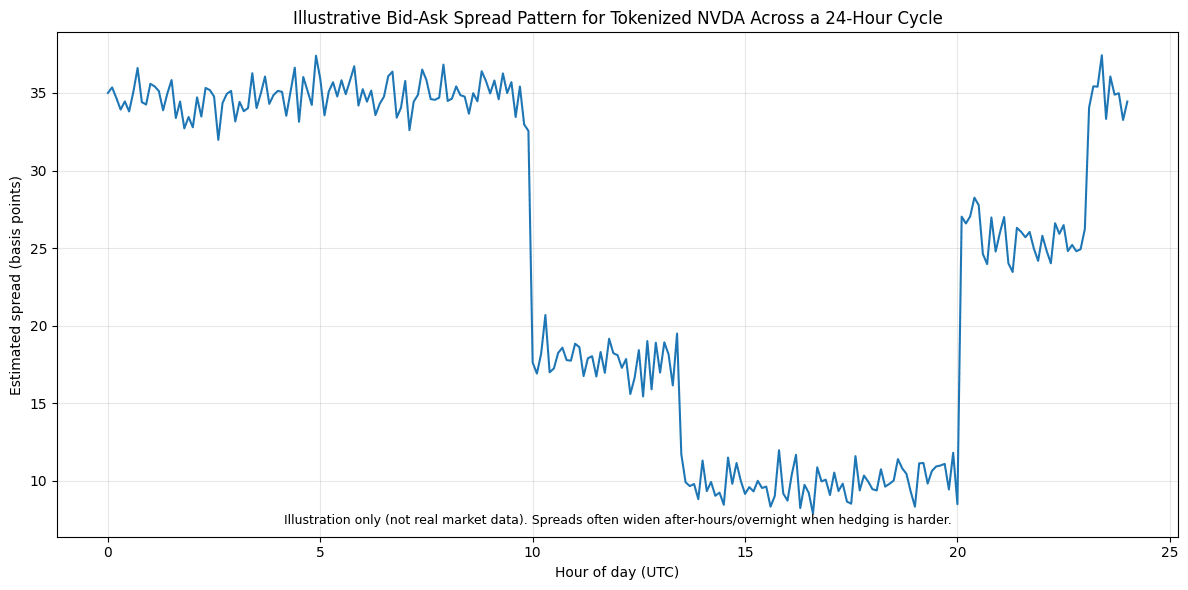
The second anchor is hedging access to the underlying. If issuers, authorized participants, or market makers can access real shares or liquid derivatives, they can hedge the exposures created by token trading. When that hedge link is strong, the market behaves more like a proxy. When it is weak, spreads widen and pricing becomes jumpier.
The spread problem: how pricing drifts after-hours and in thin windows
The spread problem is where many traders get surprised. When the U.S. market is closed, token pricing becomes a blend of last known reference price, new information, and a risk premium charged by liquidity providers who cannot fully hedge in real time.
Public market data trackers show at least one followed tokenized NVIDIA instrument posting 24-hour trading volume in the tens of millions of dollars on some days. The practical rule is that the less hedgeable the window, the more the token price can drift away from Nvidia stock.
Smart risks: counterparty exposure, redemption terms, halts, corporate actions
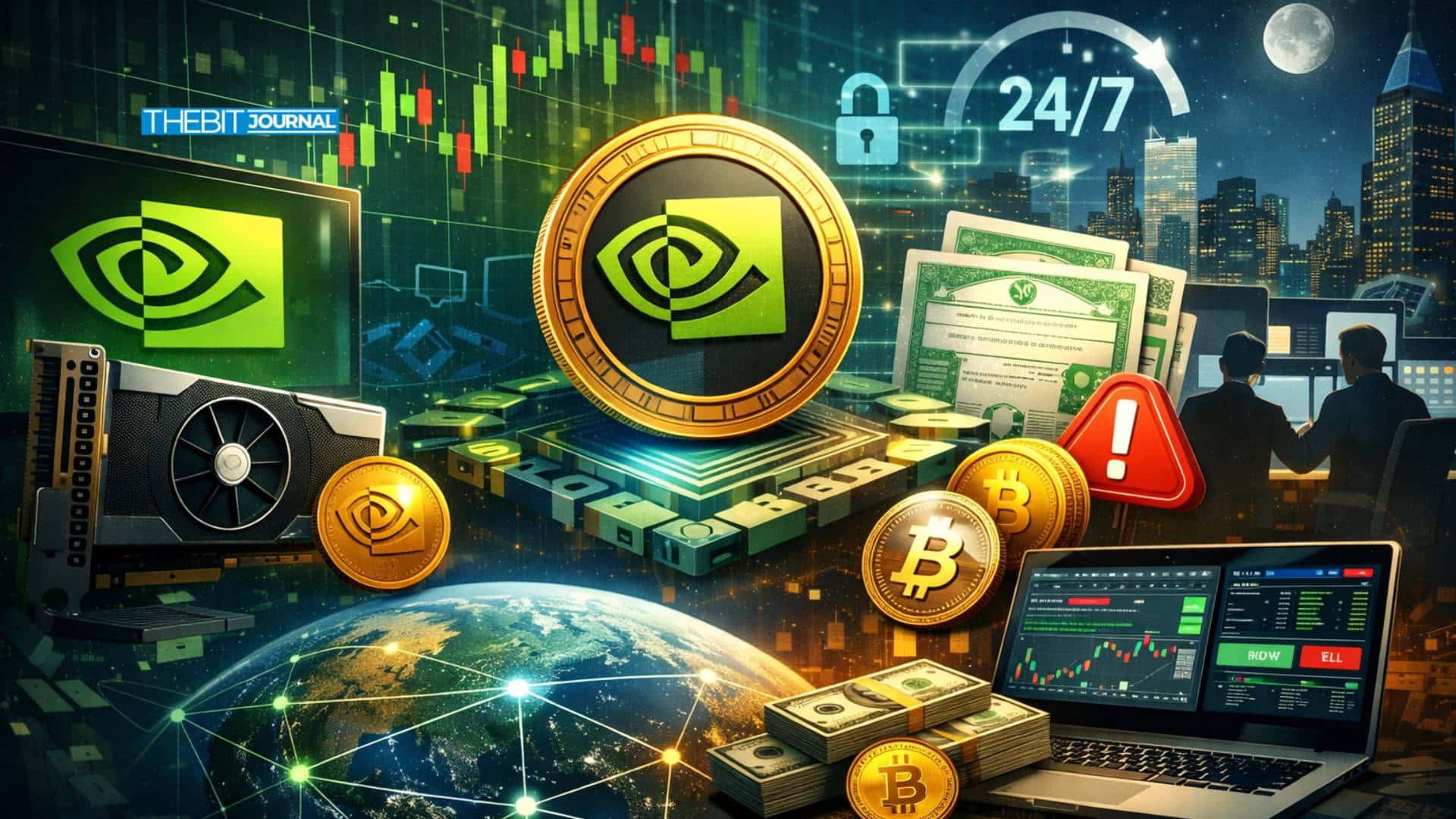
Tokenized equities look familiar on the surface, but they add layers of risk that deserve plain explanation.
Counterparty exposure is the headline risk. The holder relies on an issuer, a custody setup, and venue rules. Industry bodies have highlighted enforceability and custody questions around what claims token holders retain if a platform fails.
Redemption terms are just as important. Some issuers emphasize that their products are not offered directly to the public and can be acquired only through licensed channels, with redemption pathways described separately and often tied to eligibility rules. In stress, redemption constraints can matter more than marketing language.
Halts are another: a token can be paused by venue controls, issuer policy, or smart contract permissions, which changes the meaning of “always-on.”
Corporate actions are the quiet test. Splits, dividends, mergers, and spin-outs require clear operational policies. If rules are vague, the token can drift from the economics people associate with Nvidia stock, even if the price chart looks close most of the time.
What to disclose clearly: not the same as Nvidia stock in many structures
Disclosure is the difference between a useful product and a confusing one.
First, it should be stated upfront that in many structures it is not the same as holding Nvidia stock directly. The product may be a tracker, a certificate, or another claim model.
Second, rights and cash flows need plain language: voting rights, dividend treatment, and corporate action handling.
Third, venue protections must be explained because trading outside traditional exchanges can mean different safeguards and market integrity regimes.
Bigger rails, bigger spotlight
In January 2026, ICE, the owner of the NYSE, described work on a separate digital platform for tokenized securities, built around 24/7 access and stablecoin funding, pending regulatory approval. That is a sign the “always open” thesis has moved beyond crypto-native circles. Regulators and market infrastructure groups have also warned about investor confusion and standards, particularly around rights and protections.
Conclusion: a real market, but not a simple one
Tokenized NVDA is real enough to trade, but it is not one uniform instrument. Each issuer model comes with its own custody path, redemption rules, and risk controls. For some traders, it is a practical way to express a view on Nvidia stock when timing and sizing matter. The sensible framing is to treat tokenized NVDA like a product category, because structure is where most risk lives.
Frequently Asked Questions (FAQs)
Is tokenized NVDA the same as owning Nvidia stock?
Often it is not. Many structures provide economic exposure through a tracker or claim model, and shareholder rights such as voting may not apply.
Why can the token price deviate from Nvidia stock?
Deviation is most common after-hours, when hedging is harder and spreads widen.
Where does the backing come from?
Some models rely on underlying shares held in custody, while others are structured products designed to track the share price. Redemption access and eligibility can differ.
What happens during a split or dividend?
A well-run product should describe how corporate actions are handled. Readers should look for explicit policies before assuming perfect parity with Nvidia stock.
Glossary of key terms
Tokenized equity: A blockchain token that aims to track an equity’s price, with backing or a structured tracking model.
Custody: Who holds the underlying and what claim the holder has.
Market maker: A firm that quotes buy and sell prices and manages hedging.
Redemption: Converting a token into the underlying or a cash equivalent under set terms.
Corporate actions: Splits, dividends, mergers, and similar events that must be reflected correctly.
Sources
Disclaimer: This article is for informational purposes only and does not constitute investment advice. Tokenized equities and digital assets carry significant risk, including liquidity risk, pricing deviation, and counterparty risk.