



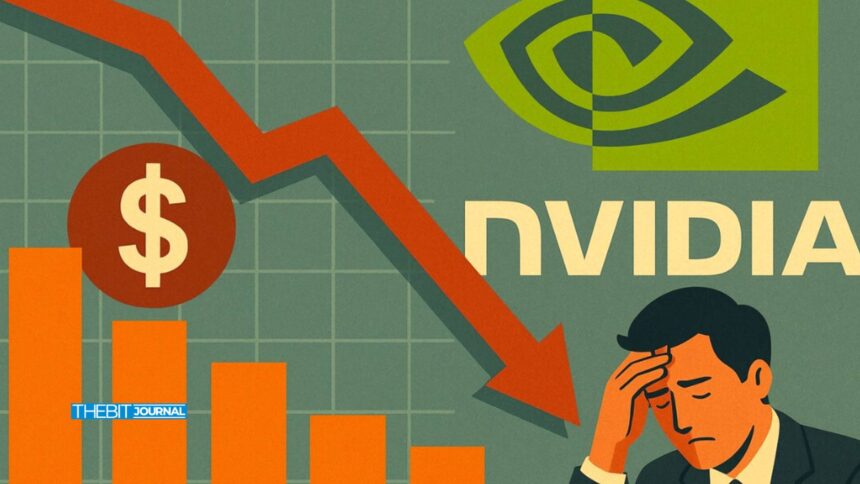

NVIDIA share price decline of at least 3% despite the AI giant posting revenue of $46.7 billion, which is 56% higher than the previous year and well above Wall Street’s estimate of $46.2 billion has surprised many.
According to a market report, the company’s stock (NVDA) dropped by 3.14% to $181.60, erasing at least $11 billion in market value and reducing its market capitalization to $4.43 trillion.

Concerns about China Business
The Santa Clara, California-based AI giant’s adjusted profit stood at $26.4 billion, amounting to $1.05 per share, in the quarter ended July 27. Analysts at FactSet had predicted that Nvidia’s share price would earn $1.01 per share on sales of $46.05 billion in fiscal Q2.
Also read: Nvidia Faces $5.5B Hit From China Export Ban—Bitcoin, XRP, ADA Drop
This marked the slowest pace of growth in more than two years. Adjusted profit stood at $26.4 billion, or $1.05 per share, beating the consensus forecast of $1.01. During the same period the previous year, Nvidia earned and adjusted 68 cents per share on cumulative sales of $30.04 billion.
Despite the positive revenue result, there have been serious concerns about Nvidia’s business in China. According to the company, US-China trade tensions led to a decline in revenues of $4 billion for the sales of its H20 processors, which were tailored specifically for the Chinese market.
No Comment on Nvidia Share Price
Nvidia Chief Executive Officer Jensen Huang disclosed further that their third-quarter forecast now excludes potential earnings from H20 sales. However, Huang stated that despite the raging US-China trade tensions, the company was optimistic that it would resume Chinese shipments as soon as it received US government approval under a new deal with President Donald Trump, which involves paying commissions to the administration.
According to Huang, talks with the Trump administration regarding US-China trade tensions are aimed at gaining access to the Chinese market. While declining to comment on the Nvidia share price or the company’s performance, Huang stated that he expected:
“American companies to lead the AI race […] The opportunity for us to bring Blackwell to the Chinese market is a real possibility.”

Investors Remain Skeptical
Despite the decline in Nvidia’s share price, the company’s high-end GPUs remain a hot commodity for tech giants creating data centers for AI applications. Nonetheless, investors are skeptical about the sustainability of the ongoing massive investment in AI. Commenting on the issue, Emarketer analyst Jacob Bourne opined:
“The data center results, while massive, showed hints that hyperscaler spending could tighten at the margins if near-term returns from AI applications remain difficult to quantify […] At the same time, US export restrictions are fueling domestic chip-making in China.”
Despite calling Nvidia’s H20 chips obsolete, even after they had previously targeted export restrictions, US President Donald Trump earlier this month confirmed that Nvidia would pay his government 15% of its revenue from sales of certain AI chips to China.
Also Read: US-China Trade Talks 2025 Begin, Will Crypto Regain Its Safe-Haven Status?
Conclusion
While the company’s revenue growth suggests a growing demand for its AI infrastructure, the decline in Nvidia’s share price casts a shadow of doubt on investor confidence, especially given the ongoing US-China trade tensions. Only time will tell whether the company will achieve its $54 billion in Q3 revenue, with gross margins forecasted at 73.5%.
Read more investment news on Our Website
Summary
- Nvidia earned $46.7 billion in revenue, surpassing Q2 Wall Street estimates and an adjusted $1.05 per share price.
- The Nvidia share price slipped 3.4% following reduced sales of H20 chips to China due to the ongoing US-China trade tensions.
- The adverse reaction could highlight investor concerns over the consequences of geopolitical risk despite the growth in data center sales.
Glossary of Key Terms
Nvidia: An American-based company specializing in GeForce GPUs for gaming and creative workloads, and professional GPUs for edge computing, scientific research, and industrial applications.
H20 Chips: Semiconductors developed for the Chinese market with the ability of AI programs to tap their training to respond to user prompts.
Wall Street: US financial markets, encompassing the stock and bond markets, major banks, and brokerages, as well as the people working in finance.
Data center: A physical location that stores computing machines and their related hardware equipment.
AI Applications: Software programs that use AI techniques to perform specific tasks.
FAQs for Nvidia share price decline
Why is Nvidia’s share price down?
Several key factors have contributed to the sell-off in Nvidia, including the Trump administration’s new tariffs on Canada, Mexico, and China, which have rattled markets.
How do the tariffs affect Nvidia directly?
The aggressive tariff plans came alongside export restrictions on AI chips, which directly impacted Nvidia, as it generates a considerable portion of its revenue from China.
What are the main challenges and risks emanating from U.S.-China tensions?
Technology competition could blur the lines between economic competitiveness and national security.
How long has the trade war between the US and China lasted?
An economic conflict has been ongoing between China and the United States since January 2018, when US President Donald Trump began imposing tariffs and other trade barriers on China.