
Tokenization spent years on the wrong stage as in 2026, real world asset tokenization is finally being judged on operational outcomes instead of online narratives. It was marketed like a revolution, mocked as jargon, and then drowned out by crypto blowups that had little to do with regulated market operations.
Now the activity is showing up where finance actually commits: in product filings, in custody and settlement pilots, and in guidance that treats tokenization as a process upgrade rather than a brand new asset category.
Real world asset tokenization is moving from novelty to market plumbing
Tokenization does not automatically change what an asset is in law. A regulated fund share remains a regulated fund share. A Treasury instrument remains a Treasury instrument. The shift is in how entitlements are recorded and moved: ownership is represented as a verifiable digital entry that can be transferred and audited with less friction.
That is why real world asset tokenization is best read as infrastructure. It aims to modernize issuance, custody, settlement, and servicing while preserving the same investor rights and protections mainstream markets already expect.
What tokenization changes, and what it does not
Tokenization is not a regulatory shortcut. Securities rules, investor eligibility, disclosure duties, and jurisdictional limits still apply. Europe’s crypto asset framework is explicit that it targets crypto assets not already covered by existing financial services law, which underscores that tokenized securities stay tied to traditional rulebooks.
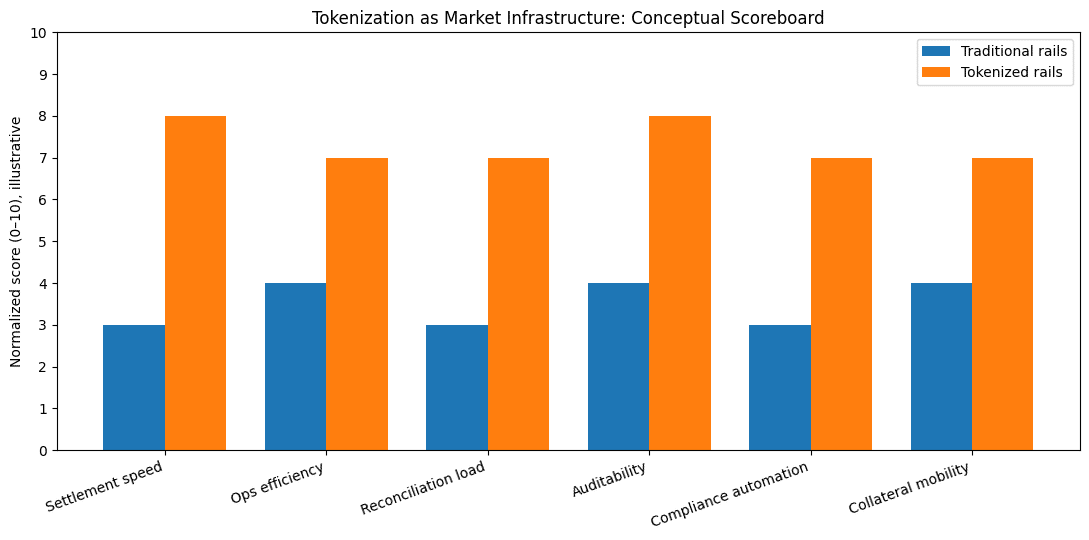
What changes is execution. Settlement can become faster and more predictable, reducing counterparty exposure and easing liquidity strain. Recordkeeping can become less dependent on reconciliation across multiple ledgers. Compliance logic can be embedded into transfers so restrictions are enforced by design rather than by manual checks.
Perception is the main adoption bottleneck
After high profile market failures, many institutions learned to treat anything blockchain adjacent as reputational risk, even when real world asset tokenization is framed as supervised market plumbing. Even a successful pilot can stall if leadership fears the topic will be confused with speculative activity. This is why supervised frameworks and familiar investor protections matter more than marketing language.
The 2026 signals look like infrastructure
Progress is increasingly coming from regulated market actors. In late 2025, the U.S. securities regulator issued a no action position supporting a pilot where certain security entitlements for assets held at a major U.S. depository could be recorded using distributed ledger technology, while preserving ownership rights and investor protections.
In January 2026, an asset manager filed with the U.S. SEC to tokenize shares of a short dated Treasury bill ETF on a permissioned blockchain, designed so investors keep the same economic rights as traditional shares. The importance is the intent to modernize delivery while keeping the product familiar.
Singapore’s central bank has also described trials involving tokenized bills and settlement experiments tied to wholesale style settlement, alongside guidance and standard setting.

The key crypto indicators that show whether tokenization is working
If tokenization is infrastructure, price is not the best scoreboard, and real world asset tokenization should be tracked with the same discipline used for other market upgrades. One signal is growth in tokenized cash equivalents, especially tokenized Treasury style products and collateral workflows. Another is whether stablecoins and tokenized settlement assets are being used in supervised settlement contexts, which is why central bank research has focused on tokenized settlements and wholesale payment modernization.
A third signal is paperwork. Filings, licensing decisions, and no action positions show whether tokenization is being integrated into the same governance structures that run existing markets. As that paper trail grows, real world asset tokenization becomes less optional and more like the next standard request from institutional clients.
A fourth signal is on chain activity tied to real workflows such as fund subscriptions, collateral movement, and distribution processing, where the data tends to be steadier and less dramatic than speculative cycles.
How big can this get, realistically
The more credible projections define a segment where friction is high and digitization can remove cost, which is exactly where real world asset tokenization has the clearest runway. One major bank research report estimated that tokenization in private markets could scale sharply and reach close to $4 trillion by 2030.
Real world asset tokenization does not create demand, but it can reduce issuance and servicing costs, improve settlement certainty, and make compliance more consistent. Those improvements tend to compound over time.
Conclusion
Tokenization is entering a grounded phase where the arguments are mechanical rather than ideological. Regulators are supporting pilots that preserve investor protections, institutions are filing for tokenized versions of familiar products, and market infrastructure is being upgraded in ways that keep entitlements intact.
If momentum holds, real world asset tokenization will become one of those changes that feels inevitable in hindsight, not because it was flashy, but because it made markets run cleaner.
Frequently Asked Questions (FAQs)
Is tokenization the same as issuing a new crypto token?
Tokenization can involve a token representation, but the defining feature is a link to an existing asset or entitlement. A tokenized fund share is designed to preserve the rights and obligations of the underlying product.
Does tokenization remove regulation?
Tokenization does not remove regulation. Eligibility rules and disclosure standards still apply, while tokenization can improve enforcement and audit trails.
Why are Treasuries and funds frequent early targets?
Conservative instruments offer a lower risk entry point for testing custody, settlement, and controls without taking on unnecessary market risk.
Glossary of key terms
Tokenization is representing ownership or entitlement as a digital record that can be transferred under defined rules.
Settlement is the process of finalizing a trade and exchanging ownership and payment obligations.
Custody is safekeeping and administration of assets, including entitlement records and servicing tasks.
Wholesale CBDC is central bank money designed for interbank settlement, sometimes explored for tokenized markets.
References