
This article was first published on The Bit Journal.
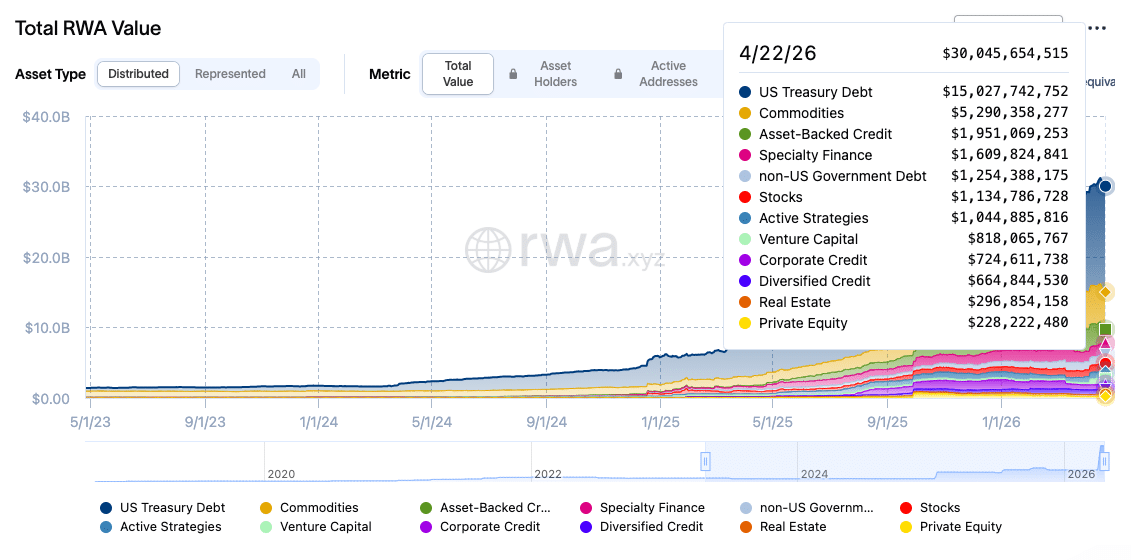
Latest RWA market growth numbers confirm an important change in finance, with tokenized real world assets hitting $30 billion in total market cap. That is a 20x increase in three years and a 238% year-on-year increase due largely to institutional adoption.
Tokenized U.S. Treasury bill funds, which now dominate the sector and have become the main entry way through which capital flows into blockchain-based financial systems.
The latest data indicates that these T-Bills backed products represent over 50% of the entire RWA market.
RWA Market Growth Increases With Institutional-Driven Expansion
The pace of RWA market growth has been nothing short of remarkable; RWA actually grew to become a giant industry in the blink of an eye.
According to market data, the size of tokenized RWAs grew from about $1.5 billion around early 2023 and reached more than $30 billion as of April 2026. This increase is driven by a steady flow of capital into RWA tokens and infrastructure development surrounding these instruments.
Unlike previous crypto cycles, this growth isn’t being fueled by speculation on a retail level but instead by institutional-grade products. Financial firms are tokenizing everything from government debt to private credit and commodities, creating a parallel financial system that runs together with the regular one.
Active RWA market cap sits around $26 billion, close to total on-chain valuation; DeFi-related total locked value (TVL) is around $2.38 billion; Open interest in RWA derivatives activity is nearing $2 billion.
U.S. Treasury Bill Fund Driven RWA Market Structure
A notable characteristic in RWA market growth today is how tokenized U.S. Treasury bill funds represent a massive proportion of the RWA market in total.
This product alone accounts for around $16 billion of market value, the largest segment by a wide margin.
Other asset classes are smaller with Precious metals at approximately $5.8 billion; Private credit, tokenized equities and Real estate all less than $2.3B.
Treasury products offer Less risk since it is government supported; Short-term maturity structures and Predictable yield profiles.
In fact, recent figures reveal that within the first half of 2023 alone, tokenized U.S. Treasuries grew from $380 million to a staggering $13.4 billion by 2026, and this growth makes it one of the fastest-expanding segments across all of crypto.
This concentration means that institutions are focusing on capital preservation and yield not merely speculative exposure when entering tokenized markets.
Major Issuers Compete for Dominance in Tokenized Treasury Space
The race to capture value within RWA market growth is being led by a small group of dominant issuers.
Circle is a worthy issuer in the space, with its tokenized Treasury product now comprising about $3 billion of the market share.
Close competitors include:
BlackRock, whose BUIDL fund has quickly grown into one of the largest tokenized Treasury instruments. Franklin Templeton expanding its on-chain fund offerings. Ondo Finance, with multi-billion-dollar tokenized yield products. Centrifuge, which is targeted towards private credit and structured finance
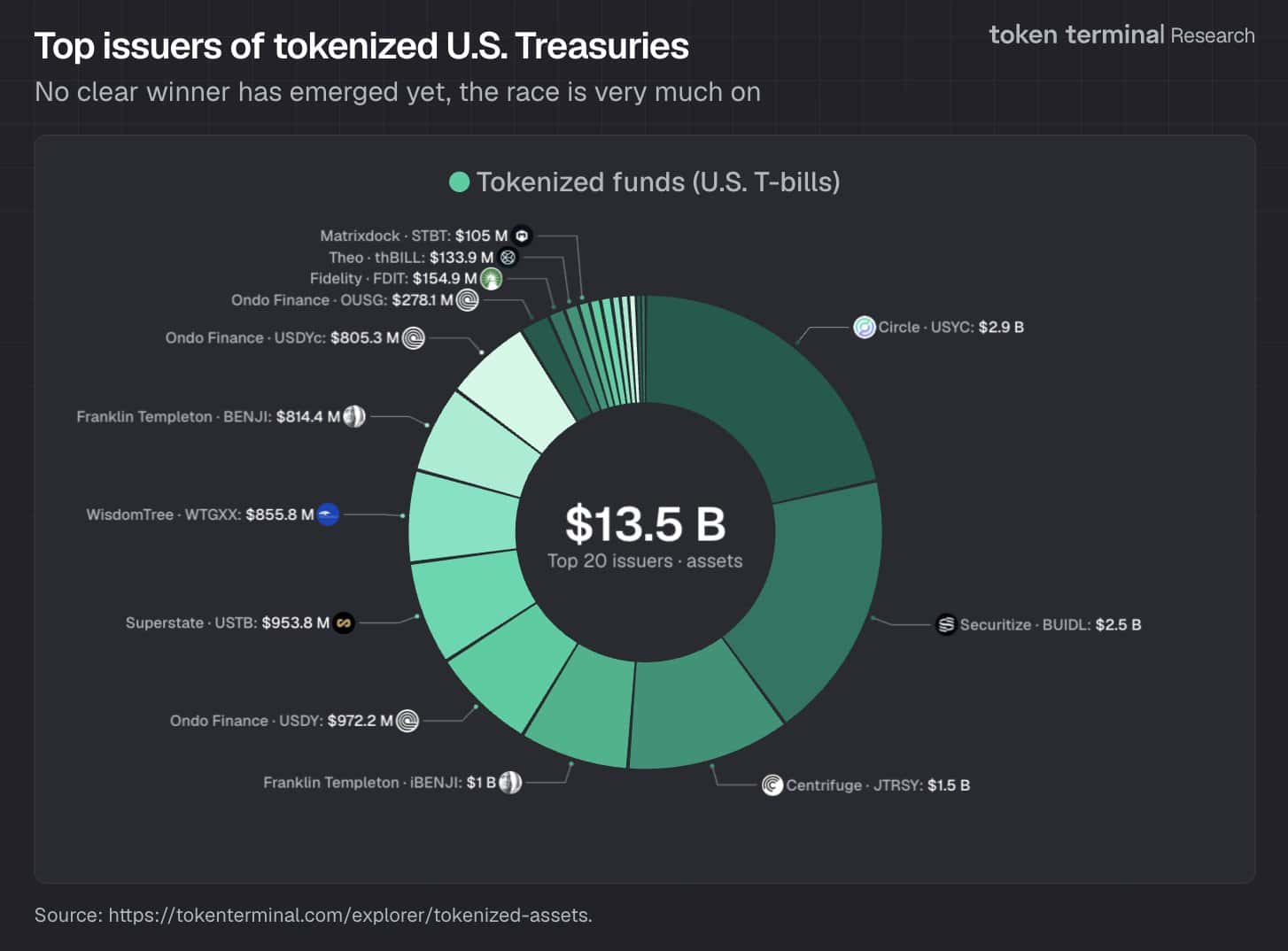
Data shows that the gap between top issuers remains relatively narrow, suggesting that no single firm has established full dominance yet.
It is this competitive environment that is speeding up quality improvements through efficiency, accessibility and compliance of tokenized products.
According to recent data, tokenized Treasury products offer yields around 3.5% on average, making them more attractive than non-yield-bearing crypto assets.
Conclusion
The RWA market growth has exceeded $29B and it continues to grow at a rapid pace. Now tokenization is becoming a strong part of the financial space.
U.S. Treasury bill funds have emerged at the forefront, because they uniquely offer institutional investors the characteristics of safety, yield and efficiency.
With ongoing competition between issuers, and more assets moving on-chain, the RWA sector is expected to go much further beyond its current focus on government debt into more asset classes.
Glossary
RWA (Real-World Asset): Traditional financial assets tokenized on blockchain.
Tokenization: The process of representing real assets in blockchain as digital tokens
Treasury bills: short-term government debt securities
TVL (Total Value Locked): the capital deposited in DeFi protocols.
Open interest: The number of active derivative contracts in a market
Frequently Asked Questions About RWA Market Growth
What is driving RWA market growth in 2026?
The main catalysts are institutional adoption and the tokenization of assets such as U.S. Treasuries.
Why are Treasury bill funds so dominant?
They promise low risk, relatively stable returns and are extremely compatible with blockchain technology systems.
How big is the RWA market now?
It has surpassed $29 billion in total value.
Who are the top issuers?
These are the top issuers in the market today: Circle, BlackRock, Franklin Templeton, Ondo Finance and Centrifuge.
References