
In December 2025, the hunt for on-chain income looks very different from the wild summers of early DeFi. Total value locked in decentralized protocols has dropped sharply since October, down to roughly the low $120 billion range, after wiping out more than $50 billion of capital in just a few weeks.
For many investors, yield farming is no longer a casino, but a structured part of a broader portfolio.
At the same time, capital has become more selective. Ethereum still dominates DeFi liquidity, with Solana, BNB Chain and a handful of other networks competing for the rest of the pie.
Stablecoins now sit at the center of this ecosystem, representing around 40% of DeFi TVL and more than $280 billion in market value across chains.
That backdrop matters because it shapes which strategies are actually sustainable rather than short-lived fads.
This guide walks through the most relevant approaches for December 2025, using live data and recent research, and focuses on risk as much as reward.
Where real yields stand in December 2025
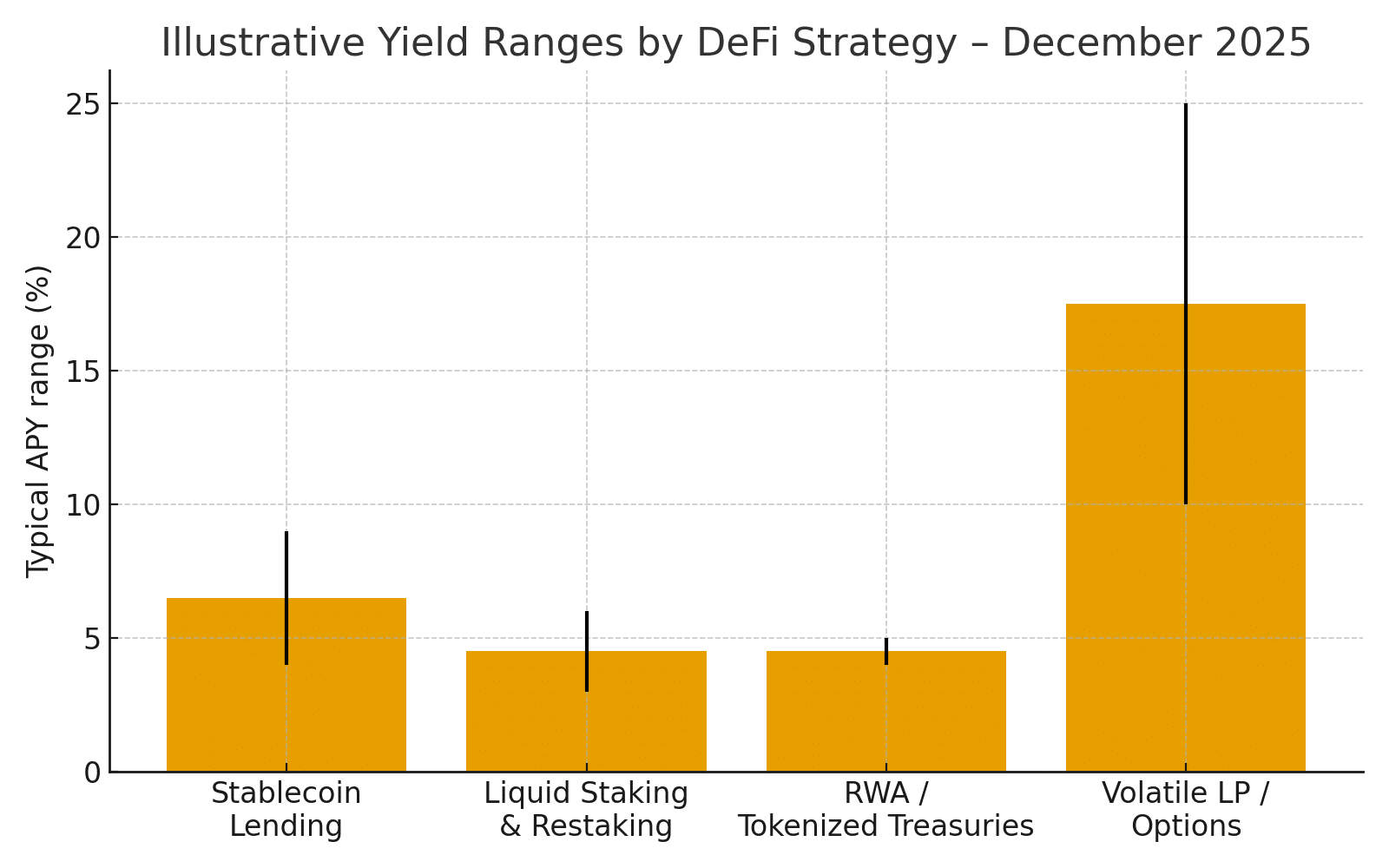
The easy double-digit yields of earlier cycles have mostly compressed. Recent research on onchain income shows that lending yields on major stablecoins such as USDC generally range between about 4% and 9%, depending on protocol, lockup, and risk profile.
Onchain cash products that effectively hold short-term Treasuries now offer only a small premium over traditional money markets, often a spread of a few dozen basis points.
This is the new baseline. Any strategy that promises 25% or more for long periods without explaining where the extra return comes from deserves extra skepticism. Some niche platforms still advertise 20% to 30% annual returns, but these usually involve higher smart contract risk, thin liquidity, or complex token incentives that may not last.
In this environment, the core of yield farming in 2025 is about stacking relatively modest, transparent yields rather than chasing the loudest headline APR.
Strategy 1: Stablecoin lending as the new on-chain savings layer
The first anchor strategy is simple: lend high-quality stablecoins on established protocols that have survived multiple market cycles and audits. For many market participants, this is now the foundation of yield farming, because it turns idle stablecoin balances into steady income without exposure to token price swings.
The path is straightforward. An investor holds dollar-pegged assets, deposits them into a lending market or a conservative liquidity pool, and collects interest paid by borrowers or trading flows. In 2025, the better platforms will integrate additional safeguards such as real-time risk dashboards, circuit breakers, and insurance options to limit fallout from sudden liquidations.
The key indicators here are not only APY, but also protocol age, audit history, on-chain governance participation, collateral quality, and share of TVL held in stablecoins. A pool paying 5% on USDC, backed by over-collateralized loans and deep liquidity, is often healthier than an obscure farm advertising 18% with thin onchain activity and no track record.
For conservative investors, this version of yield farming acts like a crypto-native savings account, with clear trade-offs spelled out in the documentation rather than hidden in marketing slogans.
Strategy 2: Liquid staking and restaking as a layered income play
The second major theme in December 2025 is layered income on staked ETH and similar assets. Liquid staking tokens (LSTs) allow holders to earn base staking rewards while keeping a transferable token that can be used across DeFi. Restaking platforms then add another layer by using those same assets to secure additional services.
Throughout 2025, restaking protocols grew into a multibillion-dollar niche, with some estimates placing peak TVL above $18 billion before a series of repricings and security scares pushed the figure down sharply.
That roller coaster highlighted both the promise and the fragility of this segment.
A balanced approach in this area treats yield from LSTs as the base, and any restaking incentives as a bonus that must be sized carefully. An investor might keep part of their ETH in simple liquid staking and allocate only a limited slice into restaking vaults. This keeps exposure to core network rewards while avoiding full reliance on experimental slashing conditions or unproven AVS (actively validated services) designs.
For many sophisticated participants, this is now one of the most attractive forms of yield farming, but it remains suitable only for those who understand smart contract risk and complex incentive structures.

Strategy 3: Real-world assets and tokenized Treasuries
The third pillar is the rise of real-world asset (RWA) protocols that tokenize short-term government debt and high-quality credit. In 2025, tokenized Treasuries and yield-bearing stablecoins became a serious competitor to bank deposits, as traditional investors moved into onchain products that mirror regulated money market funds.
These products typically hold T-bills or repos in the background and pass the income through to token holders. The yield looks modest, but the risk profile is closer to conventional fixed income, with the added benefit of 24/7 settlement and composability with DeFi.
From a strategy point of view, an investor can treat RWA tokens as a base layer, then deploy part of that collateral into carefully chosen DeFi positions. The goal is not to multiply risk, but to let traditional fixed-income returns feed into a broader on-chain portfolio. Here, the essence of yield farming lies in combining tokenized off-chain cash flows with onchain liquidity tools, while respecting the regulatory and custody nuances of each issuer.
Strategy 4: Selective volatile-asset liquidity and options overlays
The fourth approach sits at the higher risk end of the spectrum. It uses liquidity provision in volatile pairs, structured products, or options overlays to extract additional income from price swings in assets such as ETH, SOL, or major DeFi tokens.
After the recent DeFi wipeout, which erased tens of billions of TVL in a single month, many speculative pools have seen rewards fall or token incentives dry up.
However, some blue-chip protocols still offer meaningful trading fee income on large-cap pairs, especially during periods of elevated volatility.
A cautious design here might involve delta-hedged positions, algorithmic range orders, or covered call structures that seek to turn price noise into premium. Compared with previous cycles, investors now tend to demand clearer risk disclosures, historical performance data, and transparent fee splits before committing capital to this style of yield farming.
Security, regulation and risk management are now non-negotiable
Any yield farming plan that ignores security is asking for trouble. Industry data in 2025 shows that DeFi hacks and exploits have reached new highs, with several headline attacks draining hundreds of millions of dollars from under-secured protocols.
This makes risk controls central rather than optional. Serious participants now evaluate:
Smart contract risk, including audit history and bug bounty programs.
Counterparty and governance risk, especially where admin keys or upgrade powers exist.
Liquidity depth and slippage, which affect exit possibilities during stress.
Regulatory posture of key assets, such as stablecoins and staking products.
At the same time, regulators have started to clarify how some staking and stablecoin models will be treated in law, which has encouraged institutional involvement but also raised the bar for compliance and disclosure.
For readers, the practical takeaway is simple. Crypto income strategies now sit firmly inside a YMYL (Your Money or Your Life) realm. Any allocation should be tailored to personal risk tolerance, and this article should be viewed as general education rather than personal investment advice.
How to think about strategy mix in December 2025
There is no single perfect recipe. However, many professionals quietly converge on a layered approach that blends relatively safe onchain cash yields with a smaller allocation to higher-risk experiments.
A possible mental model is:
Use stablecoin lending and tokenized Treasuries as the core.
Add liquid staking as a growth-oriented second layer.
Limit restaking, volatile pairs, and exotic farms to a clearly defined risk bucket.
The unifying idea is that yield farming in 2025 is less about chasing screenshots of triple-digit APR and more about building a resilient stream of onchain income that can survive market drawdowns, regulatory shifts, and protocol shocks.
In that sense, the most valuable skill is not finding the loudest opportunity, but learning to ask careful questions about where each additional percentage point of yield truly comes from.
Conclusion
DeFi in December 2025 is smaller than at previous peaks, but it is also more mature. TVL is lower, incentives are thinner, and retail enthusiasm has cooled, yet the core infrastructure keeps evolving and institutional adoption of onchain cash products continues to grow.
Against that backdrop, the best yield farming strategies right now share a few traits. They rely on transparent revenue sources such as stablecoin lending, staking rewards, and tokenized fixed income. They respect the complexity of restaking and volatile liquidity pools instead of pretending those risks do not exist. They treat security and regulation as first-class design questions rather than afterthoughts.
For investors who approach the space with patience, skepticism, and a clear risk budget, yield farming can still serve as a meaningful source of crypto income. The key is to let data and discipline lead the way, not fear of missing out.
Frequently Asked Questions
Is DeFi yield still competitive compared with traditional finance in late 2025?
In many cases, yes, but the gap has narrowed. Stablecoin lending and tokenized Treasury products often pay only slightly more than traditional money market funds, while higher yields usually involve additional smart contract and market risk.
Which networks dominate DeFi income opportunities now?
Ethereum remains the primary base for high quality protocols, with Solana, BNB Chain and a few newer ecosystems capturing meaningful but smaller slices of TVL and liquidity.
How risky are restaking and liquid staking strategies?
Liquid staking on established validators tends to be relatively moderate in risk, although it still depends on protocol security. Restaking adds another layer of complexity, including slashing conditions and exposure to multiple services, so position sizes are usually kept smaller.
Glossary of key terms
APY: Annual Percentage Yield. A standardized measure of how much interest or reward an investment earns over one year, assuming reinvestment.
DeFi: Decentralized Finance. A network of financial applications that run on public blockchains without traditional intermediaries such as banks or brokers.
TVL: Total Value Locked. The dollar value of assets deposited in a DeFi protocol or ecosystem, often used as a rough indicator of scale and liquidity.
Stablecoin: A crypto asset designed to track the value of a reference such as the US dollar, used as a settlement and savings asset across DeFi.
Liquid staking token (LST): A derivative token received when staking assets such as ETH through a protocol, allowing holders to keep trading and using liquidity while still earning staking rewards.
Restaking: A process where staked assets or LSTs are pledged again to secure additional services or protocols, offering extra rewards in exchange for extra risk.
Real-world asset (RWA) token: A token that represents a claim on off-chain assets, such as government bonds, credit portfolios, or real estate, with income shared onchain.
Impermanent loss: The difference in value between holding tokens in a liquidity pool and simply holding them in a wallet, caused by price changes between assets in the pool.
References/Sources