


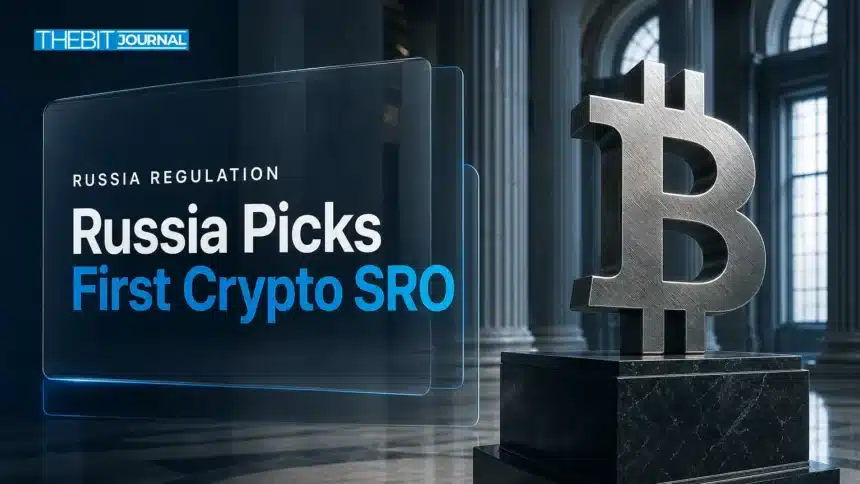

Russia crypto exchanges now have their first self-regulatory overseer. On October 29, 2026, the Bank of Russia granted the National Association of Securities Market Participants (NAUFOR) self-regulatory organization status for crypto exchanges and digital depositories, according to Interfax. Firms on the central bank’s registries have 90 days to join an SRO.
Why it matters
The decision moves Russia’s new crypto law from paper into daily practice, just weeks before big banks plan to open crypto trading to retail clients. It also puts a body whose model was built for stocks and bonds in charge of standards for bitcoin exchanges and custody.
What we know about the NAUFOR decision
NAUFOR isn’t a newcomer. The association has operated since 1996 and counts 725 members, including brokers, dealers and fund managers from traditional markets, as Bitcoin Magazine reported. Earlier in October it won the same status for information system operators.
An SRO writes industry standards, monitors its members and speaks for the sector in front of regulators. A press release published on October 29, cited by The Crypto Times, says NAUFOR will set those standards and check whether registered businesses follow them. The group also says it will press the central bank on rule changes.
The legal basis is Federal Law No. 282-FZ, “On Digital Currencies and Digital Rights.” Coin Gabbar notes that it was signed on August 4, 2026, its core provisions took effect on September 1, and the registration window for exchanges opened on October 5. The regulator can take up to 60 working days to review each application. The law requires operators to sit on central bank registries and to join an SRO.
Which Russia crypto exchanges have to join
Interfax, via Bitcoin Magazine, counts 23 crypto exchanges and eight digital depositories on the registries, including VTB, Sberbank and units of T-Technologies, the holding behind T-Bank. The first batch, approved on October 6, added five depositories and four exchanges, CryptoPotato reported, with Sberbank among the custodians and VTB listed in both categories.

What is still unclear
The headcount isn’t settled. DL News reported 17 firms on the exchange register by October 22, while Interfax now cites 23. The gap likely reflects approvals since then, but the reports available to us don’t include a full list.
It’s also not clear whether other associations will apply for SRO status, or whether NAUFOR will be the only option before the 90-day deadline. And the rulebook may not be finished. On September 21, First Deputy Governor Vladimir Chistyukhin said regulators were completing 27 implementing acts, seven primary and 20 secondary, according to KuCoin.
Self-custody is a key open question for users. Depositories would record holdings, and Bitcoin Magazine points out that one reading of the framework lets them restrict transfers to personal wallets. How strictly that is applied will shape how much control buyers keep over their coins.
How markets and media reacted
There is no sign in the data that the decision moved prices. Bitcoin traded at $81,660 at 16:13 UTC on October 29, up 1.45% over 24 hours, according to CoinGecko. The Crypto Fear and Greed Index read 51, “Neutral,” on the same day.
| Asset | Price (Oct 29, 16:13 UTC) | 24h change | 1-year change |
|---|---|---|---|
| Bitcoin (BTC) | $81,660 | +1.45% | -27.36% |
| Ethereum (ETH) | $2,367.37 | +1.54% | -40.66% |
| XRP | $1.31 | -0.08% | -50.47% |
Coverage focused on control rather than price. Bitcoin Magazine argued that placing a body built for stocks and bonds over bitcoin exchanges and custody “gives the state a familiar hand on the wheel.” The Crypto Times framed it as a tightening of oversight. CryptoPotato’s headline drew a contrast with the United States, saying America’s CLARITY stalls while Russia’s crypto market gets official operators.
What the rules mean for investors using Russia crypto exchanges
The framework is about trading, not spending. Using crypto to pay for goods and services stays banned, as Cointelegraph reported on TradingView. Bitcoin Magazine adds that the law opens a state-supervised channel for cross-border trade, a route that helps Russia work around Western sanctions.
Purchase caps on Russia crypto exchanges
Non-qualified retail buyers can spend up to 300,000 rubles a year through a single intermediary, roughly $3,800 by Bitcoin Magazine’s estimate. Reports differ on qualified investors: DL News says they have no cap, while Bitcoin Magazine describes higher ceilings. VTB plans to open retail crypto trading in November and Sberbank is aiming for December 1. TASS reported on October 8 that the Moscow Exchange plans to launch crypto trading on December 1 using its existing trading system.
A licensed platform doesn’t remove market risk. Bitcoin is still down 27.36% over a year and far below its $126,080 peak from October 2025, and crypto prices can fall sharply or go to zero. Holding coins with a custodian adds platform risk, and transfer limits could restrict withdrawals. Sanctions exposure may also matter for foreign users. Tax and legal treatment differs by country, so readers should check with a qualified professional.
Watch the 90-day deadline, the remaining implementing acts and how the first retail launches handle wallet withdrawals.
Bottom line
With NAUFOR approved, Russia crypto exchanges now have a self-regulator in place ahead of the planned November and December retail launches. Whether the system feels open or tightly fenced will depend on the remaining implementing acts and on how personal wallet transfers are treated.
Sources
- Russia Approves Securities Group to Oversee Crypto Exchanges (Bitcoin Magazine)
- Russia Moves to Tighten Crypto Oversight as NAUFOR Gets SRO Status (www.cryptotimes.io)
- Russia Crypto News: Bank Opens First Exchange License Window Oct 5 (www.coingabbar.com)
- Russia clears first crypto exchanges, custodians under new law, TradingView News (www.tradingview.com)
- While America's CLARITY Stalls, Russia's Crypto Market Gets Official Operators (cryptopotato.com)
- Bank of Russia clears 17 crypto exchangers as Sberbank and VTB ready retail trading – DL News (www.dlnews.com)
- Russia Crypto Regulation 2026: Bank of Russia Plans Fully Regulated Crypto Market Rollout Before Year-End | KuCoin (www.kucoin.com)
This article is for informational purposes only and does not constitute financial or investment advice. Cryptocurrencies are highly volatile; always do your own research before investing.