
This article was first published on The Bit Journal.
On-chain monitors have noted that a large holder has sent 100,000 SOL tokens worth about $13.57 million, to a centralized exchange.
This raises red flag for increasing sell-pressure on Solana (SOL) and speculation that long-term holders are becoming wary of the existing price range.
With $SOL trading around the $130s after being rejected around $146, this dump comes at a precarious time for the token.
The 100,000 SOL Transfer: What is Known
According to data cited by EmberCN, aggregated through analytics firm Arkham Intelligence, the whale’s wallet moved exactly 100,000 SOL, approximately $13.57 million worth, to exchange wallets presumably Binance over a short period of time.
This is the latest in a series of transfers, as the whale has transferred 615k SOL (worth roughly $107 million) from the initial stake unlocked since April 2025 back to exchanges.
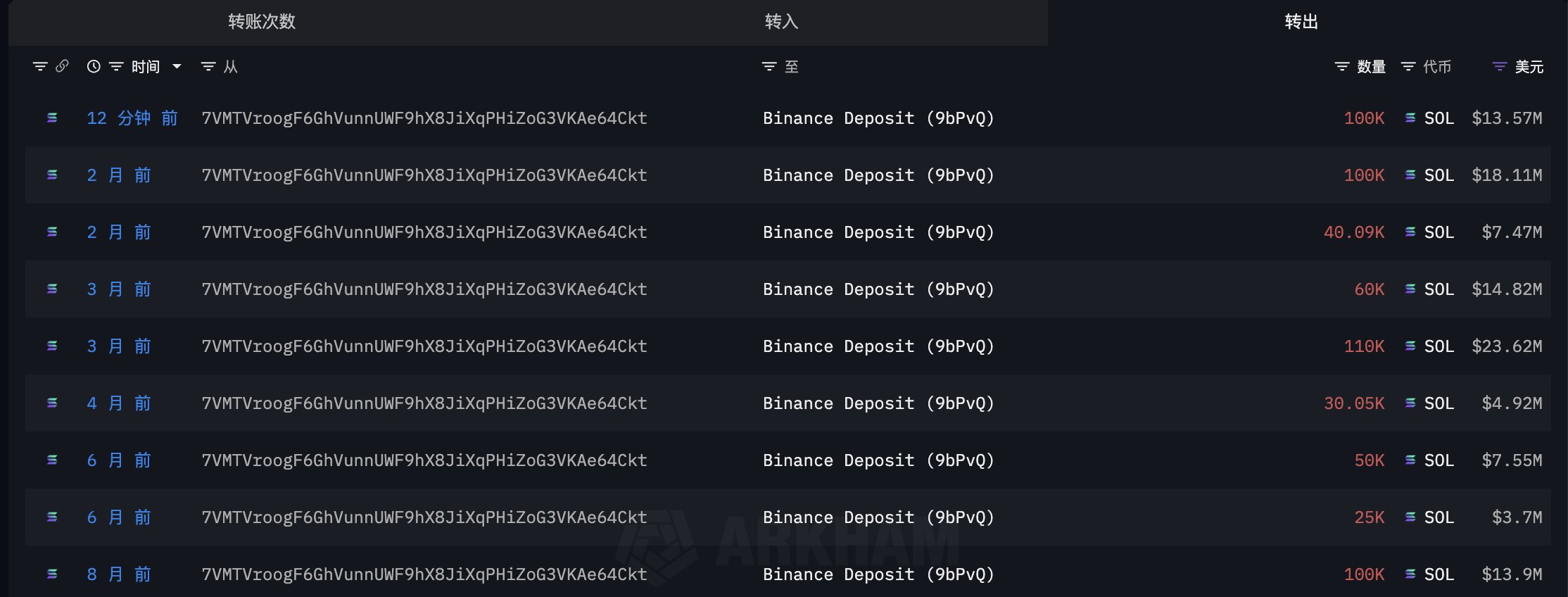
Even with those moves, it is reported that this whale still has 733,000 SOL and has earned itself a total of 357,000 SOL in staking rewards over approximately 4.5 years.
Market-wide statistics also show heavy inflows to exchanges for SOL. As the latest news goes, overall net flow turned positive (more SOL entering exchanges than leaving), a model that is habitually accompanied by selling pressure.
What Past Behavior Reveals: Whale’s History
This whale is not new to moving vast sums of SOL. In April 2025, blockchain analytics firm Lookonchain reported that the address had unstaked 100,000 SOL, which was worth roughly $13.9 million at the time, and transferred funds back to Binance.
At one point, reports claimed the whale still possessed over a million SOL with significant staking returns.
These ongoing transfers since April totaling 615,000 SOL sent to exchanges, suggest this isn’t just opportunistic selling but perhaps something more structured in terms of a sell-off, or profit-taking after holding for years.
The magnitude of these liquidations, over a period of months, also suggests that the whale is steadily turning big holdings into cash or other assets, which often spooks traders.
Price Action And Exchange Flow: Market Background
Roughly at the time of said transfer, SOL was trading within a narrow range from $130 to $140, having seen rejection near $146 quite recently.
Meanwhile, exchange netflow data has turned positive, demonstrating that more tokens are flowing to exchanges than they’re being withdrawn.
Positive netflow tends to coincide with price drops, as they become capable of being sold more easily in the future.
Some analysts have warned that $SOL could succumb to support levels around $126-$130 if the selling spree persists.
On the other hand, a bounce would need an increase in buy volume to counter supply.
What it Means to Solana
Big whale dumping, particularly those amounting to hundreds of thousands of SOL, can send shocks across the Solana ecosystem. In the eyes of institutional investors, traders, and individual smaller holders, such moves are often read as a lack of confidence or a change in sentiment.
While SOL adoption, smart contract activity and protocol usage may still be strong, price fallout from heavy withdrawals to exchanges can bear down on market sentiment.
This could, eventually, have an impact on staking decisions, development funding, and the perception of Solana’s mid-term value.
Also, repetitive large transfers originating from the same address may indicate distribution of previously locked-solutions tokens or holdings being liquidated in a systemic manner, not just one-off trades, possibly impacting how ecosystem stakeholders strategize around network expansion and source of token dynamics.
Is This More Profit Taking Than Panic?
Some data indicate that the whale could be enacting a premeditated profit-taking strategy rather than panic selling.
The fact that the whale unlocked its holdings in April and has been gradually liquidating over several months, could suggest longer-term planning than a sudden capitulation.
$SOL also just experienced inflows of institutional interest from smaller whales and funds collecting tens of thousands of $SOL, suggesting not all large holders are leaving.
Still, even planned profits can weigh on prices whenever large volumes arrive on exchanges, especially if demand isn’t there to support that increased supply.
Conclusion
A major outflow of 100,000 SOL ( $13.57M) to exchanges has been recorded in a trend towards profit-taking by long-term participants.
Even though the wallet still has plenty of $SOL in it, its sales since April totaling 615k SOL ($107M) doesn’t help market sentiment.
As exchange netflows increase, the risk for more downward pressure in $SOL price also grows, particularly while trading within a $130-$140 market range.
The wider Solana ecosystem could still be seen as technically active, although whales are acting tentatively from a token-market standpoint.
Glossary
Staking: The act of locking up tokens in order to contribute to the network and be rewarded.
Netflow: The net amount of tokens coming in and out of exchanges over a period of time. Positive netflow indicates more flow of tokens to exchanges (potential sell pressure), negative netflow indicates more tokens exit exchanges (this effect could be considered buy pressure).
Whale: Someone or some entity that holds a large quantity of a specific cryptocurrency, their trades can cause the market to become more bullish or bearish on that currency.
Unlock: When locked or staked tokens become tradable or investment.
Profit-taking: Selling to realize gains after an asset’s price has risen for a period.
Exchange inflow: The amount of cryptocurrency tokens that are transferred into exchange wallets — typically as a precursor for trading or selling.
Frequently Asked Questions About Solana Whale Sell-off
Does one whale dumping 100k SOL immediately tank the price?
Not necessarily. Price impact is a function of demand for buyers. If liquidity is ample and there are other investors to step in, the impact could be dampened.
Is this transfer for something other than selling such as staking or institutional movement?
Data shows tokens transferred to exchange wallets, a behavior consistent with dumping. There have been no public reports the funds were re-staked, or moved to a cold wallet.
Is this killing Solana?
No. Although selling pressure could put downward pressure on price in the short term, network fundamentals, alongside smart contracts, DeFi activity and dApp usage are isolated from token transfers.
Could a new whale come and buy the dumped $SOL to maintain price?
Yes. Price pressure, might be alleviated if buyers ranging from whales to smaller holders step in and soak up supply. On-chain transparency allows for this sort of re-accumulation.
References
AMBCrypto
Blockchain News
Cointelegraph
MEXC
CryptoNews