












Which are the best programming languages a serious Web3 team should learn first? Start with evidence, not vibes. Electric Capital’s latest developer study examined open-source crypto activity at scale and counted 39,148 new developers exploring crypto in 2024, with Solana attracting the highest share of new devs, while the EVM stack remains the largest by overall activity, explaining why Solidity, Rust, TypeScript, and Python dominate practical stacks.
Outside crypto, hiring supply and community gravity still steer decisions. The 2024 Stack Overflow Developer Survey again shows JavaScript on top for usage and Rust as the most-admired language two currents you’ll feel when staffing dapps, wallets, bots, and clients. Below, each language gets a concise rationale, a few must-know ecosystem notes, and crisp pros/cons. No filler, just the trade-offs that move shipping dates (and audits) in your favor.
What Is a Programming Language?

A programming language is a formal system for telling computers exactly what to do. It defines:
- Syntax: how you write instructions (keywords, punctuation, structure).
- Semantics: what those instructions mean at runtime (state changes, data flow).
- Tooling & Ecosystem: compilers/interpreters, package managers, linters, debuggers, and libraries that turn ideas into working software.
In practice, a language is both the grammar you type and the ecosystem that makes code buildable, testable, and maintainable. When teams discuss the best programming languages, they’re also weighing the reliability of compilers, the maturity of libraries, audit support, documentation, and the size/quality of the developer community.
Why Programming Languages Matter in Blockchain
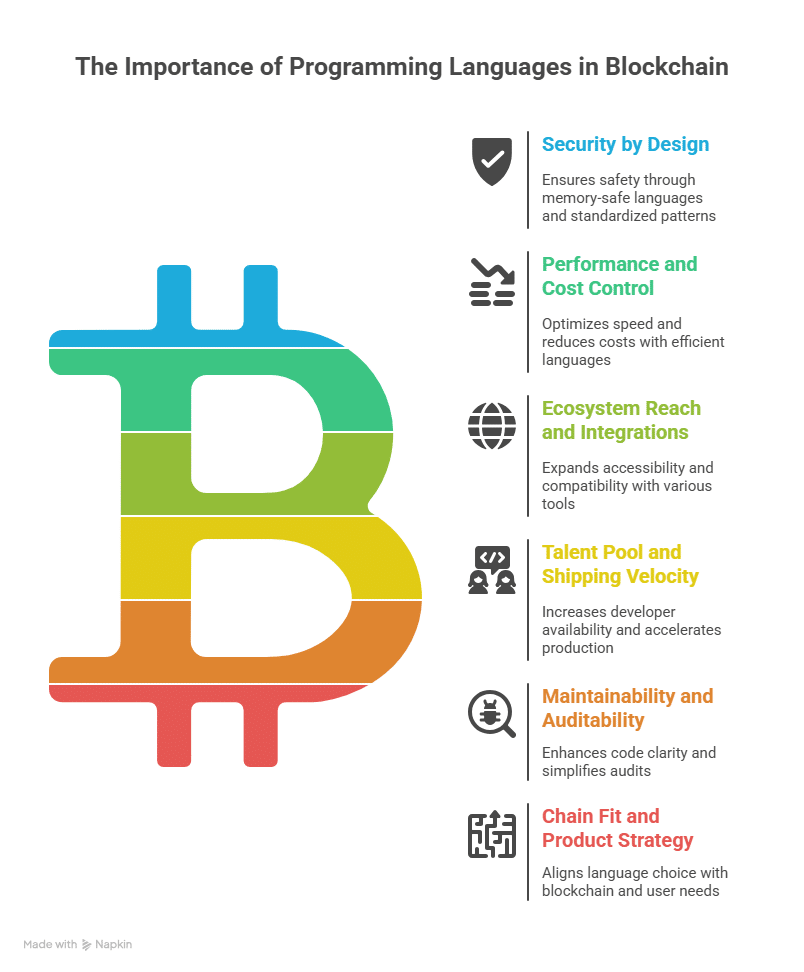
Security by Design
Languages aren’t just syntax; they’re safety rails. Memory-safe and resource-oriented options (Rust, Move, Cadence) remove entire classes of bugs before runtime. Mature EVM stacks (Solidity with OpenZeppelin, Foundry, Slither) standardize battle-tested patterns. Safer defaults mean fewer exploits and calmer incident channels.
Performance and Cost Control
At the protocol and client layer, milliseconds are money. Systems languages like Rust and C++ deliver tight control over memory and CPU, which lowers latency and helps keep transaction costs in check. Faster code translates into smoother UX and fewer abandoned flows.
Ecosystem Reach and Integrations
Picking from the best programming languages is also picking your distribution. Solidity taps ERC standards and a vast universe of wallets, exchanges, and tooling. TypeScript/JavaScript connects apps to nodes (ethers.js, web3.js), turning contracts into usable products. Better alignment equals easier integrations and wider reach.
Talent Pool and Shipping Velocity
Popular general-purpose stacks (TypeScript, Python, Go, Java) expand hiring options and reduce onboarding time. When more developers already know the tools, front ends, bots, indexers, and internal services move from ticket to production faster.
Maintainability and Auditability
Strong typing, consistent compilers, and mature toolchains yield cleaner diffs and reproducible builds. That clarity shortens audits, de-risks upgrades, and prevents the “works on my machine” shuffle—crucial when your code is public and immutable.
Chain Fit and Product Strategy
Different chains reward different choices: Solidity dominates EVM contracts; Rust anchors Solana programs and many clients; Move and Cadence encode asset rules in the type system; Go/Java pair naturally with Hyperledger Fabric. The “best” language is the one that matches your chain, your risk profile, and your users—so the technology serves the product, not the other way around.
The 10 Best Programming Languages for Blockchain Development
Here’s the list: clean, skimmable, and ready to act on.
1) Solidity
Solidity remains the gravitational center of on-chain logic across Ethereum and EVM networks. It compiles to the EVM, draws on ERC standards for predictable integrations, and enjoys the widest audit and tooling market (Foundry, Hardhat, OpenZeppelin). The syntax borrows from C++/Python/JS, and the docs explicitly state that the language is designed to target the EVM.
Pros
- Unmatched reach across wallets, exchanges, and L2s via ERC standards.
- Deep toolchain and audit ecosystem; abundant sample code and templates.
- Strong developer mindshare; fast path from prototype to integrations.
Cons
- Common pitfalls: upgrade safety, reentrancy, and access control; requires rigorous testing and analysis.
- Ecosystem maturity can breed complacency, security hygiene is non-negotiable.
2) Rust
Rust’s ownership model and zero-cost abstractions eliminate entire classes of memory errors while delivering speed. It is the primary language for Solana programs; Anchor smooths account handling and reduces boilerplate. Rust also powers many client and validator components across chains.
Pros
- Compile-time guarantees that reduce runtime surprises; excellent performance.
- Strong package tooling (Cargo), robust testing culture, thriving systems community.
- First-class for Solana programs; good fit for client/node work elsewhere.
Cons
- Steeper learning curve and heavier compile times than scripting languages.
- Smaller general hiring pool than JS/Python; onboarding needs intention.
3) TypeScript / JavaScript
The front door to nearly every dapp is a web or mobile UI; TS/JS is the universal adapter for wallets, dashboards, bots, and services. Libraries like ethers.js and web3.js provide stable RPC interfaces, while frameworks (Next.js, React) speed iteration.
Pros
- Massive talent pool; fast shipping on the app/integration layer.
- Mature libraries for EVM interaction; strong ecosystem for testing and CI.
- TypeScript’s static types reduce integration bugs across ABI boundaries.
Cons
- Dependency sprawl; version churn demands lockfiles, CI discipline, and careful upgrades.
- Runtime errors can slip through without strict type and lint rules.
4) Python
Python excels “around” the chain—analytics, ETL, risk monitoring, treasury reconciliation, research notebooks, and quick automation. web3.py covers core Ethereum interactions; pandas/NumPy empower dashboards and reports.
Pros
- Rapid prototyping with a rich data stack; easy to read and review.
- Great for bots, alerts, and analytics pipelines that pull from RPC and subgraphs.
- Strong ecosystem for ML-adjacent fraud/risk detection experiments.
Cons
- Not ideal for hot paths (validators/clients); keep it off latency-critical execution.
- Mixed packaging environments can complicate reproducibility if unmanaged.
5) Go
Go is a natural fit for long-running services, gateways, and clients. Geth—one of the most widely used Ethereum clients—is written in Go, and the language’s simple concurrency model makes node tools, indexers, and relayers approachable and maintainable.
Pros
- Single-binary deploys, straightforward concurrency, strong standard library.
- Proven in production clients; easy to instrument and operate.
- Popular with infra/SRE teams; smooth handoffs to ops.
Cons
- Intentional minimalism at the type system level; some patterns require extra ceremony.
- Generics exist but aren’t a full replacement for advanced type modeling.
6) Java
For organizations living on the JVM, Java delivers predictable ops, mature security libraries, and long-tenured talent. In permissioned settings, Hyperledger Fabric supports smart contracts (chaincode) in Java, Go, and Node.js, with official SDKs and contract APIs.
Pros
- Enterprise-grade frameworks (Spring/Quarkus), structured CI/CD, and observability.
- First-class Fabric support; good fit for regulated B2B workflows.
- Large hiring pool in enterprise contexts.
Cons
- More ceremony than JS/Python; slower prototypes for small greenfield teams.
- JVM policies may add governance overhead for startups.
7) Move (Aptos, Sui)
Move models digital assets as first-class resources, enforcing scarcity and ownership at the bytecode/type level. That design prevents entire classes of token mishandling bugs by construction. Aptos and Sui maintain strong docs, and the Move Prover/formal tools continue to evolve.
Pros
- Resource semantics, capability-based access control, clearer asset safety story.
- Modern language ergonomics; growing learning materials from both ecosystems.
- Strong conceptual fit for asset-centric apps and custody-sensitive logic.
Cons
- Smaller ecosystem and exchange/tooling breadth compared to EVM.
- Hiring market is narrower; training ramps are required.
8) Cadence (Flow)
Cadence brings the resource-oriented idea to Flow, emphasizing safety and readability for consumer-grade apps (collectibles, gaming, brand activations). The docs and Flow Playground make onboarding approachable for cross-functional teams.
Pros
- Resource types and guardrails reduce common smart-contract errors.
- Accessible syntax; good for teams focused on consumer UX.
- Official tools that flatten early learning curves.
Cons
- Smaller ecosystem than EVM/Solana; limited portability across chains.
- Hiring market is specialized; plan for targeted recruiting.
9) C++
C++ remains the go-to for protocol engines, cryptographic primitives, and performance-critical components, including Bitcoin Core and many zero-knowledge libraries. The language offers tight control over memory and CPU—useful when every microsecond matters.
Pros
- Deterministic performance; mature compilers and profiling tools.
- Deep ecosystem for crypto and systems programming.
Cons
- Memory safety is on you; audits and testing must be relentless.
- Longer development cycles and higher expertise requirements.
10) Haskell / Plutus (Cardano)
Cardano’s Plutus leans on Haskell’s strong types and functional purity, enabling high-assurance financial logic and formal verification pathways. It rewards teams that prioritize correctness and can invest in functional engineering culture.
Pros
- Strong invariants; powerful reasoning about contract behavior.
- Clear fit for mission-critical financial agreements.
Cons
- Steep learning curve; smaller hiring market and fewer off-the-shelf templates.
- Tool familiarity varies; requires patient onboarding.
Choosing Among the Best Programming Languages (fast criteria)
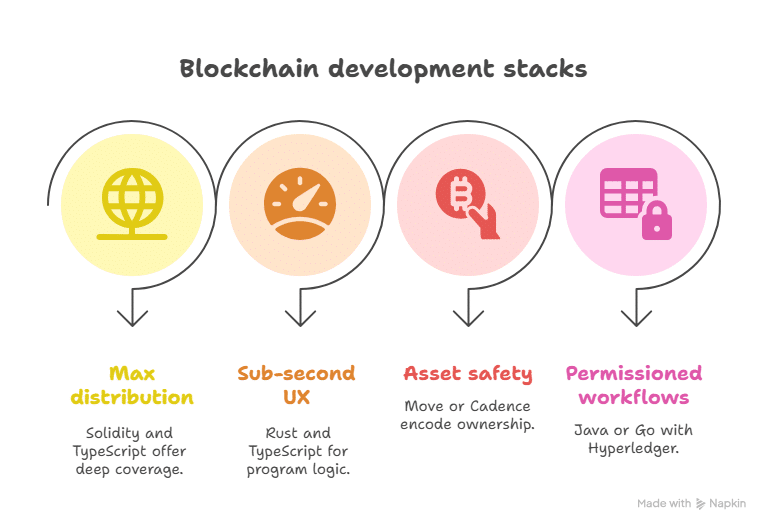
- Max distribution and integrations: Solidity for contracts + TypeScript for apps; deepest wallet/DEX/audit coverage.
- Sub-second UX and low fees: Rust on Solana (with Anchor) for program-heavy logic; TS for front-ends.
- Asset safety by design: Move on Aptos/Sui or Cadence on Flow; resource semantics encode scarcity and ownership.
- Permissioned enterprise workflows: Java or Go with Hyperledger Fabric plus TS portals.
- Protocol/ZK internals: C++ (often alongside Rust) for predictable performance envelopes.
Comparison Snapshot (one-glance recall)
| Language | Ecosystem signal | Canonical docs / anchors |
| Solidity | EVM center of gravity; ERC standards | Solidity docs (targets EVM) |
| Rust | Solana programs; high-perf clients | Solana “Programs in Rust”; Anchor |
| TypeScript/JS | Ubiquitous app/wallet/bot layer | ethers.js; web3.js |
| Python | Analytics, ETL, ops automation | web3.py docs |
| Go | Production clients/services (Geth) | Geth docs; repo |
| Java | Enterprise chaincode on Fabric | Fabric SDK/chaincode docs |
| Move | Resource semantics (Aptos/Sui) | Aptos Move book; Sui concepts |
| Cadence | Flow consumer apps | Cadence docs; Flow page |
| C++ | Protocol/crypto performance | (Core client/library docs per project) |
| Haskell/Plutus | High-assurance Cardano | (Plutus/IOG references) |
Conclusion
Builders choose from many blockchain programming languages with real tradeoffs today. The best programming languages for blockchain development depend on goals and constraints. Rust wins speed with safety for programs and nodes that must scale hard. Move wins safer asset handling with resource types that prevent common bugs.
Other stacks serve special cases across consumer apps and Bitcoin anchored flows. Leads should align stacks with hiring plans, audits, and roadmap clarity. Teams should test early, review often, and measure risks with honest metrics. Great choices keep users safe while shipping features that move value forward. Smart selections today reduce incidents tomorrow and help roadmaps stay on track.
FAQs for Best Programming Languages
What’s the quickest route to a production dapp today?
Solidity + TypeScript on an EVM chain. You inherit the widest standards, audit depth, and wallet/DEX coverage, and can ship faster with Foundry/Hardhat + ethers/web3.
Is Rust “more secure” than Solidity?
Rust prevents many memory bugs by design and suits program/client code on high-throughput chains. Solidity’s risk surface is different (auth, state transitions, upgrades), so EVM security depends on patterns, tests, and audits—not just syntax.
Do teams need both TypeScript and Python?
Not mandatory. TS can cover UI, services, and bots; Python shines for analytics, ETL, and monitoring with web3.py. Use both when you have serious data work alongside a fast-moving app layer.
Go or Java for Hyperledger Fabric?
Both are first-class chaincode options (Node.js too). Choose Go for concise services and ops simplicity; choose Java if your enterprise already runs JVM policies and wants contract code to match governance.
Will Move or Cadence replace Solidity soon?
Unlikely near-term. EVM network effects are massive. Move and Cadence win where resource-level guarantees are a feature (custody, consumer assets) and are growing quickly alongside EVM.
Glossary
- EVM: Runtime that executes smart contracts compiled for Ethereum-compatible chains; Solidity explicitly targets it.
- Anchor: Rust framework that streamlines Solana program development and testing.
- ERC-20/721/1155: Token and NFT standards that standardize contract interfaces across EVM.
- RPC: Interface for apps to read chain state and submit transactions.
- Chaincode: Hyperledger Fabric’s name for smart contracts written in Java, Go, or Node.js.
- Resource-oriented programming: Model where assets are first-class resources with enforced ownership/scarcity (Move, Cadence).
Summary
Selecting the best programming languages for blockchain development is a product decision disguised as a tech decision. If distribution and integrations matter most, pair Solidity with TypeScript and ship on the EVM. If your UX lives or dies by latency, invest in Rust (Solana) with Anchor. If you want analytics, bots, and operational glue, add Python. For permissioned B2B workflows, Java or Go on Hyperledger Fabric map cleanly to enterprise constraints. When asset safety itself is the feature, Move (Aptos/Sui) and Cadence (Flow) embed scarcity and ownership into the type system. Keep C++ (and often Rust) for protocol/crypto internals, and reach for Haskell/Plutus where correctness outranks everything. Use the pros/cons above to compress debate into decisions—and decisions into shipped, safer code.