

Last updated: November 20, 2026
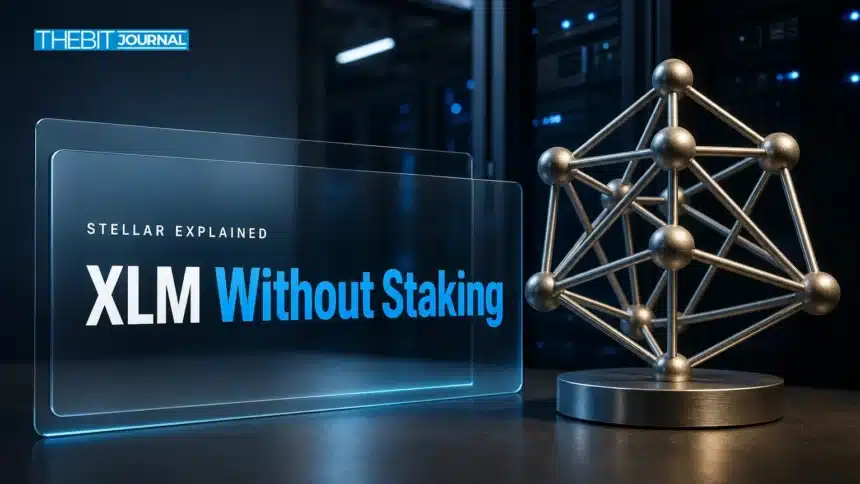
A stellar staking guide needs to start with a clear answer: XLM has no native staking mechanism, so holders can’t earn protocol staking rewards by locking or delegating their tokens. Stellar uses a different consensus system, and any third-party offer described as “XLM staking” involves separate terms and risks.
That distinction matters if you’re comparing networks or assessing a yield offer. This guide explains how Stellar consensus works, what validators receive, and how to tell protocol staking apart from lending or other services.
TL;DR
- Stellar uses the Stellar Consensus Protocol, not proof of stake, and XLM has no native staking rewards.
- Stellar validators don’t receive block rewards, transaction fees, MEV awards, or staking yield.
- Third-party XLM yield offers are separate products. Check their risks, terms, and custody arrangements carefully.
What the stellar staking question really means
On proof-of-stake networks, token holders may stake assets or delegate them to validators under the network’s rules. Stellar works differently. According to the Stellar FAQ, its Stellar Consensus Protocol is a proof-of-agreement system without on-chain financial incentives. XLM isn’t staked to secure the network in the way it is on a proof-of-stake chain.
So, “Can you stake Stellar?” has two answers depending on what someone means. At protocol level, no: there’s no native XLM staking or reward schedule. A company may use the word “staking” for an external product, but that doesn’t make it a Stellar network feature.
How stellar staking differs from validator participation
Stellar validators help the network reach agreement on transactions and ledger updates. But running a validator isn’t an income strategy built into the protocol. Stellar’s explanation of why institutions become validators says they receive no block rewards, staking yield, MEV awards, or share of transaction fees.
Holding more XLM, or operating more validators, doesn’t by itself increase a node’s influence, according to Stellar. Validator participation is about supporting network operations, not receiving a payout for locking tokens. That’s the key difference between validation on Stellar and staking on a proof-of-stake network.

Why Stellar doesn’t pay XLM staking rewards
Stellar’s consensus model doesn’t distribute new tokens to validators as staking rewards. The network’s fee design also doesn’t create a passive payout for XLM holders. Stellar says its validators deprecated the inflation operation when Protocol 12 was adopted on October 28, 2019. Network fees go to a fee pool and remain there instead of being distributed to validators or holders.
That means there’s no native reward rate to compare, no protocol staking lockup to plan around, and no standard Stellar unstaking period. Those details can still apply to a third-party service, however, so the provider’s own terms matter. A platform’s quoted yield is not a return paid or promised by Stellar.
Staking, lending, and “earn” products aren’t the same
A third-party service might lend XLM, use it in a financial product, or offer a promotional yield. Those arrangements carry risks that protocol staking doesn’t describe, including the provider’s ability to repay, custody or exchange failure, withdrawal limits, and changing rates. Smart contract risk may also matter if the product uses on-chain contracts.
Stellar’s Q3 2026 institutional-finance report describes borrowing against tokenized assets through Templar and STBL. That is an ecosystem lending use case, not protocol-level XLM staking. The report also puts Stellar stablecoin supply at $546 million and monthly adjusted stablecoin transfer volume at $2.42 billion as of September 30, 2026. Those activity figures don’t establish that XLM holders earn staking rewards.

What to check before using an XLM yield service
When a product uses “staking” in its name, check what actually happens to the assets. Read whether the service lends or rehypothecates deposits, who controls the keys, how withdrawals work, and whether the advertised rate can change. Also look for information about fees, counterparty exposure, and what happens if the service pauses withdrawals or fails.
These are general due-diligence questions, not a recommendation to use a particular product. Crypto assets can be volatile, and users can lose some or all of their funds through market losses, fraud, exchange or provider failure, or technical vulnerabilities. Rules also differ by country, so readers with tax or legal questions should consult a qualified professional.
For background on the network itself, see our guide to what Stellar is used for. If you’re learning about access and custody, our practical guide to buying and storing Stellar XLM covers related basics.
Pros and cons of the Stellar model
The points below describe what the protocol does and doesn’t offer. They aren’t a comparison of the safety or performance of any third-party yield provider.
| Potential advantages | Limitations |
|---|---|
| No protocol staking lockup or unstaking process for XLM holders to manage. | No native XLM staking rewards or protocol yield. |
| Validator participation supports network agreement without requiring a reward-seeking stake. | Validators receive no block rewards, MEV awards, or share of fees. |
| Network fees are not paid out to validators or holders. | External “earn” products add separate provider, custody, lending, or smart contract risks. |

Who this is and isn’t for
This explanation is useful for XLM holders who want to know whether staking is a native feature, people comparing consensus models, and anyone checking what a yield provider means by “XLM staking.” It can also help separate validator participation from income generation.
This guide does not endorse a product or establish that an outside service is safe. Anyone seeking a specific product’s terms needs to review that provider’s current documentation and risks. The label alone doesn’t tell you whether funds are lent, locked, held in custody, or exposed to smart contracts.
Bottom line
Stellar staking isn’t available as a native XLM protocol feature. Stellar uses proof of agreement rather than proof of stake, and its validators don’t receive staking rewards or transaction fees. Third-party services may offer other ways to generate yield, but those are separate financial arrangements with their own risks, not rewards paid by the Stellar network.
As of November 20, 2026, Stellar’s protocol-upgrade schedule listed a Bell (Protocol 30) mainnet upgrade vote for November 23 at 17:00 UTC. The listed proposed changes include muxed contract addresses, smart-contract verification of post-quantum signatures, and millisecond ledger close-time recording. Check current official information for later protocol changes before relying on this dated snapshot.
Sources
- Stellar FAQ (stellar.org)
- Why institutions choose to become Stellar validators (stellar.org)
- Stellar price and market data (CoinGecko)
This article is for informational purposes only and does not constitute financial or investment advice. Cryptocurrencies are highly volatile; always do your own research before investing.