





The Mastercard Polygon partnership has moved forward in removing traditional wallet addresses, creating an important change in how people might soon handle their digital assets. This development shows that big institutions are becoming more interested in Web3 systems, but the market reaction to Polygon’s token $POL is still not very positive.
Mastercard is now focusing on verified usernames for self-custody wallets, a change meant to make crypto transfers as easy as sending money through normal banking apps. Even though experts see this as a strong technical improvement, traders remain unsure about $POL in the short term because several bearish signals are still pulling the price down.
What is Polygon and what role does POL play in its ecosystem?
Polygon is a decentralized blockchain network built to work with Ethereum. It was created in 2017 by Anurag Arjun, Sandeep Nailwal, Jaynti Kanani, and Mihailo Bjelic. At first, it was called Matic and focused on making Ethereum faster and less crowded by using a Proof of Stake method to validate transactions.
In 2021, it grew into Polygon, a bigger system offering many different solutions to improve Ethereum. The network’s main token is called $POL. It is used for several important jobs such as securing the network, making decisions about its future, and supporting activities like decentralized finance trading, long term staking, NFT transactions, and gaming.
$POL plays a key role in Polygon’s economy. However, the price of $POL can change a lot based on how investors feel about the market.
Why did Mastercard choose Polygon for its username-based transfer system?
Mastercard chose Polygon to run its new transfer system because the blockchain is fast, has low fees, and can handle many transactions at once, which is important for real world payments. With the Mastercard Polygon partnership, the company’s Crypto Credential system now lets users send crypto using verified usernames instead of long and complicated wallet addresses.
Mercuryo, the payment API provider, will be the first to register verified users. After signing up, each person gets a unique username they can link to a self custody wallet. This makes transfers safer and helps apps send transactions to the right accounts.
Polygon said users only need to complete the verification once, after which they can easily connect their wallets and manage their assets without repeating the process. Experts say this move could make it much easier for new users to start using crypto.
Raj Dhamodharan, Mastercard’s Executive Vice President for Blockchain and Digital Assets, explained that adding meaningful verification helps build trust and makes digital assets more accessible, showing Mastercard’s larger plans in blockchain.
Could the Mastercard Polygon partnership boost network activity on Polygon?
Network data shows that the timing could be right. Polygon’s active addresses recently rose to 1.19 million, and daily transactions reached 5.39 million. Analysts note that by connecting Polygon to Mastercard’s system, the blockchain could reach millions of users worldwide, potentially turning this recovery into steady long term growth.
Many market experts think that if more users start using verified usernames quickly, Polygon could see a rise in active wallets and credential-based transfers. The idea is that making the process easier usually encourages more people to join, especially new users who find long wallet addresses confusing.
In this context, the Mastercard Polygon partnership could give a strong boost to activity on the blockchain.
Why is POL still under pressure despite the Mastercard Polygon partnership?
$POL is trading around $0.1476, up 1.5% in the last 24 hours. Over the past month, the token has dropped by 26.85%. Analysts note that $POL has stayed below its main moving averages since forming a death cross three weeks ago. The Directional Movement Index is at 9, showing that sellers are still in control, and the market remains weak despite the small recent gain.
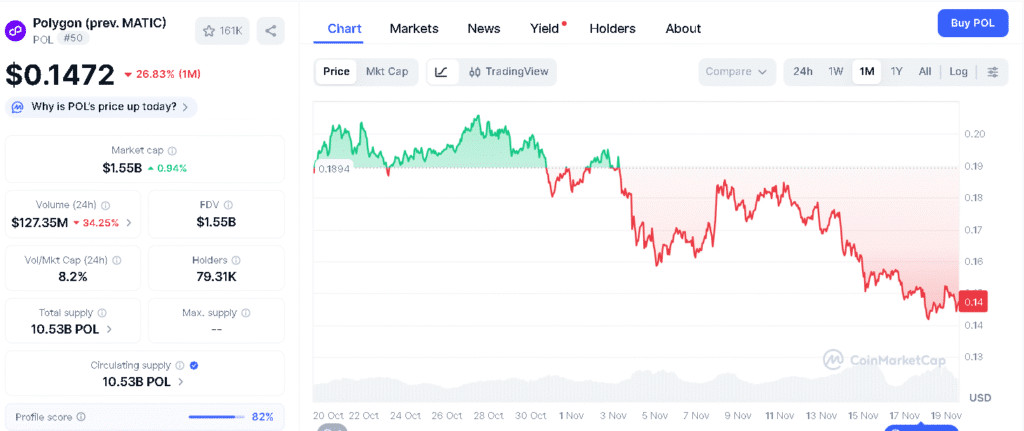
If selling pressure continues, $POL could fall to $0.13. On the other hand, a rise in demand, possibly from real world use through the Mastercard Polygon partnership, might push the token back up to $0.16. Traders say that sentiment is likely to change only once the effects of Mastercard’s rollout show up on the blockchain.
Is the Mastercard Polygon partnership a turning point for mainstream usability?
In many ways, it does. Moving from long wallet addresses to verified usernames is similar to how fintech apps simplify payments for users. By bringing together Mastercard’s global network, Polygon’s fast blockchain, and Mercuryo’s API, the system offers a safer and easier experience for everyday users.
One analyst noted that the Mastercard Polygon partnership could make using Web3 as normal as using cards for online shopping. If this happens, Polygon could benefit greatly by becoming the first major network integrated into a large scale identity system.
Conclusion
The Mastercard Polygon partnership is helping make digital assets easier to use. By swapping long, confusing wallet addresses for simple, verified usernames, Mastercard is aiming to earn users’ trust and bring more people into crypto. At the same time, Polygon gets more visibility, and its network could see a noticeable increase in activity.
$POL is still facing selling pressure. Its next move up to $0.16 or down to $0.13 will likely depend on how many people start using the new verified username system. For now, the partnership shows that blockchain is growing up with ease of use becoming just as important as the technology behind it.
Glossary
Polygon: Polygon is a blockchain that helps people send crypto quickly and at a low cost.
Mastercard Crypto Credential: This system gives users a trusted ID so they can send and receive crypto safely.
Onchain transfer: An onchain transfer is a crypto payment that goes straight onto the blockchain.
Network activity: Network activity means the number of transactions happening on a blockchain right now.
POL token: POL is Polygon’s main token. People use it to pay fees and support the network.
Frequently Asked Questions About Mastercard Polygon Partnership
Why did Mastercard choose Polygon for this system?
Mastercard selected Polygon as it is fast, cost efficient, and can handle large volumes of transactions without slowing down.
What does the Crypto Credential system do?
It gives users a verified username, making it simpler and safer to send or receive crypto without using long and complex wallet addresses.
Will this partnership increase activity on Polygon?
Yes. By making transfers easier, more people are likely to start using Polygon for regular transactions.
Which price level matters for $POL right now?
Traders are focusing on $0.16, as it could influence the token’s next significant move.
Is this partnership a long term benefit for Polygon?
Yes. The collaboration builds trust, strengthens security, and improves the user experience, which can help Polygon grow steadily over time.
Sources