






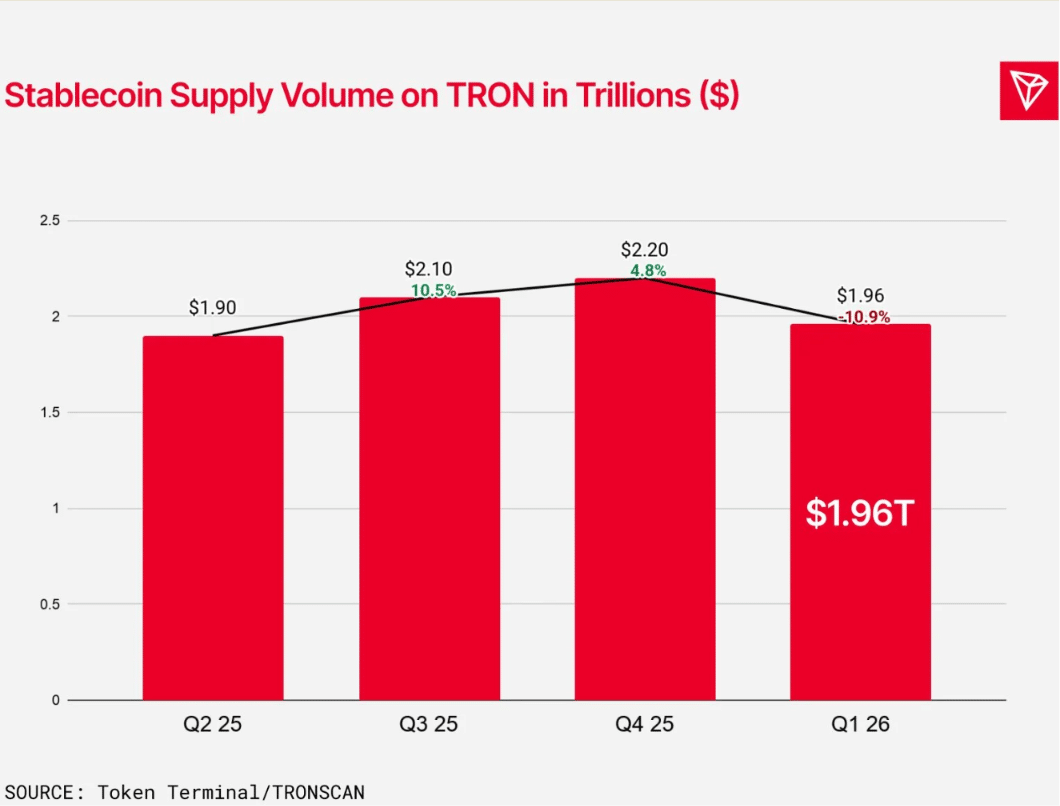
Tron has quietly become the backbone of dollar movement on the blockchain, and the numbers prove it. The network processed 1.96 trillion dollars in stablecoin settlements during the first quarter of 2026, a figure that puts it ahead of most rivals when it comes to raw payment volume.
Yet beneath that headline sits a more layered picture, one where strong usage doesn’t automatically translate into a well-rounded ecosystem. Anyone watching TRX right now needs to understand both halves of that story before drawing conclusions about where the token goes from here.
Why Tron Stablecoin Settlement Keeps Winning Market Share
Cheap fees and quick confirmations are not small details, they are the whole reason Tron stablecoin settlement has become the default choice for so many users moving money across borders. Tether liquidity on the network now sits near 85 to 86 billion dollars, and that depth makes a real difference when someone needs to send funds without waiting around or paying a fortune in gas.
Remittances, freelance payouts, peer-to-peer transfers, these are the unglamorous but essential use cases where Tron has carved out a genuine edge, and frankly, it’s earned that position through consistency rather than hype.
Think of it like a busy toll road that truckers prefer not because it’s flashy but because it’s reliable and doesn’t nickel and dime them at every stop. That’s basically what Tron stablecoin rails have become for everyday dollar transfers.
User Activity Tells a Mixed Story
Daily active users jumped 16 percent over the past 30 days, landing near 4.4 million, comfortably above the 3.2 million average recorded earlier in the quarter. On paper, that looks like momentum. Dig a little deeper, though, and the picture gets more complicated. Quarterly active addresses actually slipped to 15.8 million, down from the peak seen in the fourth quarter of 2025, and new wallet creation has cooled off as well.
What this suggests is that a smaller, more concentrated group of users is transacting more frequently rather than fresh participants flooding in. That’s not necessarily a red flag, but it does raise a fair question about how sustainable this growth pattern is if onboarding doesn’t pick back up. A network can only lean on its existing base for so long before it needs new blood to keep expanding.
TRX Network Strength and the DeFi Shortfall
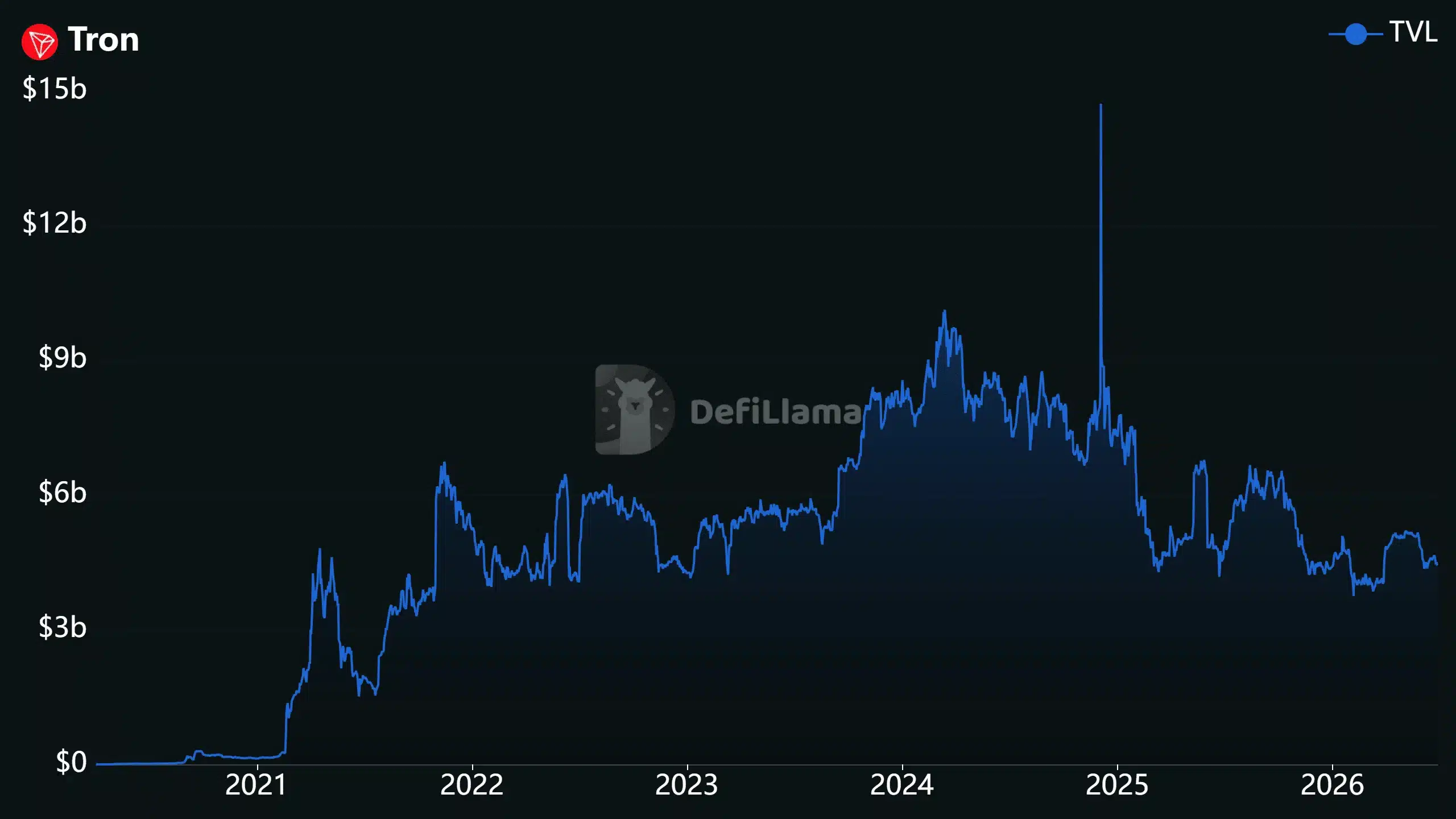
Total value locked on Tron sits around 4.4 billion dollars, and almost all of it is anchored by stablecoins rather than spread across lending markets or decentralized exchanges. Capital tends to stick around between transfers instead of leaving right after settlement, which helps fund validator rewards and recurring TRX burns without driving up costs for ordinary users.
Here’s the catch, though. Despite all that liquidity parked on-chain, Tron’s lending platforms, DEX volume, and smart contract activity remain noticeably thin compared to networks like Ethereum or Solana. It’s a bit like owning a massive warehouse full of inventory but never opening more than one storefront. The capital is there, the foot traffic is there, but the broader marketplace hasn’t been built out to match it.
If that retained liquidity eventually flows into DeFi applications, Tron could strengthen its position well beyond payments alone. If it doesn’t, the network stays a dominant settlement layer but remains vulnerable to faster-moving competitors chipping away at its edge over time.
Conclusion
Tron’s stablecoin dominance is real, and the 1.96 trillion dollar settlement figure speaks for itself. But the network’s future depends on more than payment volume alone. New user onboarding needs to recover, and idle liquidity needs somewhere productive to go beyond simple transfers. Until that gap closes, TRX’s growth story will keep carrying one unresolved question mark, even as its payment rails continue humming along.
Frequently Asked Questions
What does Tron stablecoin settlement mean?
It refers to the total dollar value of stablecoin transactions processed and confirmed on the Tron network within a given period.
Why is Tron popular for stablecoin transfers?
Low fees, fast confirmation times, and deep USDT liquidity make it efficient for cross-border and peer-to-peer payments.
Is Tron’s user growth sustainable?
Daily activity is rising, but quarterly active addresses and new wallet creation have slowed, raising questions about long-term onboarding.
Does Tron have a strong DeFi ecosystem?
Not yet. Lending, DEX trading, and smart contract usage remain small compared to its payment volume.
Glossary of Key Terms
Stablecoin: A cryptocurrency pegged to a stable asset, usually the US dollar, used to avoid price volatility.
TVL (Total Value Locked): The total amount of capital deposited within a blockchain’s decentralized applications.
DeFi (Decentralized Finance): Financial services like lending and trading built on blockchain networks without traditional intermediaries.
Active Address: A unique wallet that has sent or received a transaction within a specific timeframe.
Token Burn: The permanent removal of tokens from circulation, often used to manage supply.