




A Global Race for Bitcoin Reserves
By 2025, Bitcoin has progressed from speculation to a reserve asset in government vaults. Governments worldwide hold between 463,000 and 527,000 BTC, accounting for almost 2.5% of circulating supply in top government Bitcoin holdings. This concentration represents a transition from retail domination to institutional custody, changing Bitcoin’s role in global finance.
The trend is more than simply numbers on balance sheets. It indicates a burgeoning geopolitical conflict in which digital assets, like gold and oil, serve as tools of state policy. The United States and China are leading the way, but smaller countries such as Bhutan, El Salvador, and the United Arab Emirates are also making inroads into the digital gold rush.
The US leads the pack with a strategic reserve
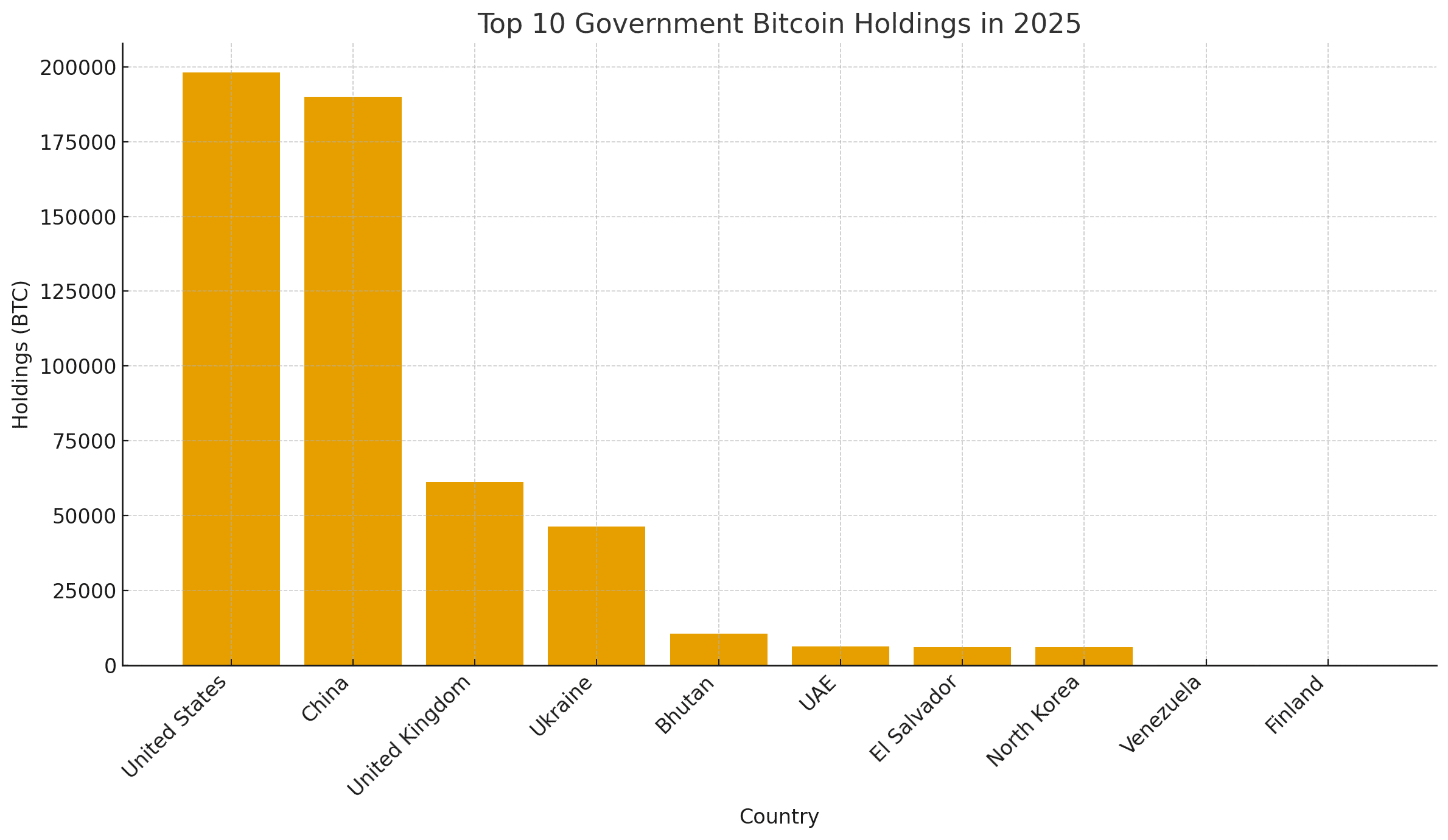
The United States government leads the list with over 198,000 BTC, worth nearly $23 billion. The majority of these currencies originate from law enforcement seizures of darknet markets and illicit activities. However, 2025 represented a tipping moment.
In March, an executive order established the Strategic Bitcoin Reserve. Officials referred to it as a “digital Fort Knox,” designed to secure forfeited cryptocurrency and use it for budgetary resiliency. According to Politico, the instruction urged agencies to buy Bitcoin using non-taxpayer funds, thereby converting confiscated assets into a national stockpile.
This move enhanced Bitcoin’s position as a recognized reserve asset. Investopedia analysts wrote, “The strategic reserve formalizes what was once ad hoc custody, turning it into an intentional tool of financial policy.”
China holds strong
China now possesses around 190,000 BTC, the majority of which came from the 2019 PlusToken fraud seizures. While Beijing maintains a stringent stance on retail cryptocurrency trading, official custody of Bitcoin demonstrates its pragmatic attitude.
Chainalysis has highlighted the possibility that Chinese policymakers may prefer to control rather than dispose of confiscated assets, thus providing an unwritten buffer against Western dominance in digital currencies.
Despite crypto restrictions, China’s quiet hoard remains a critical determinant in Bitcoin’s worldwide distribution in government Bitcoin holdings. Traders frequently believe that Beijing may hold for the long term or strategically sell if global tensions rise.
Europe’s Growing Footprint
The United Kingdom is the third-largest holder of government Bitcoin holdings, with more than 61,000 BTC. British officials began confiscating digital assets during financial crime investigations, but by 2025, a treasury plan had been developed. Officials acknowledged that cryptocurrency stockpiles are being evaluated alongside national bonds and gold.
Ukraine, with 46,000 BTC, has relied significantly on cryptocurrency contributions and state-managed assets since 2022. Despite the continued fighting, Bitcoin has provided a financial lifeline, with blockchain transparency allowing contributors to follow their transactions.
Smaller nations, larger ambitions
The quinch for government Bitcoin holdings is rising as smaller countries are also making claims. Bhutan holds about 10,000 BTC, which is primarily mined using hydropower. The Himalayan monarchy has astonished observers with its long-term, environmentally benign mining policy.
The UAE has emerged as a crypto center, with 6,300 BTC, thanks to favorable policies and collaboration with blockchain businesses. El Salvador’s holdings continue to grow, demonstrating that Bitcoin as legal cash was not a one-time experiment, but a fundamental financial strategy.
The Rise of New Players
In government Bitcoin holdings, Pakistan has established a national Bitcoin reserve, drawing inspiration from the United States. Islamabad has committed energy for mining and artificial intelligence activities in an effort to portray itself as a digital economy hub. While the effort is still in its early stages, it demonstrates the domino effect of government-driven adoption.

Meanwhile, rumors of North Korea acquiring around 6,000 BTC through cyber activity remain contentious. Analysts point to the Lazarus Group’s role in laundering stolen cryptocurrency, raising concerns about enforcement and regulation in conflict-prone areas.
Bitcoin as a geopolitical tool
Bitcoin’s concentration into government hands creates new threats and possibilities. A quick liquidation by a major holding might startle the markets. In contrast, coordinated accumulation has the potential to establish price floors.
Market attitude reflects this fact. Analysts on social media speculate about how Solana’s price potential and Ethereum staking compare to government Bitcoin holdings. A trader on X commented: “If the U.S. turns Bitcoin into a treasury asset, altcoin narratives will have to play catch-up.”
As more states experiment with reserve systems, Bitcoin’s volatility may shift from retail speculation to state-level strategy. The end consequence might be a wider integration of cryptocurrency into international financial institutions.
What Does This Mean for Traders and Developers
For crypto speculators, government Bitcoin holdings are an important signal. Whale behavior is no longer restricted to individuals or institutions. Governments now control some of the largest purses, and their policies have a direct influence on liquidity and mood.
For blockchain engineers, these developments confirm the idea that public ledgers may be used for sovereign-scale banking. The fact that governments trust Bitcoin enough to keep it reinforces the argument for expanding blockchain into settlement systems, tokenized assets, and other applications.
Conclusion: The Digital Cold War in Finance.
By the middle of 2025, Bitcoin will have evolved beyond a decentralized experiment. It has evolved into a contentious financial tool in the hands of top government Bitcoin holdings. With over half a million BTC under state control, digital assets are no longer simply about independence from central banks, but increasingly about strategic reserves that compete with traditional investments.
This move make the way for what some term a digital Cold War. As governments strive for crypto domination, the question is not simply who has the most Bitcoin, but also how they use it.
This article is for informational purposes only and does not constitute financial advice. Readers should conduct their own research before making any investment decisions.
Glossary
Bitcoin Reserve: Government-held Bitcoin used as a strategic or financial asset.
Seizures: BTC obtained through law enforcement actions against illicit activities.
Digital Fort Knox: A term for the U.S. Strategic Bitcoin Reserve.
Tokenization: Process of representing real-world assets on blockchain.
Volatility: Rapid price changes in crypto markets.
Cold Storage: Secure offline storage for digital assets.
FAQs for Government Bitcoin holdings
1. How much Bitcoin do governments hold in 2025?
Between 463,000 and 527,000 BTC in government Bitcoin holdings.
2. Which country holds the most Bitcoin?
The United States, with about 198,000 BTC.
3. Why does China hold Bitcoin despite its bans?
Most came from seizures, and the state has kept them as reserves.
4. Are smaller countries like Bhutan and El Salvador significant players?
Yes, their holdings are smaller but symbolize national strategies.
5. Could governments selling Bitcoin impact the market?
Yes, large liquidations could trigger volatility, while long-term holding supports scarcity.