






ChatGPT for crypto trading turns market noise into a clear routine. It helps traders scan pairs, build simple plans, and test ideas on past data. It keeps risk rules front and center and logs each trade for review. Markets move fast. Good choices need clean data, simple rules, and steady habits.
This guide shows a workflow that uses AI tools and plain prompts to support those habits. Readers will see how to use ChatGPT to draft setups, size positions, and track results. It sets limits, flags red flags, and keeps control in human hands. The aim is calm, repeatable action, not guesses.
What ChatGPT Does For Traders
ChatGPT reads, writes, and reasons over text. That makes it useful for research, planning, and review. It and other crypto trading AI tools can also format data and explain math in plain words. It can spot patterns in text like news or project updates. It can draft trade plans and checklists.
It does not predict the future. It does not see order books in real time on its own. It does not manage money or place orders without a connection. Treat it as a smart assistant. Give it clear inputs. Ask it to explain each step. Keep human control over entries and exits.
The best use cases are simple. Summarize a token’s key metrics. Turn a scan of notes into a clean plan. Translate chain metrics into rules. Keep a trade journal that measures risk, not feelings.
How To Use ChatGPT For Crypto Trading
This section lays out a daily loop. Each part is short and simple. Each step has a clear outcome.
Pre Market Routine
Start with a checklist. Ask ChatGPT to build a snapshot for a watchlist. Include trend, support and resistance, daily range, funding, and open interest if data is available. Add links to charts. Keep the report to one page. That keeps focus tight.
Then define a plan. Ask for two setups that fit the watchlist. For each setup, request entry conditions, invalidation, position size, take profit logic, and a stop rule. Add a line that states the risk in percent of equity.
In Trade Support
Ask ChatGPT to track the live plan. It can mirror the checklist and prompt for updates. It can help log entries, exits, and reasons. It can remind the trader of the stop rule and scaling plan. It can keep the language short and neutral.
Post Trade Review
Run a quick review at the end of the session. Ask for a score on rule follow. Ask for a note on slippage, emotions, and news impact. Ask for two lessons and one change to the plan. Save the review to a sheet. That makes the habits real.
Key Sites And Tools To Pair With ChatGPT
This is the stack that makes the workflow smooth. Each tool has a clear job. ChatGPT fits as the hub.
Market Data And Charts
TradingView for charts and alerts. It supports webhooks that send alert data to an app. That allows an automated note or a rule check when price hits a level.
CoinMarketCap or CoinGecko for market cap, volume, and supply. Binance, Bybit, Kraken, and other exchanges for execution data and fees. Deribit for options data if a trader uses options.
On Chain And Fundamentals
Glassnode, CryptoQuant, IntoTheBlock, and Santiment for on chain metrics. Messari and Kaiko for market research and feeds. Project sites, GitHub, and docs for roadmap and code activity.
Automation And Glue
Zapier to connect webhooks to ChatGPT. Alerts can trigger a workflow. The workflow can call ChatGPT to fill a template. It can then send a message to a note app or a sheet. Google Sheets for logs and basic backtests. Airtable or Notion for a structured journal.
News And Policy
CoinDesk, The Block, and major wire services for headlines. SEC, CFTC, and FTC sites for policy and enforcement updates.
This mix keeps data flowing. It also keeps human control. Alerts tell the trader when to look. ChatGPT writes what to check. The trader decides.
Prompt Patterns For Crypto Trading
Use prompts that define the job, the inputs, and the format. Keep the style short and firm. Here are quick patterns that traders can copy.
| Task | Prompt Template | Expected Output |
| Daily snapshot | Build a one page snapshot for [token list] with trend, key levels, 24 hour range, market cap change, funding, and open interest if data is supplied. Use bullets. End with two risks to watch. | A clear brief the trader can skim in one minute. |
| Setup builder | Draft two setups for [token] on the [timeframe]. Include entry, invalidation, position size as percent of equity, partial profit plan, and stop rule. Make sure each rule is testable. | Two rule sets that can be coded or journaled. |
| Backtest plan | Turn this setup into a paper backtest plan for [dates]. List data fields, sample size target, and success metrics. Give step by step rules. | A test sheet plan that a beginner can run. |
| Trade journal | Turn this trade note into a journal entry. Extract setup name, entry, exit, size, R multiple, rule follow, notes. | A clean entry that fits a sheet. |
| Risk check | Check this trade plan for risk. Flag missing stop, unclear invalidation, or size over 2 percent of equity. | A short risk audit. |
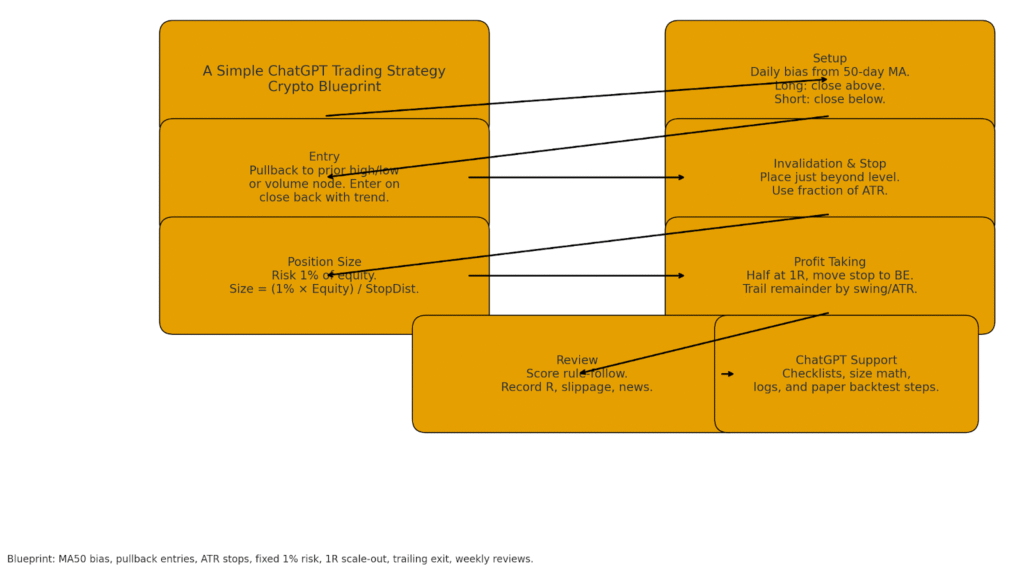
A Simple ChatGPT Trading Strategy Crypto Blueprint
This blueprint fits swing or intraday styles. It uses price action and simple stats. It keeps the rules testable.
- Setup: Market bias comes from the daily trend. Use the 50-day average as a filter. Trade long only when the price closes above the 50-day line. Trade short only when the price closes below.
- Entry: Use a pullback to a key level. The level can be a prior high or low, or a volume node from the chart platform. Enter when the candle closes back in the trend direction.
- Invalidation and Stop: Set invalidation just beyond the level. If long, the stop sits a small distance under the level. If short, place it above. The distance can be a fraction of Average True Range.
- Position Size: Risk a fixed percent of equity. One percent is common for new traders. Use the stop distance to compute size. ChatGPT can outline the math and write a small sheet formula.
- Profit Taking: Scale out in halves. First take profit at one R. Move stop to break even. Let the rest trail under a swing low or an ATR stop.
- Review: Score the trade on rule follow. Record R multiple, slippage, and any news effect.
ChatGPT supports this plan with checklists, size math, and logs. It can also translate the plan into steps for a paper backtest.
Backtesting And Tuning With Simple Tools
Backtests do not need code at first. A trader can use a sheet and screen time. Pick one pair. Pick one timeframe. Pick a date range with at least one hundred trades for power. Then log each signal by hand. Note entry, stop, and exit by the fixed rules. Record R multiple and drawdown.
When the sheet is ready, ask ChatGPT to compute win rate, average R, expectancy, and max drawdown. Ask for a short read of the results. Ask for a list of weak spots in the rules. Then change one thing and test again.
A trader with basic Python can go deeper. The model can write a script outline. It can comment on each step in plain words. That helps the trader learn while testing.
Risk, Position Sizing, And Journaling
Risk rules keep traders in the game. A common cap is one percent per trade. Another is five percent per week. The cap sets a floor under the worst case.
ChatGPT can keep a running size plan. It can compute size from stop distance and equity. It can format a journal entry that tracks R and rule follow-up. It can tag trades by setup. That allows quick reports by setup or by market phase.
Consistency beats hero trades. Tidy records beat memory. A small size with sharp rules often outperforms a big size with sloppy rules. Keep the plan dull. Let compounding do the work.
Security And Regulatory Context
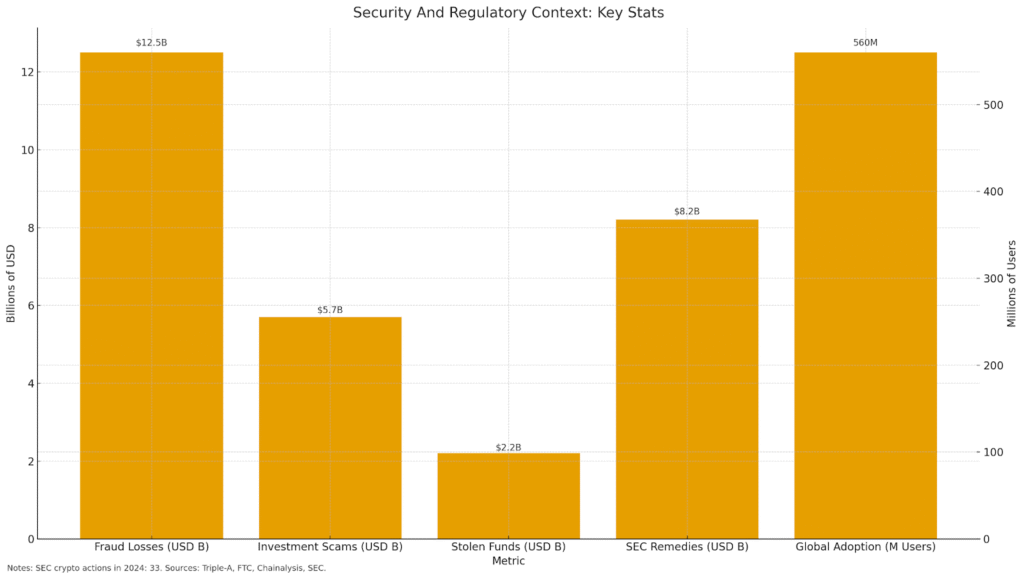
Crypto adoption keeps growing. A leading dataset put global ownership at more than 560 million people in 2024. That signals a large and diverse base of users.
Fraud still hurts many consumers. The FTC reported 12.5 billion dollars in overall fraud losses in 2024. Investment scams led the list at 5.7 billion dollars. That includes many crypto-themed scams. Traders should treat promises of safe high yield with care.
Crime patterns shift as markets evolve. Chainalysis reported that stolen crypto funds rose about 21 percent year over year to roughly 2.2 billion dollars in 2024. Ransomware and sanctioned actors stayed active. These trends matter for risk and counterparty checks.
Policy is also in motion. The SEC secured a record 8.2 billion dollars in financial remedies in fiscal 2024, even as total enforcement actions fell from the prior year. Other research counted 33 crypto-related SEC actions in 2024, a drop from 2023, but with large penalties. Traders should track this arc since policy can shift liquidity and listings.
Together, these facts point to a core truth. Growth brings new users and fresh capital. It also brings more scams and sharper rules. A strong workflow uses trusted data, a journal, and strict risk limits.
Connecting Alerts To ChatGPT
Automation should serve the pDan. Not the other way around. A practical setup links chart alerts to a ChatGPT workflow that fills a template.
TradingView supports webhooks for alerts. An alert can send a POST to a URL when price hits a level. A Zapier flow can catch the alert and call ChatGPT. ChatGPT can then update a trade sheet or post a plan to a note. The trader reads the plan and decides. That keeps human control.
AI Crypto Trading Flow (from raw data to PnL)
- Ingest & Validate
Pull prices, order books, funding, OI, on-chain, news. Deduplicate, align clocks, fill limits, schema-check. - Feature Engine
Build regimes (trend/vol), liquidity & spread stats, basis bands, whale/bridge flags, sentiment tags. - Signal Scoring
Run small interpretable models (trees/linear, simple RNN for regimes). Output score ∈ [−1, +1] with reason codes. - Signal QC Gate (D1)
Block if data stale, latency > threshold, spread too wide, depth too thin, or event blacklisted (upgrades/unlocks). - Risk Sizing
Convert score → size using vol targeting + exposure caps (per asset, per theme, global). Enforce per-trade and daily max loss. - Route & Execute
Choose venue by spread+fees+depth; stage limit orders; time-in-force; cancel/replace logic. No market orders unless in an emergency. - Post-Trade Audit
Log fills, slippage vs. model, fees/funding, reason code, features snapshot. Human-readable timeline per trade. - Health & Kill Switch (D2)
Heartbeat pings to venues/data. On 3 failures or drift > guardrail → flatten, pause, page human. - Portfolio Hygiene (Daily)
Reconcile positions, orders, cash, fees; roll funding; refresh keys/permissions; reload risk limits. - Performance Loop (Daily/Weekly)
Track net PnL after costs, drawdown, time-to-recovery, capacity, and downtime. Compare to the paper “shadow” model. - Model Maintenance (Weekly)
Drift checks, walk-forward re-fit on rolling window, re-run stress (gaps, throttles). Promote only if Variant B beats Control A. - Governance & Security (Ongoing)
Model cards, versioned configs, least-privilege API (withdrawals off), secrets in vault, access reviews..
Limits And Best Practices
ChatGPT works with text. It does not see every tick. It can make errors if inputs are vague. It can sound sure when the data is thin. Good prompts and guardrails reduce these risks.
Keep inputs structured. Use the same template every day. Pin the rules in plain text. Ask for numbered steps. Set clear bounds like timeframes and assets. Ask for citations when the model summarizes research.
Do not give financial control to any single tool. Always confirm signals on a chart. Always compute size from equity and stop distance. Log every trade. Review every week.
Keep a sharp line between facts and ideas. Ask the model to label claims it cannot verify. Use links and sources for any research it cites. Build trust with repeatable steps. Over time, the habits will make the edge.
Conclusion
ChatGPT for crypto trading is most useful as a coach and a scribe. It speeds up research. It turns loose notes into clear plans. It keeps a steady journal. It helps traders test and refine rules. Paired with solid data, simple risk limits, and a calm routine, it can raise the quality of each decision. That is the real edge.
Traders start small and keep strict records. They test one rule at a time and let stats guide changes. ChatGPT for crypto trading fits this mindset. It keeps the plan simple, the language clear, and the risk tight.
FAQs About ChatGPT for Crypto Trading
How can traders use ChatGPT crypto trading prompts without overfitting?
Keep prompts simple. Define rules that are testable. Change only one rule at a time.
Can traders use ChatGPT for live entries and exits?
Yes, as support. The trader should still confirm on a chart and keep control of orders.
What is a safe starting risk per trade?
Many new traders start near one percent of equity. Size can rise with skill and proof.
Which data sources pair best with ChatGPT?
Chart data from TradingView, market data from CoinMarketCap or CoinGecko, and on chain metrics from Glassnode or CryptoQuant are common choices.
What is a good first backtest size?
Aim for at least one hundred trades. That gives enough samples to trust the stats.
Glossary
- ATR: Average True Range. A measure of volatility used for stops and targets.
- Backtest: A test of a strategy on past data to see how rules perform.
- Expectancy: Average R per trade across a set of trades.
- Funding: Regular payment between long and short positions on perpetual swaps.
- Invalidation: The clear point where a trade idea no longer holds.
- Position Size: How many units to trade based on risk and stop distance.
- R Multiple: Profit or loss divided by the initial risk per trade.
- Stop Loss: A rule that closes a trade at a preset price to cap loss.
- Webhook: A way for an app to send a message to another app when an event fires.
- Watchlist: A focused list of pairs or tokens under review.
Blog Summary
This guide shows how to use ChatGPT for crypto trading as a support tool, not as a signal machine. It maps a daily loop that covers pre market planning, in trade tracking, and post trade review. It lists key sites and tools for charts, data, on chain metrics, and automation. It gives prompt templates for snapshots, setup rules, backtests, and risk checks. It offers a simple price action strategy with fixed risk and clear exits. It explains how to backtest in a sheet and how to log each trade. It reviews security and policy facts and links to sources. It closes with limits and best practices that keep human control and protect capital. The goal is a calm, repeatable process that raises decision quality.