




Modern Web3 development is moving away from dense code editors and long release cycles. In their place, a new pattern is emerging where a person describes a product in plain language and an AI system scaffolds the app, wires the contracts, and prepares deployment in minutes. This is the promise behind vibe coding, and it is already changing who can build in crypto and how quickly ideas reach mainnet.
Instead of years of practice with Solidity or Rust, founders, product managers, and designers can sit in front of an AI prompt, describe the shape of a trading tool or a gaming app, and receive production-ready code to refine. Combined with no code interfaces that manage hosting, wallets, and payments, Web3 development starts to feel less like engineering and more like collaborative design.
The shift is still early, but it already carries serious implications for builders and for anyone who tries to read the health of crypto projects from the outside.
From code editor to conversation: what vibe coding really means
At a basic level, vibe coding describes a workflow where a large language model acts as a development copilot that handles most of the boilerplate. The human describes the intent, the “vibe” of the product, and the AI translates that intent into smart contracts, front end components, and infrastructure scripts.
In Web3, this does more than save time. Writing on chain logic usually requires knowledge of gas costs, state management, permission models, and interactions with token standards. Vibe coding tools contain that expertise inside prebuilt modules. The prompt steers the high level logic, and the system plugs into audited components for payments, swaps, or governance.
This makes crypto development feel far more conversational. A builder might say, “Create a raffle dapp that accepts a specific token, runs draws every 24 hours, and sends fees to a treasury,” and a vibe coding engine can stitch together the contracts and a basic interface. The person can then ask for adjustments, new conditions, or additional views, instead of hand editing every file.
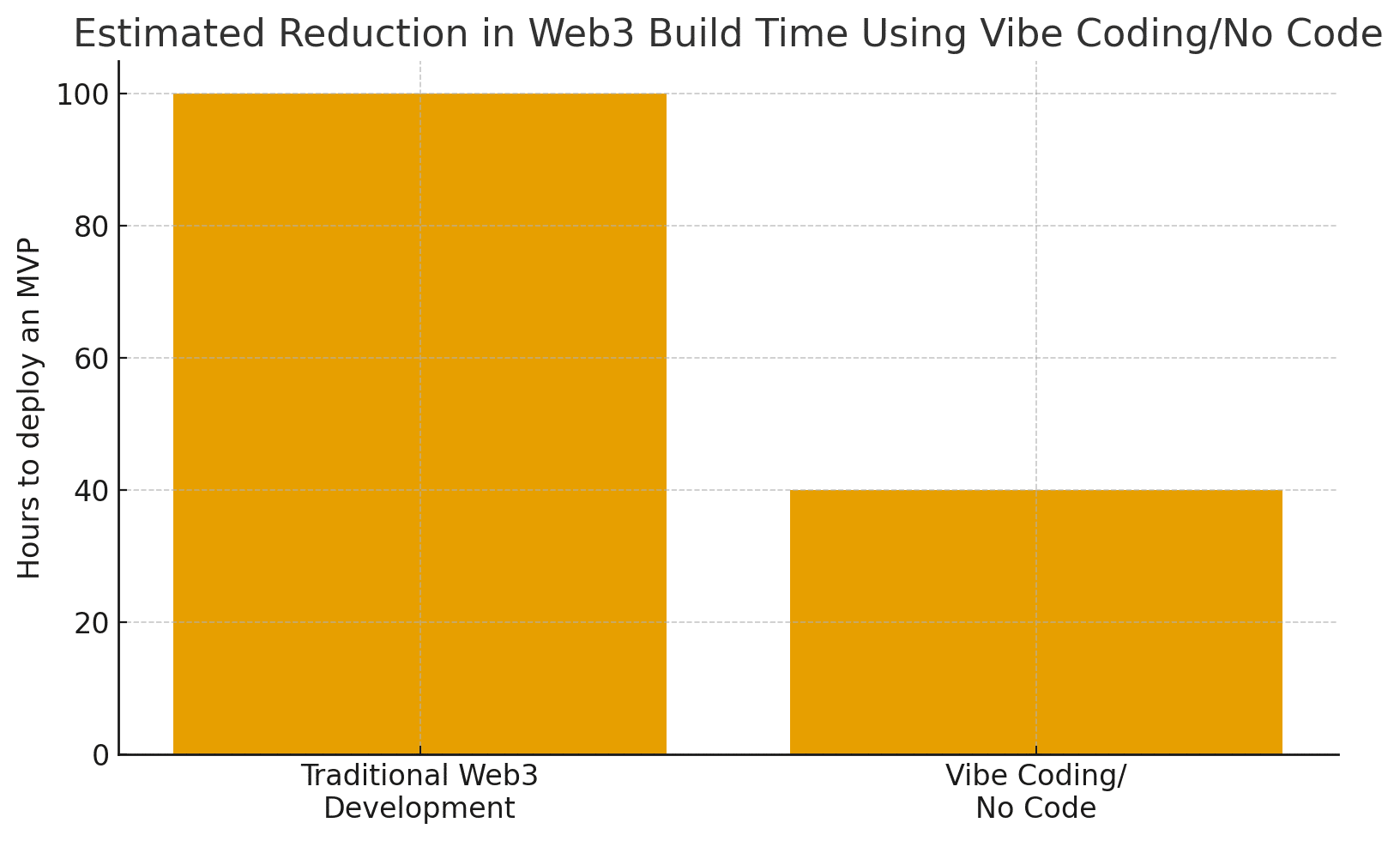
For experienced developers, vibe coding is not a replacement for skill. It behaves more like a force multiplier that shrinks the time between idea and live test. For newcomers, it functions as a ramp into Web3 creation that previously felt unreachable.
How no code and AI compress the Web3 build cycle
AI assistance would not matter much without platforms that handle deployment. This is where no code enters the story.
Modern Web3 no code stacks handle several heavy parts of the pipeline. They manage RPC connections, support multiple virtual machines, hook into indexers for data, and often integrate wallets and fiat gateways. Where a traditional team might wrestle with configuration for days, a no code dashboard can present toggles and forms.
Add vibe coding on top and the cycle compresses even further. Someone can generate the base application with prompts, then use no code panels to adjust parameters such as fee rates, token lists, or reward schedules. A feature that once required a pull request and review turns into a configuration change inside a protected interface.
This compression changes the shape of experimentation. Hackathon teams can spin up a dozen variations of a DeFi strategy and observe which one gains real volume. NFT communities can launch custom experiences around drops without a resident smart contract engineer. Local businesses can test loyalty tokens or digital vouchers using Web3 rails without hiring a full stack blockchain team.
Security, audits, and the trust problem
The obvious concern is security. If an AI can deploy a smart contract with a few sentences, it can also deploy insecure code just as quickly. Web3 history already includes painful examples where small mistakes in contract logic led to multimillion dollar exploits.
The new generation of vibe coding tools tries to answer this in two ways. First, they rely heavily on audited modules for critical operations such as token transfers, lending logic, or order matching. Instead of asking the AI to invent a new payment engine, the system connects the prompt to a safe building block that already protects significant on chain volume.
Second, the feedback loop in code generation is tighter than in natural language. When an AI produces incorrect or incomplete code, compilers and test suites throw specific error messages. The model can use these messages to iterate toward a working version. This does not guarantee safety, but it reduces obvious failures and encourages structured testing.
From a user point of view, trust will still depend on familiar signals. Serious projects will publish audit reports, disclose which templates and modules they used, and keep contracts open source. Investors will look for well documented security practices, multi signature control over admin keys, and clear incident response plans.
Key indicators that matter when crypto runs on AI built tools
As vibe coding and no code platforms speed up Web3 launches, surface level metrics like “time to mainnet” matter less. Instead, a different set of indicators grows more important for anyone who tracks crypto fundamentals.
One indicator is active usage. On chain transaction counts, unique wallet interactions, and volume trends show whether a rapidly built dapp is more than a weekend experiment. Sustainable growth in daily active addresses is a stronger sign of value than a flood of short lived deployments.
Another indicator is capital resilience. Total value locked, depth of liquidity pools, and stability of deposits across market swings reveal how much real money trusts the contracts. When a project built with vibe coding maintains TVL through volatility, it suggests that the underlying design and risk controls hold up.
Developer activity also matters. Even in a world of no code, serious teams maintain repositories, push updates, and publish postmortems when things go wrong. A steady cadence of releases, combined with transparent roadmaps, shows that the project is not just a one click deployment.
Finally, security posture is crucial. Independent audits, bug bounty programs, and public documentation of how the team uses vibe coding modules or templates give outside observers something concrete to evaluate. In a fast build environment, discipline around security is a strong positive signal.

Why this trend matters for the next wave of Web3 builders
For early stage founders, the combination of vibe coding and no code tools lowers the cost of trying new ideas. A small team can test several product directions in the same time that one prototype previously required. Capital can be spent on user research, partnerships, and liquidity incentives rather than large engineering squads from day one.
For established institutions that explore tokenization, faster development cycles mean shorter pilots and clearer data. A bank that wants to test tokenized deposits, or a retailer that wants to experiment with on chain loyalty, can reach a working proof of concept without a full internal blockchain department.
For the broader ecosystem, more experimentation translates into a richer set of open source primitives. Many of the apps built through vibe coding will not survive, but the contracts, ideas, and patterns they leave behind can be forked and refined by others. This is how Web3 has always grown, and AI assisted workflows accelerate the process.
Risks, limits, and why human judgment still matters
Despite the appeal, vibe coding is not a magic solution. Poor product ideas will still fail, even if they launch faster. No amount of AI assistance can replace thoughtful token economics, user centric design, or responsible treasury management.
There is also a cultural risk. If teams rely too heavily on AI templates, many apps may start to feel similar. Differentiation in Web3 has often come from unusual design choices, new governance models, or creative use of blockchains. Human creativity needs room to steer the AI rather than follow it.
Most importantly, oversight must remain human. Someone has to decide when a contract is safe enough to hold funds, when to pause an app during abnormal activity, and how to compensate users in case of incidents. AI can assist with analysis, but accountability sits with people and organizations.
Conclusion
The rise of vibe coding marks a clear shift in how Web3 products come to life. Instead of long, code-heavy sprints guarded by a small group of specialists, crypto development starts to resemble a broader creative process where more people can participate.
Paired with mature no code platforms, AI-assisted workflows are compressing build times, expanding who can ship a dapp, and reshaping the indicators that matter when evaluating crypto projects. At the same time, security, transparency, and human judgment remain non-negotiable if real value is going to move across these systems.
As this trend matures, the most successful teams will likely be those that treat vibe coding as a powerful instrument rather than a shortcut, combining fast iteration with rigorous risk management and honest communication with their communities.
Frequently Asked Questions
Q: What is vibe coding in Web3 development?
Vibe coding is a development style where an AI system turns natural language prompts into working smart contracts and app code, allowing builders to describe what they want and receive ready to test Web3 applications.
Q: How is no code different from vibe coding?
No code platforms provide visual dashboards and configuration panels so that teams can deploy and manage apps without writing traditional code, while vibe coding focuses on generating the underlying code through AI from conversational input.
Q: Are AI generated smart contracts safe to use with real funds?
They can be safe when they rely on audited modules, thorough testing, and human review, but they still require external audits, bug bounties, and strong operational controls before managing significant value.
Q: Which crypto indicators matter most for projects built with AI tools?
Key indicators include active on chain usage, consistent transaction volume, stable total value locked, ongoing developer activity, and clear security practices such as audits and public documentation.
Glossary of key terms
Vibe coding
An AI assisted development approach where natural language prompts are converted into application and smart contract code for Web3 projects.
No code
A class of platforms that allows users to create and manage applications through visual interfaces and configuration options instead of manual programming.
Smart contract
A program that runs on a blockchain and automatically executes agreements when predefined conditions are met, often used for DeFi, NFTs, and tokenized assets.
Total value locked (TVL)
The amount of capital held inside a protocol or set of contracts, often used to measure the economic weight and trust level of DeFi platforms.
On chain metrics
Data recorded directly on the blockchain, such as transaction counts, wallet activity, and token flows, used to evaluate the real usage and health of crypto projects.
References
- From code editor to conversation: what vibe coding really means
- How no code and AI compress the Web3 build cycle
- Security, audits, and the trust problem
- Key indicators that matter when crypto runs on AI built tools
- Why this trend matters for the next wave of Web3 builders
- Risks, limits, and why human judgment still matters
- Conclusion
- Frequently Asked Questions
The price predictions and financial analysis presented on this website are for informational purposes only and do not constitute financial, investment, or trading advice. While we strive to provide accurate and up-to-date information, the volatile nature of cryptocurrency markets means that prices can fluctuate significantly and unpredictably.
You should conduct your own research and consult with a qualified financial advisor before making any investment decisions. The Bit Journal does not guarantee the accuracy, completeness, or reliability of any information provided in the price predictions, and we will not be held liable for any losses incurred as a result of relying on this information.
Investing in cryptocurrencies carries risks, including the risk of significant losses. Always invest responsibly and within your means.
For advertising inquiries, please email . [email protected] or Telegram