






Crypto now looks less like one highway and more like a web of connected roads. Different networks specialize in different things, and users follow the path that feels fastest or cheapest in the moment. The downside is obvious: value and applications get stuck in silos. Cross chain bridges exist to connect those silos, letting assets and instructions travel between networks so the market feels less fragmented.
Why fragmentation became expensive
When liquidity sits on many chains, the same token can trade at slightly different prices depending on where demand shows up first. A decentralized app can be popular in one ecosystem while a useful collateral asset lives elsewhere. Without interoperability, moving value requires multiple steps, extra fees, and time delays that matter during volatility. Cross chain Bridges reduce that friction, which is why they show up underneath cross-chain swaps, multi-chain lending, and steady migrations of stablecoins and trading activity.
How value moves from chain to chain
Most bridge designs follow a familiar flow as a token is locked on the origin chain, and a representation is issued on the destination chain. When the holder returns, the representation is burned and the original token is released. The entire structure rests on verification, because the bridge must be sure the lock or burn happened and that it happened once.
Verification can be handled by committees or by proofs. Committee based systems rely on a validator set or a multi-signature group that signs off on events. Proof based systems try to minimize trust in humans by verifying another chain’s state cryptographically. Interoperability systems built around light clients aim for that stronger model. One interoperability protocol describes itself as enabling secure, permissionless transfer of data, including tokens and arbitrary application logic, which signals how interoperability can go beyond simple token shuttling.
Why messages matter as much as tokens
Token transfers are only half the story as the bigger unlock is message passing, where a contract on one chain can trigger a change on another chain. That is why some frameworks describe their purpose as enabling smart contracts to read from and write state to different blockchains. When that works well, cross chain bridges stop feeling like a separate step and start feeling like part of the application itself.
Why bridges became an attack magnet
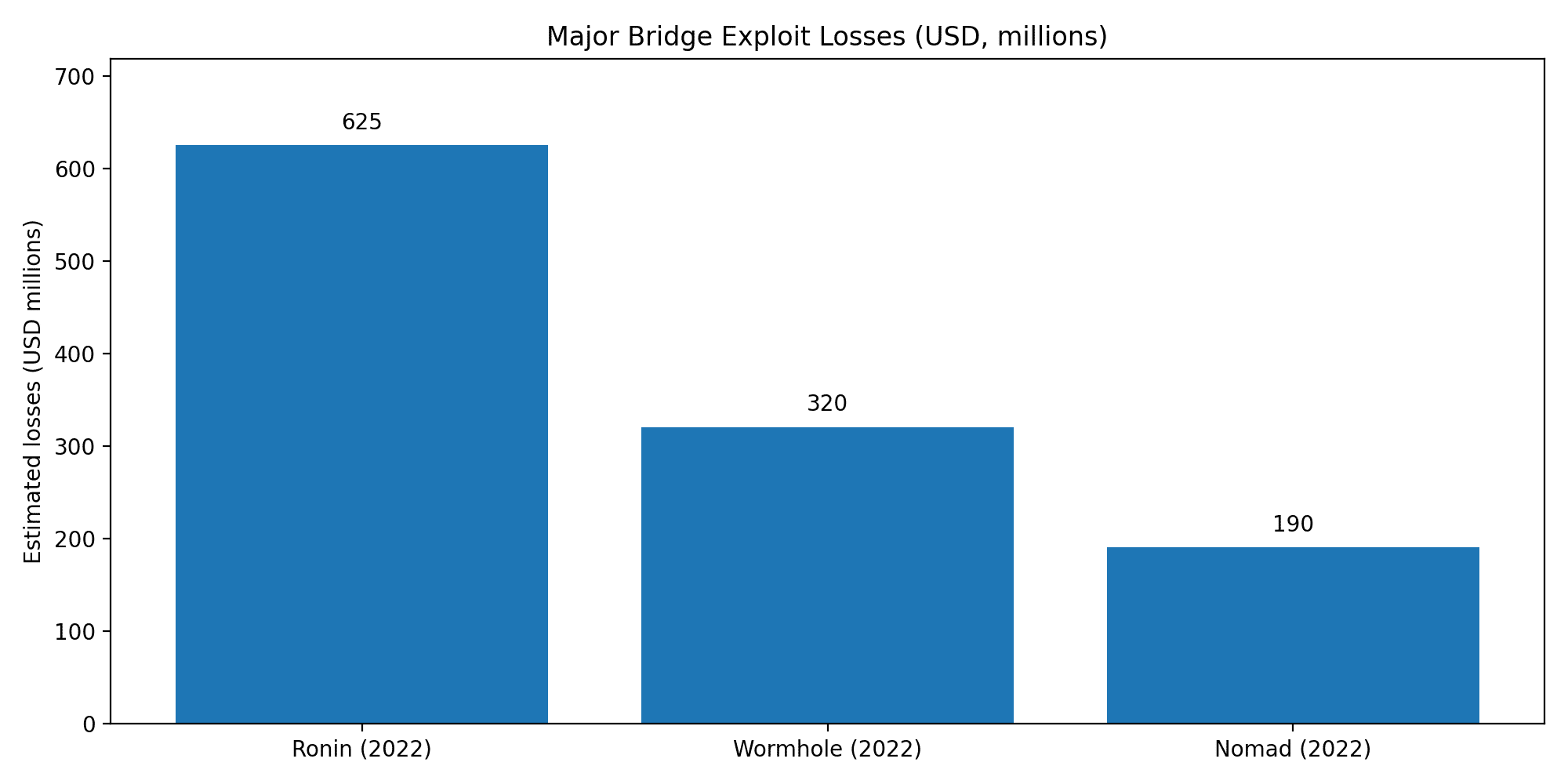
Bridges concentrate money, and they often concentrate authority. A small signer set, an upgrade key, or an operational workflow can become the weak point. In March 2022, the Ronin bridge breach was widely estimated at about $625m, a reminder that compromised trust points can outweigh clever code.
In 2022, reporting put the Nomad theft around $190m, and later analysis emphasized how quickly copycats could drain funds once the exploit pattern spread. Wormhole is another reference point, with reported losses over $320m and a response that focused on restoring funds to reduce systemic shock.
Those incidents shaped a more realistic view of cross chain bridges. The risk is rarely one-dimensional. It can be a contract bug, a governance mistake, a signer compromise, or an emergency process that fails when stress hits.
What current data says about usage
Even after those lessons, bridges remain heavily used. One widely followed dashboard listed total value locked across bridge protocols at about $46.282b, with about $1.28m in fees over 7 days at the time of checking. That footprint helps explain why cross chain bridges remain core infrastructure rather than a niche tool.
Threat reporting suggests the attack surface keeps shifting. A 2025 analysis described a pivot away from bridges toward centralized infrastructure and social engineering, while also noting that attackers often move stolen funds across chains as part of laundering flows. Risk does not disappear, it moves.

The indicators that matter before trusting a route
Evaluating cross chain bridges can feel complicated, but a few indicators do most of the work.
Trust design comes first: whether verification relies on a small signer set or on proofs. Upgrade and governance risk comes next: whether core contracts can be changed quickly, and who controls that ability.
Liquidity depth matters because thin pools create slippage and failed transfers in volatile markets. Operational transparency matters too, including audits, monitoring, and a clear incident history. Finally, there is dependency risk: if a bridge depends on a single relayer, a single oracle, or a single operational team, downtime can become a real-world constraint, not just a theoretical one.
Habits that reduce damage in practice
Users reduce risk with simple discipline as a small test transfer can catch routing mistakes before serious money is involved. Keeping wrapped balances small and short lived limits exposure if a bridge suffers an incident. For large moves, many users prefer canonical routes supported by the chain’s ecosystem, even if they are slower.
Builders integrating cross chain bridges treat the bridge layer as part of the application’s threat model. Replay protection, strict message validation, rate limits, and pause mechanisms can make the difference between a contained event and a headline.
Where interoperability is headed next
Interoperability is pushing toward fewer trust assumptions and less visible complexity. Proof based verification, including light client approaches and newer proof systems, is receiving attention because it can reduce reliance on small signer sets. At the same time, chain abstraction is making routing feel automatic, so users focus on outcomes rather than on which chain executed each step. If that trend holds, cross chain bridges will feel more like background plumbing, noticed mainly when something breaks.
Conclusion
Cross chain bridges turn a scattered set of blockchains into something closer to a connected economy. They move liquidity, enable multi-chain applications, and reduce the cost of switching ecosystems. They also concentrate risk, which is why trust design, key management, and transparency remain the real differentiators. The market keeps using bridges because the utility is real, and the market keeps debating them because the responsibility is real too.
FAQs
What is the core purpose of cross chain Bridges?
They move value or messages between blockchains so assets and applications can operate across ecosystems.
Do cross chain Bridges always create wrapped tokens?
Many routes rely on locking and minting, which creates wrapped representations. Some routes use liquidity pools so recipients receive native assets, but the system still depends on reliable backing and verification.
Why do some transfers feel fast while others feel slow?
Speed depends on how the route verifies the origin chain, how much finality it waits for, and whether liquidity and relayer capacity are available.
Are bridges still a major hacking theme in 2025?
Some reporting suggests attackers increasingly target centralized infrastructure and social engineering, even while bridge systems remain high value and widely used.
Glossary of key terms
Interoperability is the ability for blockchains to exchange data and value so applications can work across networks.
A wrapped asset is a token on one chain that represents an asset locked on another chain and can be redeemed through a bridge process.
A light client is a verifier that checks another chain’s consensus and state proofs without running a full node.
A validator set is the group of entities that attest to events and sign messages in many bridge designs.
Finality is the confidence that a transaction will not be reversed, influencing bridging delays and safety.
References