






Cross-chain activity is no longer a side quest. It is where serious on-chain volume flows when users want native assets to move quickly, safely, and at a fair price. For teams, the race is simple: connect deep pools across chains, keep finality tight, and make rewards worth the effort. For users, the goal is steadier yield with clear risk controls. This article breaks down how the leading players connect liquidity across networks, what to watch before providing capital, and where liquidity mining actually makes sense today.
Why Cross-Chain Liquidity Matters Now
Single-chain pools can feel like small ponds. Capital gets trapped, slippage creeps higher, and exit routes are limited. Cross-chain systems let traders and apps tap shared pools, move native assets, and price risk more cleanly. Protocols that route value without wrapped tokens reduce extra smart-contract exposure and keep settlement closer to the metal. That is not just a nice-to-have. It is the difference between predictable flows and constant patchwork.
How To Judge a Cross-Chain Platform
A few signals separate robust systems from speculative experiments. First, native asset support. Designs that avoid wrapped tokens lower the attack surface and make accounting simpler. Second, unified or shared liquidity. If pools are fragmented per chain, capital efficiency suffers. Third, message passing and finality guarantees. Users should know exactly when funds are final and how reorgs or failures are handled. Fourth, economics. Rewards should align with real usage, not only emissions. Finally, audit history and incident response. When things break, speed and transparency matter.
Leading Platforms And What They Actually Do
Some names have become core building blocks for cross-chain flows. Here is what they aim to solve and why builders continue to integrate them.
THORChain focuses on native asset swaps across multiple chains without wrapped representations. Capital is organized in continuous liquidity pools and paired with its native asset, which helps route trades and balance inventory. Because swaps settle in native assets, users avoid bridge minting and redemption steps. Wallets and aggregators integrate it to reach deeper pools for non-wrapped swaps, which is useful when routing Bitcoin to other ecosystems. Multiple sources document this native approach and pool design.
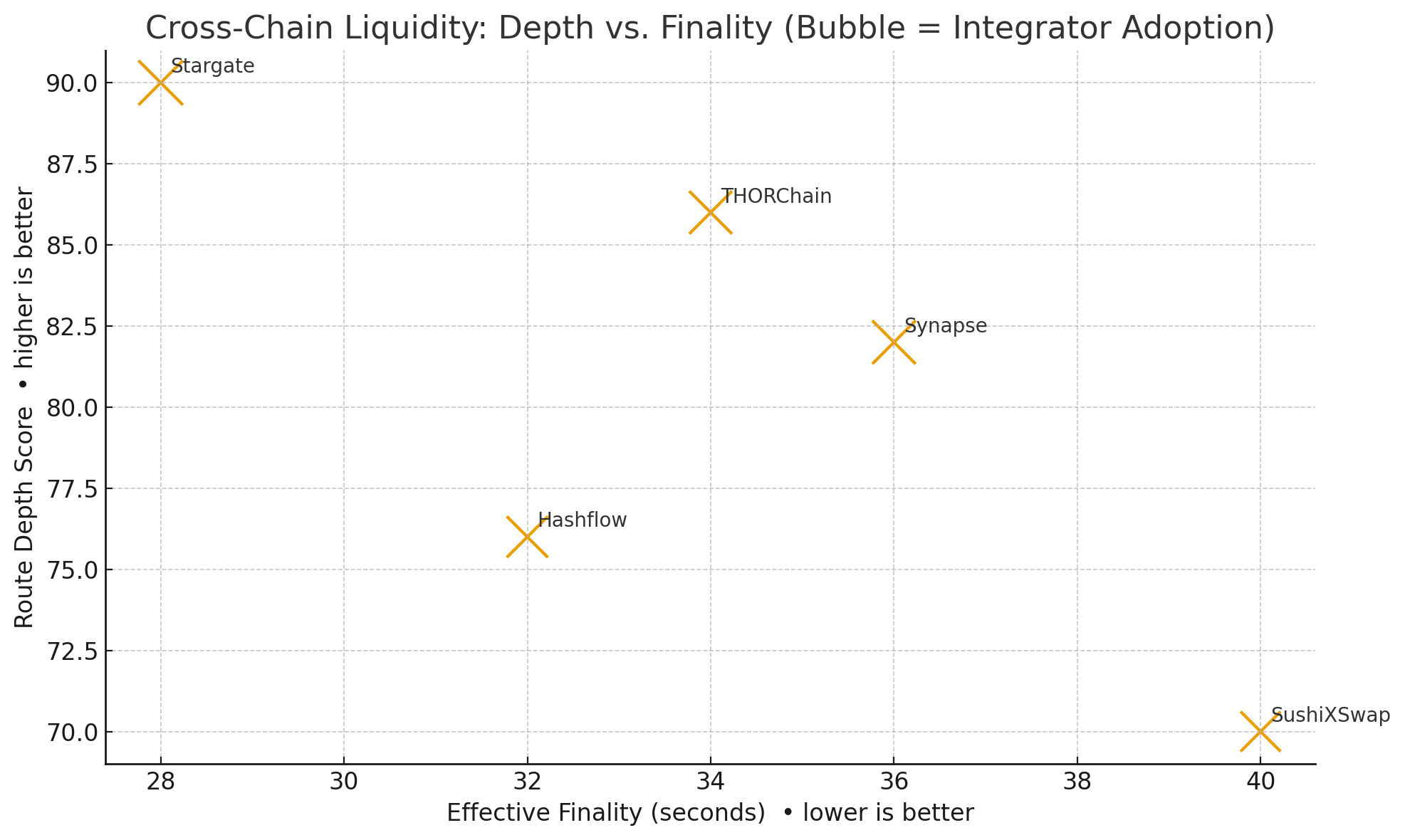
Stargate is built on omnichain infrastructure and uses unified liquidity to move value across supported networks. Its design targets instant or guaranteed finality on approved routes and keeps assets native, which reduces wrapping risk and improves capital efficiency for applications. The shared pool model helps concentrate depth rather than splitting liquidity per chain. Analyses from several reputable research hubs highlight these mechanics and the push to consolidate the stack within its underlying messaging ecosystem.
Synapse Protocol combines a cross-chain bridge, a stableswap AMM model for efficient pricing, and a communications layer that applications can use for more than simple asset transfers. The goal is to reduce slippage for stable pairs while supporting asset and message movement across many networks. Coverage from learning portals and deep-dive research notes confirms this multi-pronged design.
Hashflow uses a request-for-quote model with off-chain market makers to provide firm quotes that are protected from slippage and MEV. Its cross-chain swaps are “bridgeless,” meaning users trade native assets across chains without the typical lock-and-mint pattern. That architecture has been widely profiled since its launch and remains a reference for RFQ-based cross-chain pricing.
SushiXSwap routes cross-chain trades through underlying messaging and liquidity plumbing while letting users pay on the source chain. The update to its second version simplified user flow, cut extra steps, and reduced the need to juggle destination-chain gas before completing a trade. Builders often slot it into aggregators to offer one-click experiences.
These platforms are not identical. Some emphasize native swaps. Others optimize stables and shared pools. A few lean on RFQ with market makers. What they share is a focus on capital efficiency across networks, a clear settlement story, and an integration path for wallets, venues, and on-chain apps.
Where liquidity mining Fits In
Rewards exist to attract capital when a pool or route needs depth. In cross-chain contexts, deep pools are not optional. They are the engine that keeps pricing tight as assets hop across networks. Well-structured programs use emissions to pull in sticky capital from long-tail assets, strengthen high-traffic lanes, and backstop volatile periods. Poorly designed programs leak value, inflate TVL briefly, and then watch it walk out the door.
A steady approach treats liquidity mining as a bootstrapping tool, not the only source of returns. Traders bring volume when pricing is good. Pricing is good when slippage stays low. Slippage stays low when pools are balanced and routes have enough inventory. If rewards are the only reason capital shows up, the music stops as soon as incentives fade.
That is why protocols tie emissions to lanes that demonstrate usage and why they shift weights as traffic changes. This keeps liquidity mining aligned with real activity instead of vanity numbers. Savvy providers look for programs that publish clear targets, spell out how gauges change, and report volume per route in plain language.
Key Risks To Respect Before Providing Liquidity
Smart-contract risk is the obvious one. Cross-chain systems have more moving parts, from messaging layers to pool accounting. Read recent audits and incident reports. Economic risk is next. Impermanent loss can bite harder when volatile assets stretch across multiple chains. Some pools reduce this by concentrating on stables or through RFQ models, but nothing removes price divergence entirely. Operational risk rounds out the list. Finality promises and failed message handling need to match the documentation. When routes halt, capital can be idle in the wrong place at the wrong time.
Responsible providers reduce these risks with a few habits. Start small and expand only after measuring the net yield in practice. Favor pools with documented caps, circuit breakers, or route-level kill switches. Track realized volume per incentive unit. If emissions are high but fills are thin, rethink the lane.
Practical Metrics That Actually Matter
Depth per route tells more than headline TVL. If a route consistently clears large orders with minimal slippage, that route deserves capital. Effective finality time is next. Faster settlement is not just convenient. It reduces exposure to cross-chain uncertainty. Fee structure matters too. Some systems take dynamic fees based on pool imbalance. Others offer stable pricing via RFQ. Compare net yield after fees and emissions, not the top-line APY.
Another underrated metric is integrator adoption. When wallets, bots, or aggregators plug into a protocol, real flow arrives. Developer-facing SDKs and simple endpoints are not cosmetic features. They are fuel for usage, and usage is what sustains rewards once liquidity mining cools.
Strategy Playbook For Providers
A focused plan beats a scattershot portfolio. Pick two or three routes that match your risk profile and track them over weeks, not hours. Reinvest earned tokens that have actual governance power or fee claims, and regularly rotate out of lanes where emissions run ahead of demand. If a pool relies entirely on liquidity mining with no volume, consider exiting early. When in doubt, favor pools that move native assets, share liquidity across chains, and publish plain-English status pages for routes.
Providers who want extra staying power can blend stables with volatile pairs. Stable routes usually deliver steadier, lower variance returns that cushion drawdowns from riskier pools. Over time, this balance helps smooth the ride while the portfolio compounds.
How The Platforms Compare In Practice
Native swap engines excel when users prioritize non-wrapped settlement and broad chain coverage, often with continuous pool models and clear fee dynamics. Shared-pool bridges shine for moving stables and major assets quickly across multiple networks with unified depth and instant or guaranteed finality. RFQ-driven designs reduce slippage surprises and MEV exposure by fixing the price upfront through market makers. Each design space has a place. The best fit depends on the assets, the route, and the liquidity goals.
If the aim is to anchor a cross-chain stable route, unified pool systems are attractive. If the aim is to let users swap native Bitcoin into other ecosystems, native swap protocols are the obvious choice. If predictable pricing is paramount for larger tickets, RFQ can be the right lane. Routing stacks often combine these legs to get the best of each world. That is why aggregators weave multiple backends into one flow and why integrators keep adding endpoints that optimize pathfinding. Independent reviews and docs repeatedly highlight these roles across the ecosystem.
The Role Of Governance And Emissions
Healthy programs give the community control over gauges and emissions so capital follows demand. If a route picks up traffic, it gauges direct more rewards there. If a route cools off, emissions taper.
This discipline keeps liquidity mining from turning into a pure subsidy and helps align providers with users. When reviewing a proposal, the best questions are simple. What problem does the incentive solve? How will success be measured? When will rewards wind down? Documents and governance threads around major deployments often address these points in detail.
Conclusion
Cross-chain is not just hype. It is a practical way to move value where users want it. The strongest platforms make native assets flow, pull depth into shared pools, or lock in quotes without hidden slippage. For providers, the edge comes from disciplined selection, careful sizing, and relentless tracking of real usage. The right routes compound quietly. The wrong ones wave high APYs and fade. Treat liquidity mining like a tool, not a crutch, and let the data tell you where your capital earns its keep.
Frequently Asked Questions
What is cross-chain liquidity
It is the combined pool of capital that supports asset movement and swaps across multiple blockchains, ideally with native settlement and predictable finality.
How does liquidity mining work across chains
Protocols offer token rewards to attract capital into pools that service routes between networks. The goal is deeper depth, lower slippage, and more reliable fills.
Are wrapped tokens always a bad idea
No. They can be useful, but native settlement reduces additional smart-contract risk and simplifies redemption. Many systems focus on native pathways whenever possible.
What should a provider track weekly
Net yield after fees and emissions, depth per route, effective finality time, and realized volume. If rewards lead but usage lags, capital may be misallocated.
Why do RFQ systems appeal to larger orders
They provide firm quotes that resist MEV and slippage by locking price before execution, which helps with predictability across chains.
Glossary Of Key Terms
Native asset
A token on its home chain rather than a wrapped representation. Native transfers avoid extra mint and burn steps.
Unified liquidity
A pool design that aggregates depth across chains so routes draw from the same reserves, improving capital efficiency.
Finality
The point at which a transaction is irreversible for practical purposes. Cross-chain systems either guarantee finality on supported routes or disclose timing assumptions.
RFQ
Request-for-quote. A model where market makers provide firm prices that execute without slippage and with MEV protection.
Continuous liquidity pool
A pool structure that dynamically adjusts price based on inventory and demand while pairing assets with a bonding token to balance routes.
Compliance note: This educational article follows general best-practice guidance for financial topics. It is not investment advice. Evaluate protocol risk, read current audits, and consider independent professional guidance before allocating funds.