



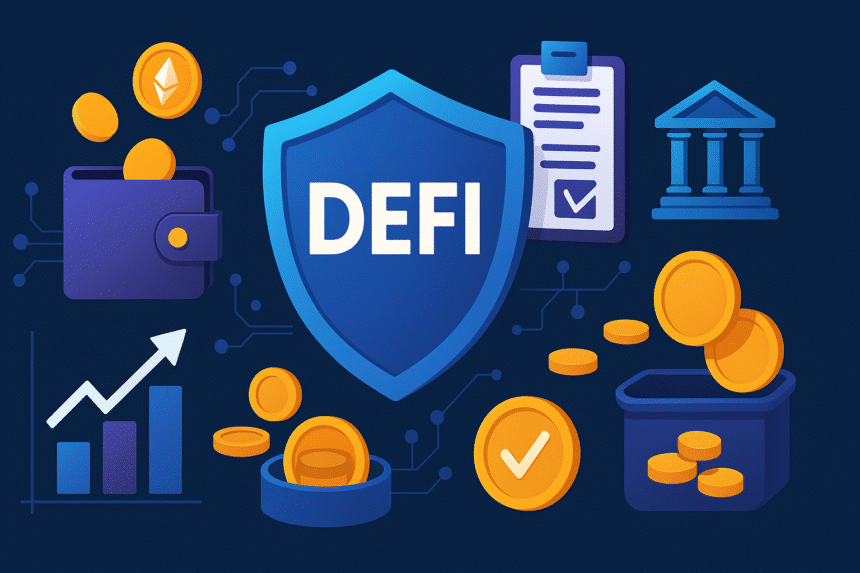

Decentralized Finance (DeFi) is reshaping how people think about money. It enables borrowing, lending, trading and saving without the involvement of banks and brokers. Rather than depending on financial institutions, DeFi swaps on blockchain networks and smart contracts to do all of this automatically.
What started as a trial has become a multi billion dollar-dollar industry. In simple words, DeFi is concerned with the replacement of intermediaries by open and transparent systems. In order to visualize its influence, one should look at how DeFi functions, what its use cases are, and whether it can ever become the future of finance.
Understanding Decentralized Finance (DeFi)
Fundamentally, DeFi is a system, that eliminates gatekeepers. Code running on blockchains replaces the banks, clearinghouses, and payment processors.
A smart contract is the most prominent aspect of DeFi. These are programs that compile automatically. In case of loan repayment ,the contract releases collateral without the consent of a banker. This results in a system that is open to anybody, 24/7 and every transaction is transparently captured.
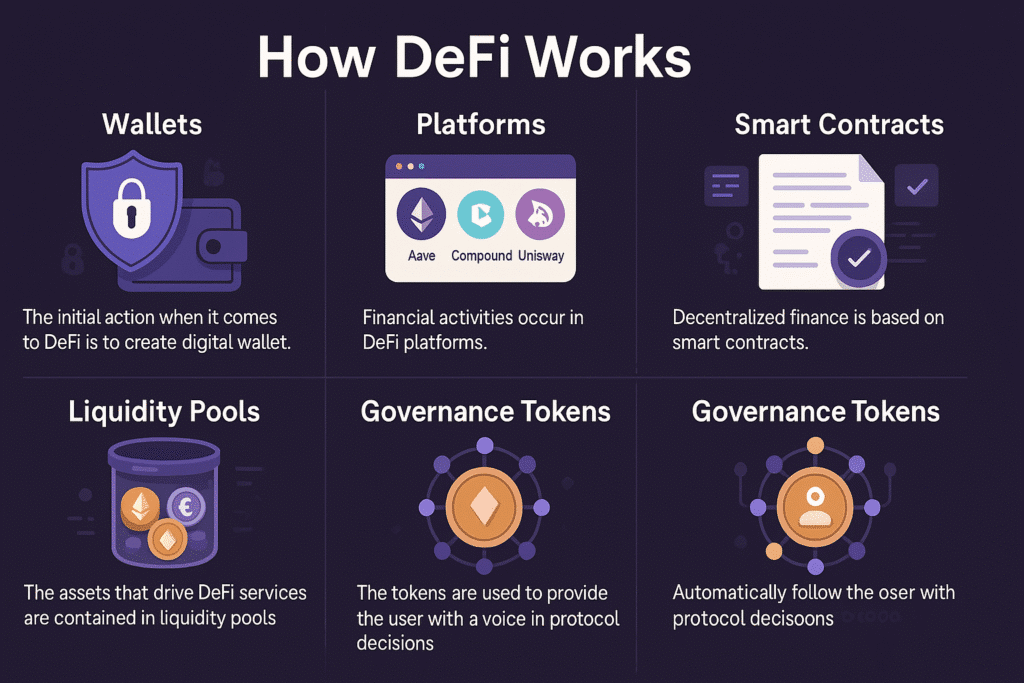
How DeFi Works
Wallets
The initial action when it comes to DeFi is to create a digital wallet. Such wallets as MetaMask or Trust Wallet hold tokens and provide direct interaction with blockchain networks. They are the entrance to all the decentralized services.
Also wallets delegate responsibility. In conventional banking, banks protect money. In DeFi, access is provided by using key numbers, and in the event of their loss, the funds are lost forever.
Platforms
Financial activities occur in DeFi platforms. Some examples of services include Aave, Compound, and Uniswap which allow borrowing, lending, and trading without a central authority. They are worldwide and do not need any paperwork.
Users, rather than bank,s provide the funds in the form of liquidity. That is why DeFi is accessible to everyone who has an internet connection and contributes to building a borderless financial ecosystem.
Smart Contracts
Decentralized finance is based on smart contracts. They automatically follow the meeting of conditions, like the disbursement of funds post-repayment.
They are blockchain-based, which makes them resistant to tampering and transparent. Coding errors, however, might lead to significant issues, and contracts cannot be modified easily once they are put in place.
Liquidity Pools
The assets that drive DeFi services are contained in liquidity pools. Users submit tokens and those tokens can be traded, borrowed, or lent out.
Contributors, on the other hand, receive fees or interest. This model substitutes the banks with a community based system, which spreads both risks and rewards among parties.
Governance Tokens
The tokens are used to provide the user with a voice in protocol decisions. Voters are allowed to vote on modifications, including modifying charges to the introduction of new functionalities.
This produces decentralized government. Rather than boardrooms making decisions, token holders all over the world determine the course of platforms.
DeFi Applications
Lending and Borrowing
Some of the most common applications of DeFi are lending and borrowing. Lenders can lend their tokens and gain interest on platforms like Aave, Compound and MakerDAO. The lenders secure loans with collateral, typically in crypto.
This forms a peer-to-peer credit market that is fast. It is freer than banks but high collateral will be demanded to decrease risk.
Decentralized Exchanges (DEXs)
Intermediary-free trade of tokens is possible through decentralized exchanges such as Uniswap and Curve. Orders are determined by algorithms and liquidity pools and not by the order books.
The outcome is quicker more open trading. The problems of slippage and temporary loss are however a problem to users.
Stablecoins
To DeFi, stablecoins such as USDC and DAI are a necessity. They are pegged to the U.S. dollar and make it less volatile and offer a sure method of storing value.
They are largely used in making payments, savings and lending. At times of financial crises within the market, having a stablecoin is a secure way of storing money.
Synthetic Assets
Synthetic assets expand access to global markets. Platforms like Synthetix create blockchain-based versions of stocks, commodities, or indexes.
This lets investors gain exposure to traditional assets without leaving crypto. But it also blurs lines between decentralized and regulated finance, raising legal questions.
Payments and Remittances
DeFi makes payments faster and cheaper. Transfers that take days through banks can be completed in minutes through blockchains.
Remittances especially benefit from this model. Workers sending money home avoid high fees that traditional banks and money transfer services charge.
Yield Farming and Staking
Yield farming and staking allow users to earn passive income by locking tokens into protocols. Rewards often come in the form of fees, interest, or new tokens.
Returns can be high, but risks are real. Market swings and smart contract exploits can quickly wipe out profits.
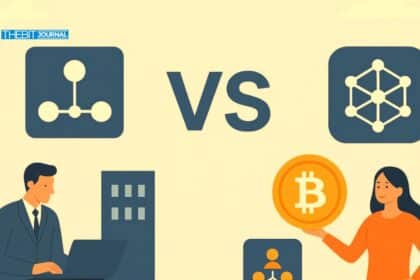
DeFi vs Traditional Finance
| Feature | DeFi | Traditional Finance |
| Access | Open to anyone with internet | Restricted by geography and rules |
| Middlemen | None, uses smart contracts | Banks and intermediaries |
| Transparency | Public blockchain records | Private institutional records |
| Speed | Near-instant settlement | Days for cross-border transfers |
| Control | User holds private keys | Banks hold customer funds |
| Risks | Bugs, hacks, regulation gaps | Fees, restrictions, slower speed |
DeFi Benefits and Risks
- Accessibility
Anyone can use DeFi because of a connection to the internet. This inclusivity would enable individuals in the underserved areas to borrow, save and send remittances without the presence of banks.
The fact that it significantly reduces barriers allows DeFi to bridge any financial access disparities, but it also shifts more of the burden on the user.
- Transparency
All the transactions of DeFi are transparent on blockchains. Such openness allows to easily check activity and minimize manipulation under the carpet.
The difficulty lies in the fact that the very transparency may make the users vulnerable in case their activity is exposed to a dangerous extent.
- Lower Costs
In the absence of banks and brokers, transaction charges are much less. Days and high cost services in the banking sector can be cheap and almost instant on the DeFi.
This difference is emphasized by cross-border payments that reduced the costs by several per cent up to fractions of a per cent.
- Innovation
New ideas are always presented by DeFi. This ecosystem has its own unique yield farming, staking and synthetic assets.
Such innovation leads to blistering development; it also implies that risks may occur as quickly as opportunities.
- Security Threats
Smart contracts are efficient and merciless. Hackers may steal millions with one fault.
One KPMG report estimated that more than three billion dollars was lost in DeFi hacks in 2023 to demonstrate the importance of enhanced security.
- Regulatory Uncertainty
Rules in DeFi continue to be developed by governments. The SEC in the U.S has been targeting specific protocols and Europe has adopted the MiCA framework.
Lack of clarity in regulations complicates long-term planning on the part of developers and investors.
- Volatility and User Risks
The majority of the DeFi tokens are very volatile and drop and surge in value significantly. Stablecoins minimise this risk, but they are not flawless.
User errors also add danger. In cases of loss of the private keys or transfer of tokens to an incorrect address, there is no possible recovery.
Blockchain and DeFi Connection
DeFi would not exist without blockchain. Ethereum is the largest base layer, but Solana, Avalanche, and Tron also play key roles.
Blockchains provide security and transparency, ensuring that records cannot be altered. They are the foundation that gives DeFi trust and resilience.
Security and Regulatory Context
Security Challenges
DeFi is still dominated by security. Messari cited that the majority of all crypto-related losses in 2022 were the results of decentralized finance attacks (60 percent).
In response to this, developers are putting money into code audits, bug bounties, and insurance products. These applications are meant to inspire trust and raise more users.
Regulatory Shifts
Defi is becoming a topic of interest to governments. The SEC is examining websites which look similar to securities markets in the U.S. The MiCA framework of Europe has more explicit guidelines on stablecoins and decentralized platforms.
These control measures demonstrate that regulation is on the way. Although it might restrict certain freedoms, it might also increase the stability within the industry.
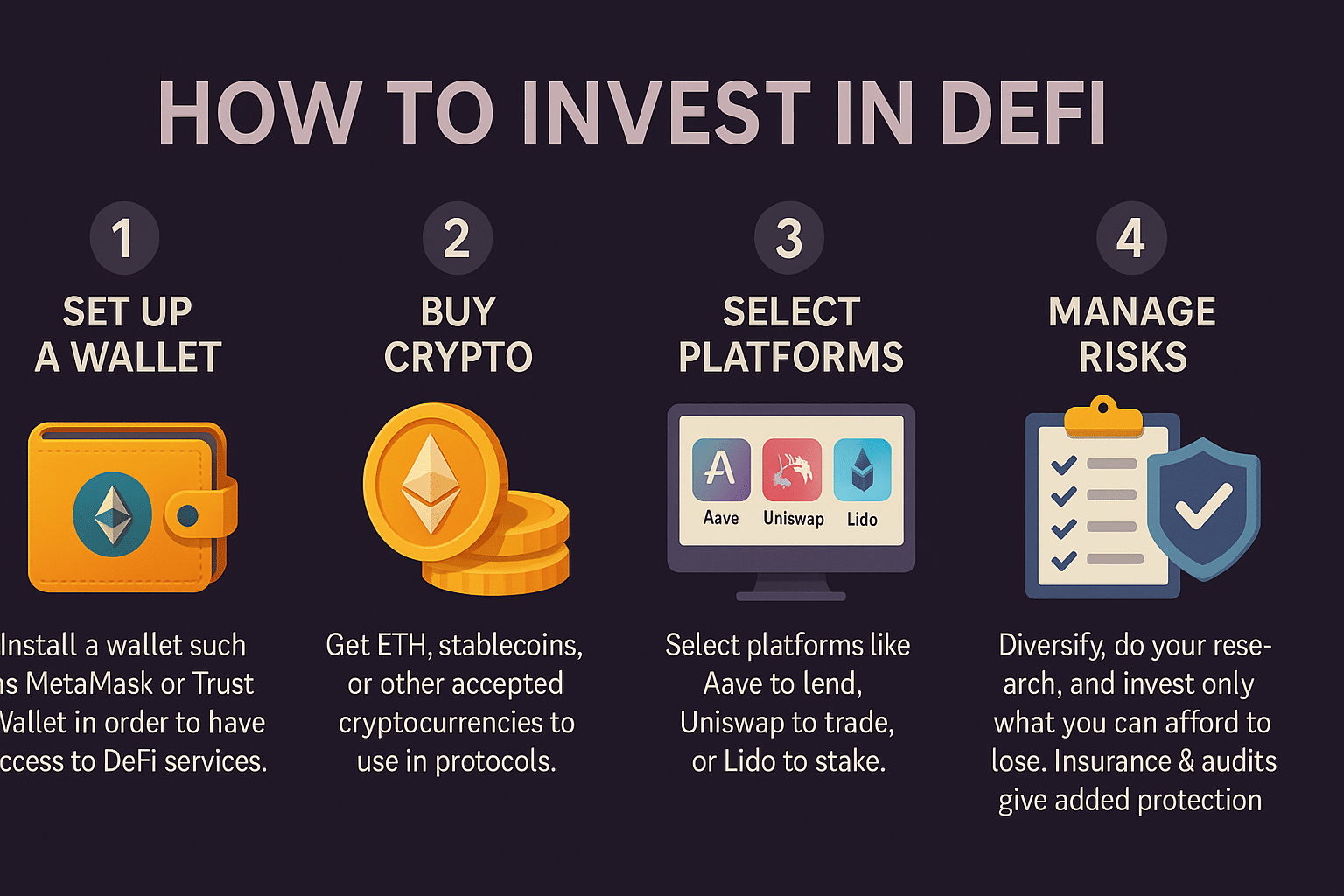
How to Invest in DeFi
Step 1: Set Up a Wallet
Install a wallet such as MetaMask or Trust Wallet in order to have access to DeFi services.
Step 2: Buy Crypto
Get ETH, stablecoins, or other accepted messages in order to communicate with protocols.
Step 3: Select Platforms
Select platforms like Aave to lend, Uniswap to trade or Lido to stake.
Step 4: Manage Risks
Diversify, do your research and invest only that which you can afford to lose. There are insurance and audits which are added protection.
Is Decentralized Finance the Future of Finance?
The utilization of DeFi is increasing. The value locked in protocols had topped over 70 billion dollars by 2024. Several millions of users communicate with DeFi every month.
Stability and regulation still control the traditional finance. But DeFi has more open alternatives, which are faster and cheaper. Analysts predict that the two systems will co-exist. As central bank digital currencies are being developed, the world markets could be reorganized with the implementation of the DeFi.
The Technology of Decentralized Finance (DeFi)
The DeFi ecosystem depends on a combination of technologies. Such blockchains as Ethereum and Solana offer the settlement layer. Smart contracts are agreements that are automated and that do not require human approval. Chainlink oracles introduce real-world information, e.g. asset prices.
Ecosystems such as Arbitrum and zkSync are used to scale and reduce the costs. Combined, these factors form the infrastructure that drives the decentralized markets.
The Future of DeFi
The second stage of DeFi can feature tokenized bonds, digital treasuries, and more expansive use of stablecoins. Cross-border remittances will be increasingly quicker and less expensive, and identity solutions can permit verification without financial institutions.
The Bank for International Settlements estimates that the trillions of value passing through decentralized systems in a single day would be a one-day outlook. The release of that future will rest in the factor of striking a balance between innovation and security and regulation.
Conclusion
Decentralized Finance (DeFi) is no longer a marginal experiment. It is an exploding trend that provides users with direct control over money via blockchain and smart contracts. Since its inception in lending and trading to the most recent stablecoins and synthetic asset, DeFi has grown to a larger scale.
But risks remain. Security vulnerabilities, absence of regulations and user errors are real problems. The future of DeFi will not be alone competing with banks, but possibly collaborating with them. They would together develop a more transparent, inclusive and innovative financial system.
FAQs about Decentralized Finance (DeFi)
What is Decentralized Finance (DeFi)?
It is a blockchain-based system that provides financial services without banks.
How does DeFi work in simple terms?
Users connect wallets to platforms that run on smart contracts, enabling lending, trading, and payments.
What are common DeFi applications?
Lending, decentralized exchanges, stablecoins, synthetic assets, and payments.
How safe is DeFi?
It carries risks such as hacks and bugs. Choosing audited platforms and using insurance helps reduce exposure.
DeFi vs traditional finance: which is better?
DeFi is faster and more open, while traditional finance offers stability and protection. Both have strengths and weaknesses.
What role does blockchain play in DeFi?
It provides a secure infrastructure where all contracts and transactions are recorded.
What are the biggest risks in DeFi?
Smart contract flaws, volatile tokens, regulatory uncertainty, and user errors.
Glossary of Key Terms
- Blockchain: A digital ledger that records transactions.
- Smart contract: Automated code that enforces rules.
- Decentralized application (dApp): An app built on blockchain networks.
- Stablecoin: A cryptocurrency pegged to stable assets like the U.S. dollar.
- Liquidity pool: Tokens locked in contracts to enable trading or lending.
- Governance token: A token that gives holders voting rights.
- Yield farming: Earning rewards by providing liquidity to protocols.
- Decentralized exchange (DEX): A marketplace for token swaps without intermediaries.
- Collateral: Assets locked to secure a loan.
- Private key: A unique code that controls access to funds.
Summary
Decentralized Finance (DeFi) is a blockchain-based system that provides services like lending, trading, and payments without banks. It is a program based on smart contracts and is traded on networks, including Ethereum and Solana. Applications of DeFi are decentralized exchanges, stablecoins and synthetic assets. DeFi is quicker, less expensive and open-ended than traditional finance, yet it has risks like hacks, volatility and vague rules. Adoption is on the increase and protocols worth billions and millions of wallets are used. Analysts do not think DeFi will eliminate banks but will co-exist and create a more inclusive and transparent future of finance.