
Stablecoins in DeFi are the backbone of the ecosystem, providing stability, liquidity, and trust that make decentralized finance possible.
In 2025, they will transfer more funds across blockchains than the combined Bitcoin and Ethereum. Stablecoins are used to power billions of dollars in day-to-day transactions conducted on DeFi protocols.
Why? There is wild pricing of crypto. In a day, an individual can lose or gain 10 percent in Bitcoin. Ethereum can increase twice in a month and lose a half of its value the next.
Such coins cannot be used by traders, investors and ordinary users to make payments and lend.
Stablecoins overcome this. A stablecoin in DeFi is a digital currency that is meant to maintain a constant value. They are tied to the American dollar, thus 1 stablecoin is around 1 dollar.
It is this stability that allows DeFi to be used to save, lend, and trade. In the absence of stablecoins, the DeFi ecosystem would not be as it is today.
A Short History of Stablecoins
Stablecoins are not new at all. The first, Tether (USDT) was launched in 2014. It guaranteed a one-to-one support with US dollars in banks.
This was the beginning of a new epoch: implementing the stability of traditional money into the speed and openness of blockchain.
In 2018 more coins were introduced. USD Coin (USDC), issued by Circle and Coinbase, gained popularity as it was audited and trusted by the institutions.
Meanwhile, MakerDAO presented DAI, which is the first significant crypto-collateralized stablecoin. It went through Ethereum in place of banks, but this time in smart contracts.
Then was the DeFi Summer of 2020. There was a flood of billions of dollars into lending platforms and decentralized exchanges. The use of stablecoins was almost in every transaction.
However, history is a lesson: In 2022, UST (TerraUSD) crashed. It was a stablecoin that was not really backed by any algorithm. The loss of value of this product was worth $40 billion when its design went wrong. The weakness of such models became apparent in this crash.
This crash showed the dangers of weak models.By 2025, stablecoins are stronger, bigger, and more important than ever. Over $150 billion worth of stablecoins are in circulation, according to Messari. They are used for trading, saving, payments, and more.
What is a Stablecoin in DeFi?
In layman’s terms,
- A stablecoin is a cryptocurrency that maintains a fixed value.
- DeFi Financial services that are built on blockchain without banks.
- A stablecoin in DeFi is a stable digital currency that is utilized within DeFi platforms to trade, lend, borrow and make payments.
Stablecoins are the dollars of DeFi. Stablecoins are the cash registers that keep everything running, which means that they are analogous to gold and oil, respectively.
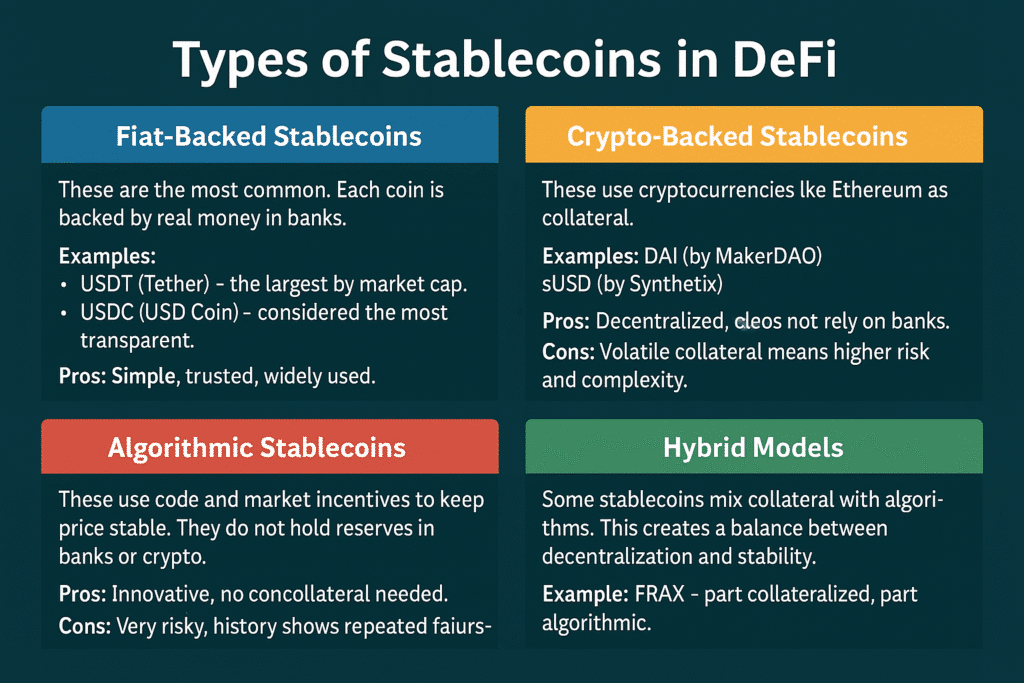
Types of Stablecoins in DeFi
Fiat-Backed Stablecoins
These are the most common. Each coin is backed by real money in banks. For example, for every 1 USDC in circulation, Circle holds $1 in reserves.
Examples:
- USDT (Tether) – the largest by market cap.
- USDC (USD Coin) – considered the most transparent.
- BUSD (Binance USD) – regulated until 2023, but now phased out.
Pros: Simple, trusted, widely used.
Cons: Depend on banks and regulators. If reserves are not managed well, risk rises.
Crypto-Backed Stablecoins
These use cryptocurrencies like Ethereum as collateral. To mint $100 of DAI, you might lock $150 of ETH. If ETH falls in value, you may need to add more collateral or risk liquidation.
Examples:
- DAI (by MakerDAO)
- sUSD (by Synthetix)
Pros: Decentralized, does not rely on banks.
Cons: Volatile collateral means higher risk and complexity.
Algorithmic Stablecoins
These use code and market incentives to keep price stable. They do not hold reserves in banks or crypto. Instead, they change supply when prices move.
Examples:
- TerraUSD (UST) – collapsed in 2022.
- AMPL – an experimental model.
Pros: Innovative, no collateral needed.
Cons: Very risky, history shows repeated failures.
Hybrid Models
Some stablecoins mix collateral with algorithms. This creates a balance between decentralization and stability.
Example:
- FRAX – part collateralized, part algorithmic.
Pros: Flexible, experimental.
Cons: Complexity creates more risk.
Why Stablecoins Matter in DeFi
DeFi would not work without stablecoins. Here’s why:
- Stability: Crypto is too volatile. Stablecoins give users confidence.
- Liquidity: Most DeFi pools trade against stablecoins.
- Unit of account: People measure gains and losses in dollars. Stablecoins bring that into DeFi.
- Access: Anyone with a wallet can use stablecoins, even without a bank account.
They are not just tokens. They are the foundation of DeFi.
Use Cases of Stablecoins in DeFi
Trading and Hedging
Traders use stablecoins to move in and out of positions quickly. Instead of cashing out to banks, they park money in USDT or USDC.
Example:
A trader sells ETH at $3,000 and holds USDC. If ETH drops to $2,500, they can buy back more ETH with the same USDC.
Lending and Borrowing
On platforms like Aave, Compound, or MakerDAO, users deposit stablecoins to earn interest. Others borrow stablecoins by putting up collateral.
This creates an entire credit system without banks.
Payments
Stablecoins are quicker and less expensive as compared to bank wires. International payments which require several days with SWIFT can be carried out in a few seconds on the blockchain.
Example:
A freelancer in India can get USDC sent by a US based client within seconds, at a lower fee compared to PayPal or banks.
Cost Savings and Inflation Protection
In nations that have unstable currencies such as Argentina or Turkey, individuals purchase stablecoins to guard against savings. They do not keep pesos or lira, but digital dollars.
This has rendered stablecoins a savior in emerging markets.
Liquidity on DEXs
Decentralized exchanges run on stablecoins The vast majority of crypto pairs are traded against USDT or USDC This produces greater liquidity and solid prices.
Risks, Regulation, and the Future of Stablecoin in DeFi
Risks of Stablecoins in DeFi
Stablecoins are powerful, but they are not perfect. Every type has risks. Understanding these risks is key before using them in DeFi.
- Regulatory Risk
Governments worldwide are still deciding how to regulate stablecoins. The SEC in the United States says some stablecoins may be securities. The European Union has passed the MiCA regulation, requiring issuers to prove they hold full reserves.
Unclear rules create uncertainty. A country could ban or restrict a stablecoin, making it hard to use.
- Collateral Risk
Stablecoins must be backed by something. If reserves are weak or mismanaged, the coin can lose its peg.
Case Study:
Tether (USDT) has faced questions for years about whether it holds enough real reserves. While it remains the largest stablecoin, trust issues persist.
- Algorithmic Risk
Algorithmic stablecoins are the riskiest. They depend on smart contract design and market confidence.
Case Study: TerraUSD Collapse
In 2022, TerraUSD (UST) lost its peg. Billions in value were destroyed, wiping out investors worldwide. This showed how fragile algorithmic designs can be.
- Smart Contract Hacks
Stablecoins live on blockchains. If the smart contracts that manage them are hacked, funds can be stolen. According to Chainalysis, DeFi hacks caused more than $3 billion in losses in 2023. Stablecoins are often at the center of these attacks.
- Centralization Risk
Many fiat-backed stablecoins rely on banks and issuers. If regulators shut down a company or freeze reserves, the stablecoin could fail. This makes them less decentralized than Bitcoin or Ethereum.
Regulation and Security
Stablecoins have grown too big to ignore. Regulators are stepping in to protect users and ensure financial stability.
United States
The SEC and Treasury want stablecoin issuers to hold 100 percent reserves. Bills in Congress propose rules requiring issuers to be licensed like banks.
European Union
The MiCA law, passed in 2023, sets strict requirements for stablecoin issuers. They must publish audits, hold reserves, and follow capital rules.
Asia
- Singapore has introduced licensing rules for stablecoin issuers.
- China bans private stablecoins but promotes its own digital yuan.
- Japan now allows stablecoin issuance under banking rules.
Global Impact
The IMF says stablecoins could support financial inclusion if regulated well. MIT research highlights that regulated stablecoins may help central banks build safer payment systems.
Risk vs Reward of Stablecoin Types
| Type | Reward Level | Risk Level | Example Coins |
| Fiat-Backed | High trust, easy to use | Low to Medium | USDT, USDC |
| Crypto-Backed | Decentralized, open | Medium | DAI |
| Algorithmic | Innovation, no collateral | Very High | TerraUSD (failed), AMPL |
| Hybrid | Balance of models | High | FRAX |
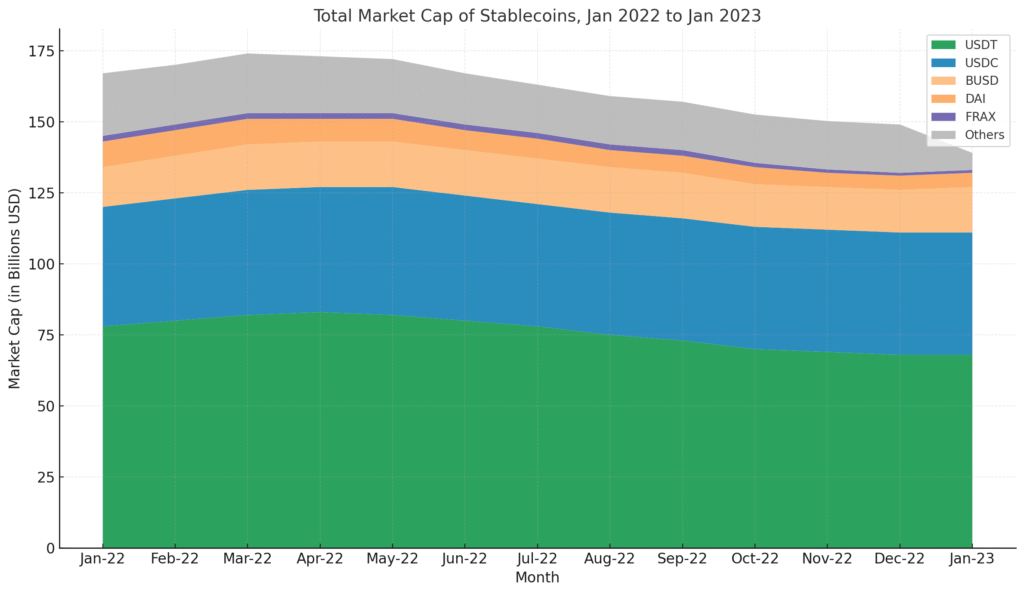
Stablecoin Market Caps in 2025
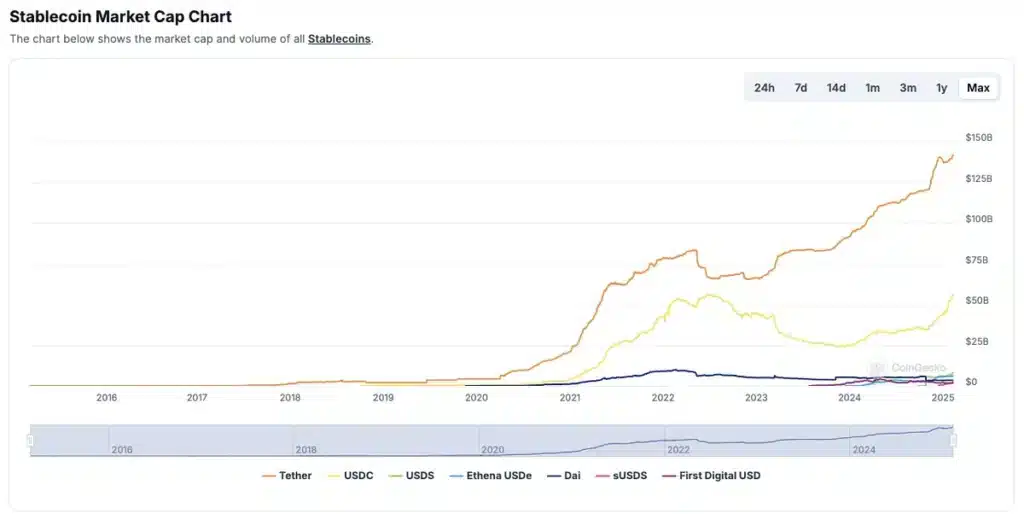
Stablecoin Growth Over Time (2019–2025)
The Future of Stablecoins in DeFi
Stablecoins are not just growing — they are shaping the future of finance.
Institutional Adoption
Big companies like Visa and PayPal now use stablecoins for payments and settlements. In 2023, Visa announced it would use USDC on the Ethereum and Solana networks for cross-border payments.
CBDCs vs Stablecoins
Central banks are creating their own digital currencies, called CBDCs. Examples include China’s digital yuan and the EU’s plans for a digital euro. Some experts believe CBDCs and stablecoins will compete. Others think they will work together.
Growth in Emerging Markets
Stablecoins are helping people in high-inflation countries save and transact. In Argentina, where inflation passed 100 percent in 2023, stablecoins became a lifeline. People used USDT and USDC to protect their money.
Predictions
- Messari analysts predict stablecoin supply could top $300 billion by 2030.
- CoinDesk reports stablecoins may become a bridge between banks and DeFi.
- MIT research says stablecoins could help redesign global payments.
Conclusion
Stablecoins in DeFi are no longer experimental anymore. They have become the foundation of DeFi and one of the most powerful instruments in the crypto industry in 2025. They provide stability, trust and speed to users in a world of volatile assets.
However, stablecoins are risky as well. They are not flawless as collateral issues, regulatory uncertainty, and previous failures serve as reminders of that fact. Their future will rely on transparency, audits and tougher rules.
Stablecoins and CBDCs will coexist, most probably in the future. Togethe,r they would be able to pay faster, cheaper, and more transparently across the globe. At this point, only stablecoins do the work of the bridge between traditional finance and blockchain innovation.
Frequently Asked Questions For Stablecoins in DeFi
What is a stablecoin in DeFi?
It is a cryptocurrency tied to stable assets, mainly used in lending, trading, and payments inside DeFi platforms.
Which stablecoins are most trusted?
USDC is considered the most transparent, while USDT is the largest by circulation.
Can I earn passive income with stablecoins?
Yes. Lending stablecoins on DeFi platforms can earn interest from 3 to 10 percent.
Are stablecoins better than banks?
They are faster and cheaper, but they do not yet replace banks. Risks like hacks and regulation still exist.
What was the TerraUSD collapse?
It was a failed algorithmic stablecoin in 2022 that lost its peg and caused $40 billion in losses.
How do stablecoins help in poor economies?
People in high-inflation countries use them to store value in digital dollars, protecting savings.
Will stablecoins survive regulation?
Yes. Regulation will likely make them safer and more widely adopted.
Glossary of Key Terms
- Stablecoin: A crypto asset with stable value, often tied to the US dollar.
- DeFi: Decentralized finance, services like lending and trading on blockchain.
- Collateral: Assets backing a loan or token.
- Liquidity Pool: A pool of tokens that allows decentralized exchanges to run.
- Yield Farming: Earning rewards by lending or staking assets in DeFi.
- DEX: Decentralized Exchange where users trade directly.
- Fiat: Government-issued currency like USD or EUR.
- CBDC: Central Bank Digital Currency issued by governments.
- MiCA: EU law regulating crypto assets including stablecoins.
- Overcollateralization: Putting up more value than borrowed to reduce risk.
Summary
In 2025, stablecoins will be at the core of DeFi. They are in circulation to the tune of over 150 billion dollars and they can be used in lending, trading, payments, and international money transfers. USDT and USDC are the most popular coins backed by Fiat currency, whereas those that are popular with decentralization enthusiasts are crypto-backed DAI. Risks still exist, including collateral and regulation as well as algorithmic failures such as TerraUSD.
To ensure stablecoins are safe, regulators in the US, Europe, and Asia are developing new regulations. Innovation is also increasing rapidly in emerging markets, where inflation is making people hold digital dollars. Financial institutions such as Visa and PayPal are using stablecoins, and central banks are experimenting with CBDCs. Nevertheless, stablecoins will go on to dictate the future of money and play a very crucial role in the development of decentralized finance.