












This article was first published on The Bit Journal.
Blockchain networks like Ethereum gave a scalability challenge. They can process only a limited number of transactions on their main chain (approximately 15 tx/s for Layer-1 Ethereum).
This causes congestion and high “gas” fees when demand is high. Layer 2 scaling solutions are meant to address this.

They are independent networks that conduct transaction processing off the Ethereum blockchain and submit the results to Ethereum’s base layer.
Put simply, L2 solutions can batch many transactions or perform computation off the chain and only send a summary back to Ethereum. That can ramp up throughput many times over and slash fees.
L2 networks now settle millions of transactions daily for fees that are commonly below 0.01 each, an extraordinary development pointing to how significant L2 has become for Ethereum advancement in 2025.
What are Layer 2 Scaling Solutions?
L2 scaling solutions are the protocols that work on top of a live blockchain (Layer 1). For Ethereum, an L2 is a secondary network that extends the capabilities of Ethereum and inherits its security guarantees.
An L2 does manage transaction execution off chain but it still depends on Ethereum for effective and final settlement.
L2s shift bulky transactions off-chain, ensuring the main Ethereum network does not become a bottleneck. This is essential as Ethereum’s Layer 1 can only handle a few transactions per second.
For instance, Amberdata claims that L2s have the capacity to hit many thousands of transactions per second, while Ethereum L1 only has a TPS around 15.
Pros of Layer 2 solutions include higher throughput, much lower fees and maintaining security.
On Ethereum, majority of those bundled transaction means that gas fees are divided equally between all users in the batch. This is what the Ethereum Foundation describes as “massively reduces” per-user fees, which in turn makes Ethereum way more affordable.
Importantly, L2s are still anchoring their contents onto Ethereum thus they benefit from Ethereum’s strong security.
In other words, Layer 2 scaling solutions allow Ethereum to process many more transactions without compromising its strengths.
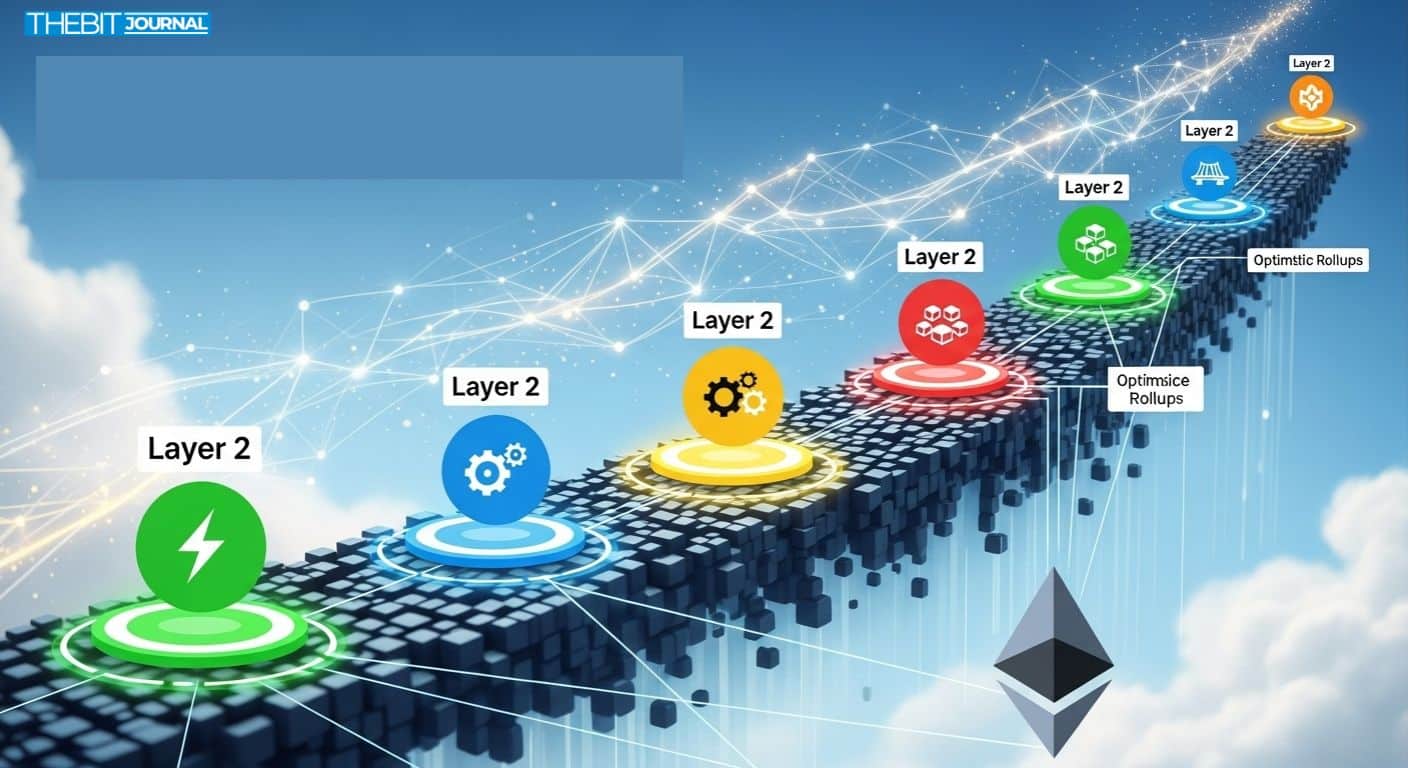
How do Layer 2 Networks Work?
Layer 2 solutions have different technical mechanisms, but they’re looking to accomplish the same goal which is to Roll volume off the main chain. The rollups, state channels and sidechains are the most frequently used.
Rollups: This is the most commonly used approach for L2 today. Rollups perform transactions off-chain, and then submit summarized information (or “proofs”) to Ethereum. There are two main styles:
- Optimistic rollups: They presume transactions are valid and execute a fraud-proof check only if an outside party flags for potential error. In operation, implementations of Optimistic rollups like Arbitrum and Optimism bundle hundreds or thousands of transactions into a batch, submit the batch to Ethereum and have a multi-week “challenge period”. This is a cost-effective design in Ethereum, as the system only processes one large batch instead of many small payments.
- Zero-knowledge (ZK) rollups: Produce a cryptographic proof of the validity of each batch. ZK rollups such as zkSync and StarkNet aggregate transactions off-chain and add a compact zero-knowledge proof to the batch. Since the proof mathematically proves correctness, there is no such long challenge window. Ethereum can just accept the batch immediately. ZK rollups can be faster to finalize on-chain, although they have also traditionally been more challenging to build.
State Channels: These enable a group of users to transact many times with each other directly without those on-chain transactions, settling only the net difference on-chain.
One example is Bitcoin’s Lightning Network, which provides a state-channel network where parties can send payments to each other quickly, yet have simple settlement on the blockchain with nothing more than initialization and finalization. State channels are fantastic for repeated interactions between the same parties, they only have to pay fees on opening and closing a channel.
Sidechains: A sichechain is an independent blockchain that is attached to its parent blockchain using two-way bridge.
Sidechains such as Polygon PoS have their own validators and consensus mechanisms. They can handle a high volume of transactions and charge very low fees because they don’t use Ethereum to process every block. But, sidechains do not share Ethereum’s security. Instead, they trust the security model of their network. (Note: a true Layer 2 actually inherits security from Ethereum, while sidechains impose an additional trust assumption.)
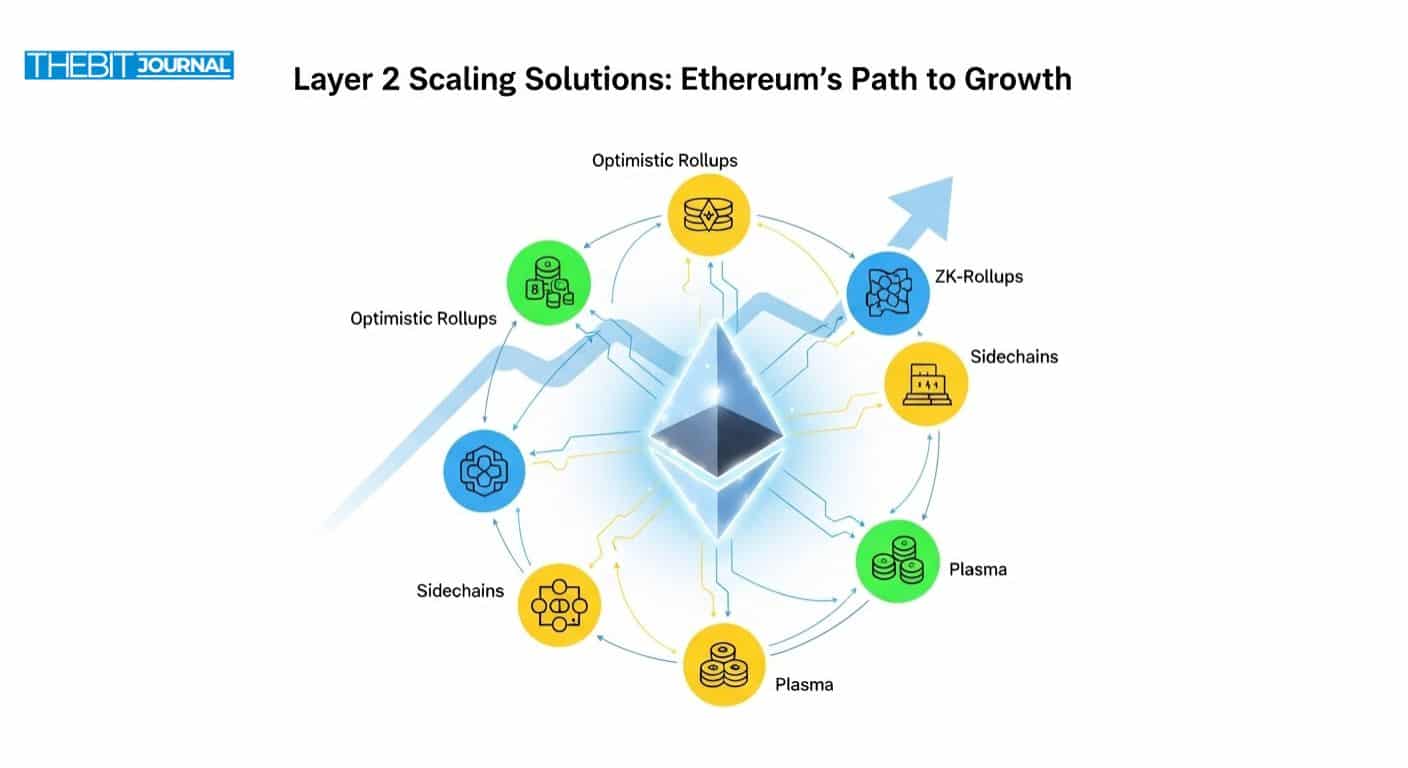
For clarity, the main L2 types are summarized in Table 1 below:
| Layer 2 Type | Key Idea and Security | Examples |
| Optimistic Rollup | Bundles tx off-chain, submits only minimal data to L1; uses a fraud-proof period to ensure validity | Arbitrum, Optimism |
| ZK Rollup | Bundles tx off-chain and submits a succinct cryptographic proof on L1; no challenge period needed | zkSync, StarkNet |
| State Channel | Users transact directly off-chain in a “channel”; only open and close transactions touch L1 | Bitcoin Lightning Network |
| Sidechain | Independent chain with its own security, bridged to Ethereum; secures more tx cheaply but trust is separate | Polygon PoS |
Irrespective of kind, all L2 solutions follow the same pattern: process non interactive transactions off-chain to light Ethereum’s burden, then anchor the result on Ethereum itself.
This “off-chain processing” is precisely what allows L2s to scale Ethereum’s capacity. As one review says, moving work off-chain lowers cost without sacrificing the security of the base layer.
Why Ethereum Needs Layer 2 Scaling Solutions
The success of Ethereum has driven heavy demand, hence it regularly processes more than a million transactions a day.
At times of high demand, that can far exceed what Ethereum’s Layer 1 is capable of processing.
When too many users attempt to transact at once, the network gets clogged and gas fees soar. An unsustainable financial model of driving away smaller users.
Layer 2 scaling solutions remove this bottleneck while upholding Ethereum’s key principles.
The blockchain trilemma is one can get two of either decentralization, security, and scalability.
Ethereum’s community decided to maximize decentralization and security, which means base-layer throughput is capped. The missing leg is the scalability, which is provided by L2 solutions.
By moving transactions off-chain, L2s can grow the number of transactions without compromising security or decentralization.
The difference it makes to fees is dramatic. For instance, industry leaders forecasted L2 transaction costs would drop by some 80–90% following the Ethereum “Dencun” upgrade (EIP-4844) was implemented.
Average gas fees on Ethereum dropped from roughly $5.90 in early 2024 to about $3.78 by 2025, and most small transactions on L2 now cost mere cents at most.
This makes using Ethereum possible again for the average person and applications. Lower fees on L2 services “will facilitate accessibility, especially for decentralized finance,” Polygon’s chief scientist wrote in response to the vote above.
To sum up, Layer 2 solutions are essential to Ethereum because they enable the network to scale without altering its fundamentals; they retain security and decentralization, whilst multiplying transactions per second by orders of magnitude, slashing cost.
Without L2, scaling the network would take dangerous short cuts such as blowing block sizes out of proportion (which would centralize the chain).
Expert Analysis: Ethereum’s Rollup-centric Roadmap
From industry experts to Ethereum’s own co-founder Vitalik Buterin, it has been reiterated that Layer 2 scaling is the ground on which the future of Ethereum plays out.
On October of 2024, Vitalik published a Roadmap that targeted 100000 TPS for Ethereum. He added that this would be realised through Layer 2 solutions (optimistic and ZK rollups) with sophisticated data compression.
His approach is “rollup-centric”. Vitalik makes a comparison to a court system, where the main chain enforces security and contracts, while entrepreneurs build fast solutions (L2s) on top.
Other experts echo this vision. Karl Floersch, co-founder of Optimism (an optimistic rollup) said post Ethereum’s Dencun upgrade, Layer 2 transaction fees should decrease by at least 90%.
Declan Fox from Linea (another rollup) also predicted 65-80% reductions on rollup fees.
Polygon Labs noted that the “blob” storage in Dencun eliminates a lot of the work L2s needed to do to save expenses.
All these deep insights emphasize one thing: L2 solutions are providing exponential improvements.
Going forward, analysts predict that Ethereum and its L2 ecosystem will continue to grow. On-chain data confirms the increase in L2 activity. TVL on L2 rollups broke $39 billion after rising 262% over five months.
Millions of people now use L2 networks for payments, DeFi trading and much else. This is consistent with research which warns of only advanced scaling (mostly on L2) can support Ethereum’s mass use cases.
Impacts and Adoption of Layer 2 Solutions
The real impact of Layer 2 is already apparent. L2 networks have allowed Ethereum users of today to operate faster and more affordably.
Stats are being reported that say Layer 2s are doing millions of transactions per day. Gaming platforms, NFT projects and DeFi protocols have all begun to favor L2 chains to bypass high gas prices.
The proliferation of L2 is driving new revenue and activity. Coinbase’s Base chain (an L2) now averages $185k in daily on-chain fees, outpacing Arbitrum’s $55k.
The Layer 2 networks today are also more secure and user-friendly than some of the early experiments. Numerous L2 projects audited their systems and constructed bridges to make it easy to move assets between chains.
Where in previous years there were dozens of small L2 prototypes, 2024-25 saw consolidation into a few leaders (Arbitrum, Optimism, Base, zkSync …) which get heavily used.
On top of that, upgrades to Ethereum itself (such as July’s Dencun upgrade) lowered L2 costs directly and significantly making the L2 ecosystem more resilient.
All that adds up to a new era, blockchains are solving their fee and speed issues through Layer 2.
Essentially, L2s are ushering in a “payments and dApps boom” on Ethereum. Projects that had long ago been priced out by gas are back in play.
The creation of an NFT on L2 can now cost pennies. L2 DeFi swap fees have now been slashed by over 80% according to analytics. In a nutshell, L2 scaling solutions are ensuring that it is safe and possible to use Ethereum again, both for the average users and for institutions.
Conclusion
Layer 2 scaling solutions is the secret to Ethereum fulfilling its potential. These protocols are processed off-chain to clear up traffic on the over-crowded main chain, then relaying those blocks back to Ethereum.
This is how they can process thousands of transactions per second and drastically reduce fees, all the while maintaining their security.
Layer 2 scaling solutions are the growth solution for Ethereum; they enable mass user adoption without sacrificing decentralization.
L2 networks will continue to lower fees and increase transaction capacity as the technology matures, meaning Ethereum will become more accessible than ever to all.
Frequently Asked Questions About Ethereum Layer 2 Solutions
What are Ethereum Layer 2 scaling solutions?
Ethereum Layer 2 scaling solutions refer to secondary systems or protocols that are created on top of Ethereum’s existing blockchain (its mainnet) in order to help it become faster, as well as a more efficient network for processing transactions. Off-chain, or in batches, they handle transactions then record these on Ethereum.
How do Layer 2 protocols reduce gas fees on Ethereum?
Layer 2 networks bundle up (or common “roll up”) many user transactions into a single Ethereum transaction.
What kind of Layer 2 solutions are there?
The main types are: Optimistic Rollups, Zero-Knowledge (ZK) Rollups, State Channels, and Sidechains. There are trade-offs in speed, cost and trust assumptions for each method, but all are designed to scale better.
What is the importance of Layer 2 solutions for Ethereum’s future?
Layer 2 solutions are important because they solve the Ethereum scalability problem without sacrificing its key value propositions. Layer 1 of Ethereum is secure and decentralized, but with limited capacity. L2 networks scale capacity massively (to 1000’s of TPS) while lowering fees, making it feasible for Ethereum to accommodate mass adoption.
Glossary
Layer 1 (L1): The blockchains infrastructure (L1), where transactions are settled and all nodes secure the system. L1 emphasizes decentralization and security.
Layer 2 (L2): A second layer network built on top of Layer 1 that processes transactions off chain, or in lump sums, to increase speed and decrease fees. Examples include rollups and sidechains.
Gas Fees: The amount paid to miners/validators on a blockchain in order for them to process your transactions. It’s gas fees on Ethereum that L2 solutions are trying to mitigate.
Transactions Per Second (TPS): How fast the system can process transactions. Ethereum L1 can do ~15 TPS, while many L2s can process thousands of TPS.
Total Value Locked (TVL): The sum of the value that is trapped in a DeFi protocol or blockchain. TVL on Ethereum L2 networks is now tens of billions of dollars.
References