
This article was first published on The Bit Journal.
DeFi tokens seem to be making a comeback on Wall Street’s Radar even as the sector is getting scrutinized left and right over security issues and dwindling total value locked (TVL).
There has been renewed interest in Ethena’s ENA and Morpho’s MORPHO, two governance-focused DeFi tokens that have attracted backing from firms including Coinbase Ventures, Janus Henderson, Apollo Global Management, Paradigm & a16z.
Institutional Capital Flooding Into DeFi Infrastructure
The strongest signal was back in early June when Coinbase Ventures announced they’d bought ENA tokens straight from the open market. That same week, they also made plans to expand Ethena products to their user base of more than 100 million customers. Coinbase also deepened their existing partnership with Ethena to create on-chain savings products.
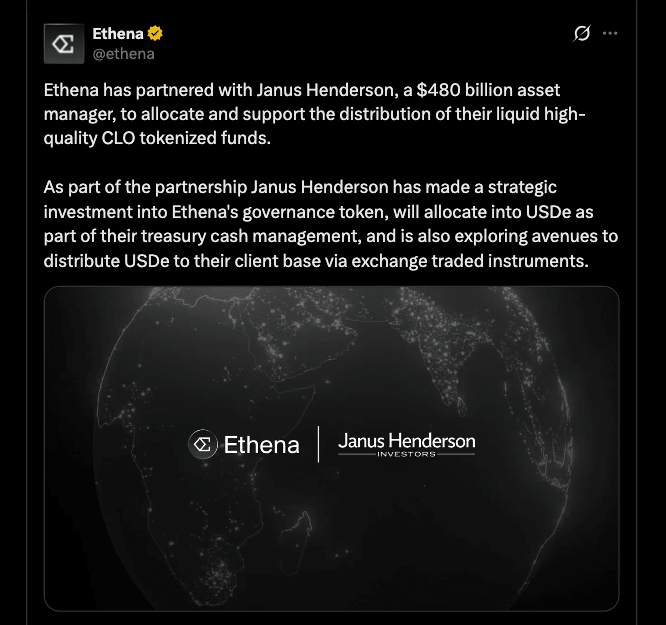
A few days later, global asset manager Janus Henderson also revealed an investment in ENA while exploring distribution opportunities involving Ethena’s USDe synthetic dollar product.
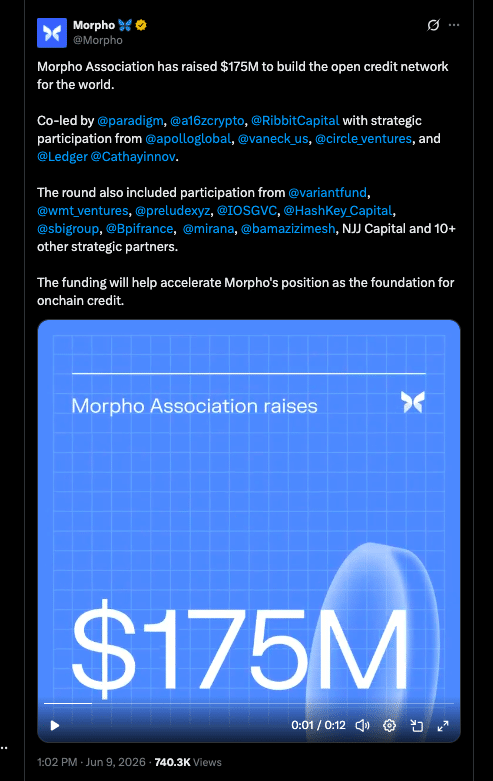
Meanwhile, Morpho just closed one of the biggest funding rounds in DeFi this year. The protocol raised $175 million in a round backed by Paradigm, a16z crypto, and Ribbit Capital valuing the project at roughly $2 billion.
Why MORPHO is Getting So Much Attention
Morpho has quietly become one of the fastest growing lending protocols out there in crypto. The platform reports over $11 billion in deposits and serves institutional users like Coinbase, Binance, Kraken, Bitwise, Galaxy, and Anchorage Digital signed up to use their platform.
Apollo Global Management also secured the right to buy up to a massive 90 million MORPHO tokens over the course of 4 years in exchange for a partnership focused on decentralized credit markets.
Supporters argue that this relationship gives Morpho access to a whole more institutional lending demand than many of its competing protocols.
Security Risks Still Hanging Over DeFi
Even as more institutional money flows into the sector, security risks remain one of the biggest concerns.
The DeFi sector has suffered through some serious security breaches this year, and that has understandably put a lot of investors on edge about issues like protocol vulnerabilities, governance attacks, bridge failures and compromised private keys. These risks are part of why TVL across the market has gone down.
However, it seems like some institutional investors are starting to separate the stronger protocols from weaker ones. Many are actively concentrating capital into the projects that have clear business models, established custody partners and solid collateral structures instead of abandoning decentralized finance altogether.
This somehow explains why certain DeFi tokens are attracting fresh capital even as overall sentiment in the sector is still mixed.
The Big Question: Do Governance Tokens Capture Value?
One big issue surrounding both ENA and MORPHO is whether token holders actually benefit from the growth of these protocols.
Neither of these tokens actually represent equity ownership in the organizations. What holders get instead are governance rights, which lets them be a part of the decision-making process on the protocol.
This makes a difference because increased adoption doesn’t automatically mean higher token valuations.
For example, Ethena’s USDe has been seeing more growth in circulation, while Morpho’s lending activity has been expanding at a rapid pace.
But investors are still left wondering just how much of that economic activity is actually benefiting token holders as opposed to users, liquidity providers, or the protocol operators.
Conclusion
The latest wave of institutional activity is proof that DeFi tokens are once again on the radar for Wall Street. When one looks at what institutional firms are up to, they seem to be making a long-term bet on the infrastructure of the space.
Coinbase, for example, is leveraging thena’s products for its ecosystem. Janus Henderson is exploring treasury and tokenized assets use cases. Apollo is positioning itself within on-chain credit markets through Morpho.
Still, the security concerns and the question of how much value actually gets captured by the tokens are still unresolved.
Glossary
DeFi (Decentralized Finance): Financial services built on blockchain networks without the traditional middlemen.
Governance Token: A token that gives its holders a vote in determining what the protocol should be doing.
TVL (Total Value Locked): Total amount of assets that have been deposited into a DeFi protocol.
USDe: Ethena’s synthetic dollar product
On-Chain Credit: It’s lending and borrowing that gets done directly on the blockchain.
Frequently Asked Questions About DeFi Tokens
Why are Wall Street firms buying DeFi tokens?
A lot of them see DeFi as the kind of infrastructure that could support lending, payments, savings products and tokenized assets in the future.
What is the significance of Coinbase backing ENA?
Coinbase Ventures purchased ENA tokens and is integrating Ethena products into services aimed at its large user base.
Why is Morpho attracting institutional investors?
Morpho has surpassed $11 billion in deposits and has relationships with major crypto exchanges, custodians, and asset managers.
Are ENA and MORPHO equity investments?
No. Both are governance tokens which give their holders a vote not an actual stake in the organization.
What’s the biggest risk for DeFi tokens really is?
Security issues, regulatory uncertainty and the ongoing issue over whether or not governance tokens can really capture the value that gets generated by the protocols they’re overseeing.
References