






Ripple’s XRP market showed signs of steadier sentiment as exchange supply continued to fall. XRP ETF inflows also supported spot demand while Binance reserves moved near their lowest level in almost three months.
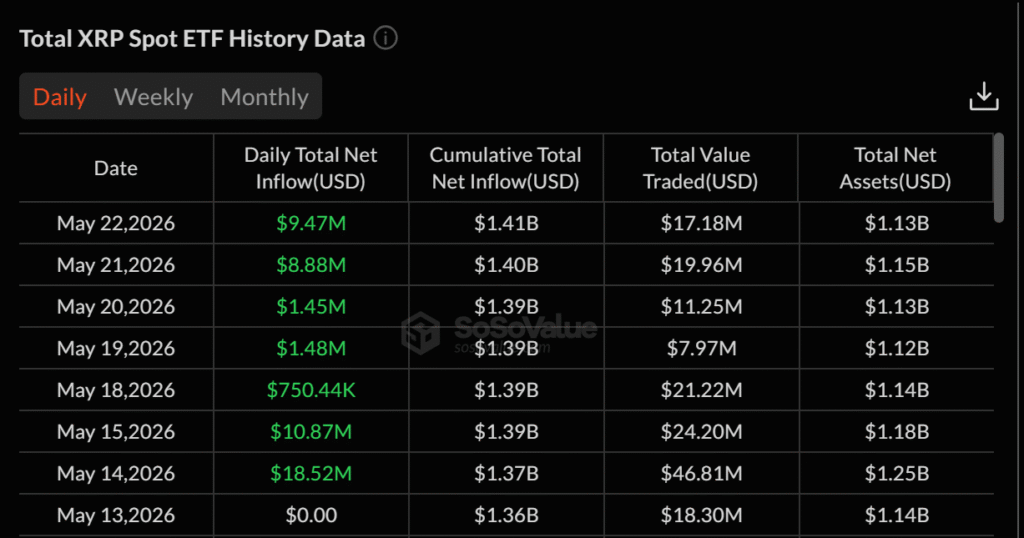
Daily XRP ETF inflows reached about $9.47 million on May 22. Earlier sessions added nearly $18.52 million and $10.87 million.
The six-day accumulation streak pushed cumulative inflows near $1.41 billion. ETF-held assets also stayed above $1.13 billion.
XRP ETF Inflows Support Tighter Exchange Supply
At the same time, Binance XRP reserves fell toward roughly 2.70 billion XRP. The decline showed tighter supply on one of the largest crypto exchanges.
XRP had already started stabilizing before Binance reserves moved lower. Market activity also slowed as volatility weakened across the broader altcoin market.
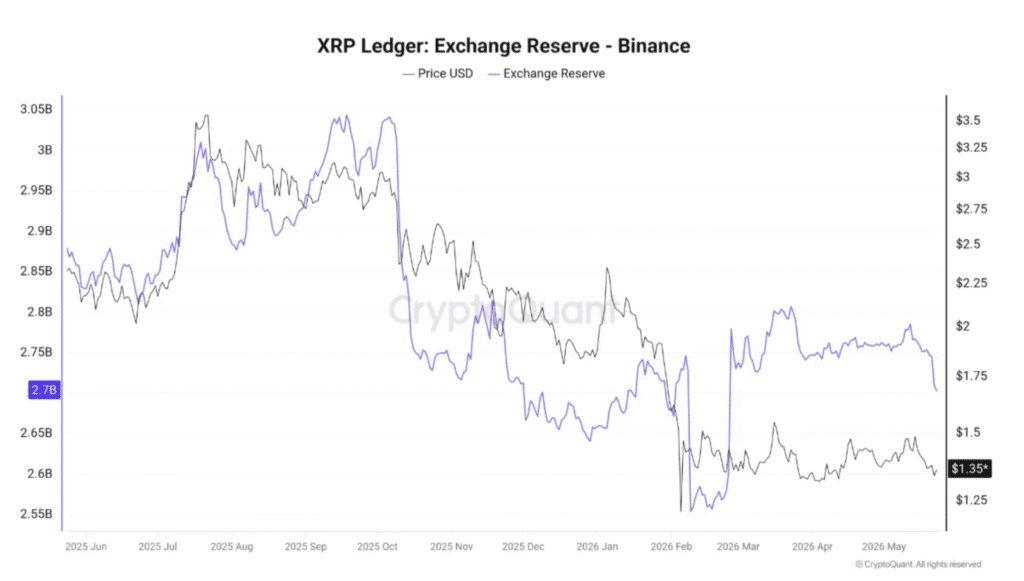
Between July and October 2025, Binance reserves stayed closer to 3.0 billion XRP. During that period, XRP traded above the $3.0 level.
The recent decline in reserves showed that fewer tokens were available for immediate selling. Still, lower exchange balances do not confirm a bullish breakout by themselves.
Binance Reserves Move Lower
Binance XRP reserves later moved toward the 2.70 billion XRP area. The price also consolidated near the wider $1.35 region.
This reserve decline suggested that some holders moved XRP away from exchanges. That can reduce short-term sell-side liquidity.
However, the same move also came during weaker trading participation. This means the market still lacked strong speculative demand.
XRP ETF inflows Support Spot Demand
XRP ETF inflows added pressure to already tightening supply conditions. The latest demand came while exchange reserves were still falling.
Active XRP products recorded several sessions of inflows without an outflow during the reported streak. That helped improve market confidence.
ETF demand also showed that institutional participation remained present. This support became more important as spot supply continued to shrink.
Spot Buyers Absorb Supply
Spot activity showed signs of improvement under calmer volatility. Stronger Spot Taker CVD suggested that buyers absorbed available supply more efficiently.
This helped XRP maintain a more stable position despite weaker altcoin momentum. It also supported the view that spot demand was improving.
Still, the market needs stronger follow-through. A few inflow sessions cannot confirm a long-term trend without broader volume support.
Supply Tightens Across XRP Markets
Nearly 898 million XRP was held within ETF products, according to the supplied market data. This reduced the amount of XRP available outside those products.
Lower exchange balances can support price stability when demand improves. They can also limit sudden selling pressure.
Yet supply tightening alone is not enough. XRP still needs stronger buying volume to clear key resistance levels.
Resistance Near $1.52 Remains Key
XRP struggled to hold momentum above the $1.50 to $1.52 resistance zone. That area remains important for the next move.
Sellers appeared active near overhead liquidity levels. This slowed breakout attempts despite tighter supply.
If buyers absorb that resistance, XRP could gain stronger upside momentum. If they fail, the price may remain trapped in consolidation.
XRP Market Outlook
XRP ETF inflows improved the demand side of the market. Falling Binance reserves also showed reduced immediate sell-side liquidity.
The setup remains balanced. Tight supply supports recovery stability, but weak breakout volume still limits confirmation.
A stronger move would need sustained inflows, higher spot volume, and a clear break above resistance. Without those signals, XRP may continue trading in a narrow range.
Conclusion
XRP ETF inflows supported spot demand as Binance reserves eased further towards three-month lows. Supply side-wise the market is now tight and buyers are absorbing better.
Yet XRP required much stronger breakout volume yet. But until that shows up, we argue that tightening supply may provide larger price support than expansion.
Appendix: Glossary of Key Terms
Binance reserves: XRP held on the Binance wallets, it can reflect how much liquidity supply might become available for trading or selling anytime.
Exchange supply: These are tokens that are held as currency on centralized exchanges and can be sold quickly if market conditions deteriorate.
Sell side liquidity: The total amount of XRP that can be use for on demand selling — it is a significant factor impacting the price pressure during any active trading sessions.
Spot Demand: Direct purchasing of XRP in the spot market, rather than by means of futures or different leveraged products.
Spot Taker CVD: A market metric that is used to measure whether aggressive spot counterparty buyers or sellers are in control of short-term trading.
Resistance zone: An area at which XRP will face selling pressure, and thus it will be more difficult for buyers to push the asset higher.
Frequently Asked Questions About XRP ETF Inflows
1- What do XRP ETF inflows show?
They show demand for XRP-linked investment products. They can support spot demand when exchange supply is falling.
2- Why are Binance XRP reserves important?
They show how much XRP is available on Binance. Lower reserves may reduce immediate sell-side liquidity.
3- Can lower reserves push XRP higher?
Not by themselves. XRP also needs stronger demand, higher volume, and a confirmed breakout above resistance.
4- Can XRP rise only because supply is tightening?
No. Tighter supply can help, but price still needs strong demand, trading volume, and a confirmed breakout above resistance.
References