




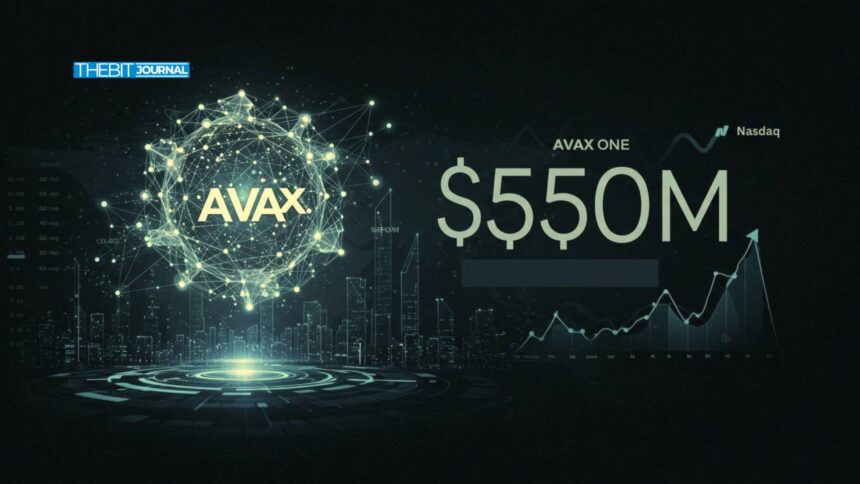

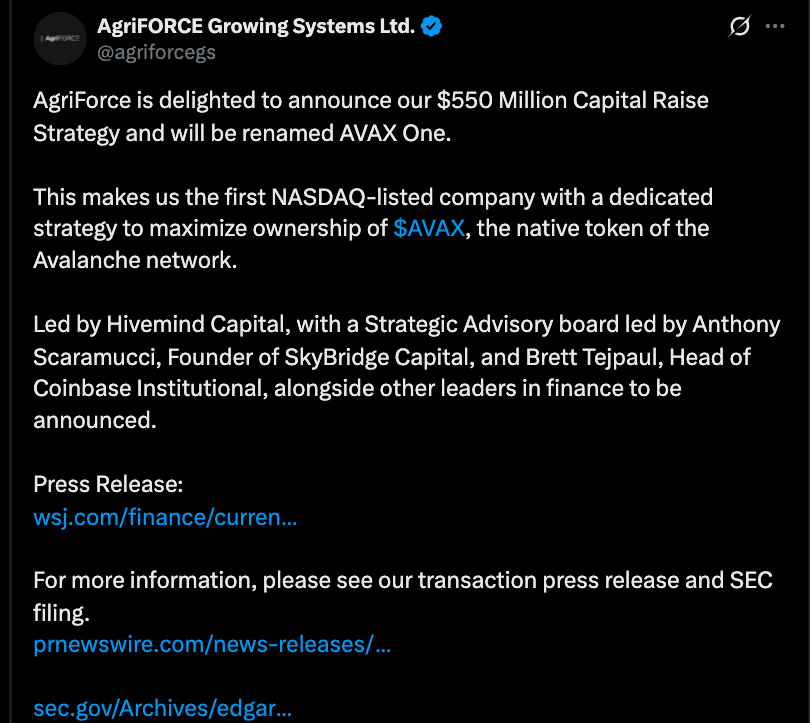
Following the latest industry reports, AgriFORCE Growing Systems, a small agritech firm, is rebranding as AVAX One and will become the first Nasdaq-listed company whose business is centered around Avalanche’s native token (AVAX).
They will raise $550 million in capital to build an AVAX treasury, targeting over $700 million in holdings, and to stake their assets, while building out fintech and tokenization infrastructure on Avalanche.
Backed by Hivemind Capital and an advisory board including Anthony Scaramucci and Coinbase figures, AVAX One is making a step in bridging public markets with on-chain finance.
From AgriTech to AVAX Treasury – The Transformation
AgriFORCE Growing Systems (Nasdaq: AGRI) announced they will transform into AVAX One and will reposition entirely around Avalanche. They will raise around $550 million to do so. The capital raise includes a $300 million Private Investment in Public Equity (PIPE), subject to shareholder approval, and a further $250 million through equity-linked instruments.
Under the new direction, AVAX One will acquire over $700 million in AVAX tokens. They will stake most of their holdings, using Avalanche’s native staking yield, and also explore yield strategies such as liquid staking, liquidity provision and MEV (maximal extractable value) strategies.
The rebrand is supported by Hivemind Capital, with their founder, Matt Zhang, as chairman. Anthony Scaramucci, founder of SkyBridge Capital, and Brett Tejpaul of Coinbase Institutional are on the advisory board. Scaramucci has publicly said tokenization is “the single biggest theme for the next decade of finance”.
AVAX One’s mission is to provide a publicly traded vehicle for investors to get regulated exposure to Avalanche’s growth and to build a long-term on-chain treasury vehicle tied to AVAX per share.
Also read: Whales Push AVAX Higher: Price Prediction Points to $38–$40 Breakout
Avalanche’s Institutional Moment
Avalanche’s ecosystem has been getting institutional attention in recent months and that’s why AVAX One’s timing may be right. The Avalanche network has over $6.2 billion in staked assets, showing a lot of validators and long-term commitment.
KKR, Apollo and J.P. Morgan have reportedly used Avalanche’s subnet architecture to build compliant blockchains and deploy financial infrastructure.
Avalanche’s native token $AVAX has also shown strength even in a weak market. It recently rallied 10% while the rest of the crypto market was down, partly due to confidence in treasury and network growth strategies.
Avalanche’s institutional narrative has been reinforced through VanEck’s filings for an Avalanche ETF, Grayscale’s efforts to convert its Avalanche Trust into an ETF, and other on-chain treasury vehicles being proposed.
Structure, Governance, and Advisory Alignment
AVAX One’s strategy aligns public markets and on-chain architecture. Governance puts Hivemind in the driver’s seat and brings in heavyweight finance and crypto talent via its advisory board. Scaramucci’s role is notable as a strategic amplifier, bringing credibility and access.
Holding $AVAX as treasury and acquiring fintech or blockchain businesses to migrate onto Avalanche mirrors a hybrid growth model of asset accumulation and vertical integration. Zhang has called it building a “Berkshire Hathaway of the on-chain financial economy”.
By staking holdings and deploying them into yield strategies, AVAX One aims to be cash flow positive from day one, setting up a feedback loop: profits reinvested into AVAX accumulation and business acquisitions, strengthening the network effect.
What AVAX One Means for Avalanche and Investors
For Avalanche, having a large publicly traded entity with a big AVAX treasury can be a stable demand anchor, signaling confidence and aligning long term incentives. It may also accelerate adoption among fintech firms looking for a pathway onto Avalanche.
From an investor standpoint, AVAX One is a hybrid: equity plus crypto exposure. If it works, it might trigger similar moves across other ecosystems, bridging public markets and token treasuries.
Also read: AVAX Price Prediction: Can Avalanche Hold $30 and Rally to $50?
Conclusion
Based on the latest reports, the launch of AVAX One is momentous for the convergence of public markets and blockchain infrastructure.
By rebranding from AgriFORCE, raising $550m and setting a strategy to accumulate, stake, and operationalize AVAX, this entity bridges the gap between traditional finance and on-chain finance in a big way.
For in-depth analysis and the latest trends in the crypto space, our platform offers expert content regularly.
Summary
AVAX One is the first Nasdaq-listed company focused on the Avalanche ecosystem. With a $550m raise and a plan to hold over $700m in AVAX, stake it, and acquire blockchain businesses, it’s bridging public equity and on-chain finance.
Glossary
AVAX One – New name and business model for AgriFORCE, a Nasdaq-listed company moving into the Avalanche token treasury and finance.
Staking – The process of participating in proof-of-stake consensus by locking tokens, securing and earning rewards.
Liquid staking / MEV strategies – Advanced staking models where staked tokens remain liquid or yield extra profits via transaction ordering.
Treasury model – A company holding a large reserve of a digital asset as a core part of its value.
Tokenization – Representing real-world assets (securities, bonds, real estate) as digital tokens on a blockchain.
Frequently Asked Questions About AVAX One
Why turn a small agritech company into a crypto treasury?
It allows AVAX One to reuse an existing public listing, saving the cost and time of listing anew, and refocus on Avalanche’s growth.
What gives AVAX One credibility?
Backers like Hivemind Capital, advisory involvement from Anthony Scaramucci and Coinbase Institutional, and over 50 institutional investors participating.
How does AVAX One make money?
Primarily through staking yields of AVAX holdings, yield strategies (liquid staking, MEV) and cash flows from fintech businesses acquired and moved into Avalanche.
What are the downsides?
Regulatory changes, AVAX price volatility, execution failure, token concentration risk and capital markets turning adverse are the key risks.