

This article was first published on The Bit Journal.
Ethereum price has been falling throughout February, but the deeper issue of concern isn’t the price action; it’s the Ethereum ETF flows that show how institutional investors are responding to market stress.
With Ether hovering near the $2,000 level, exchange-traded fund holders are sitting on large losses on paper. ETF flows have gone from mostly positive to mixed and even negative and market structure is forming its outlook for near-term price action.
The flow of capital into and out of Ethereum ETFs continues to be a major influence on Ethereum’s performance and investor sentiment.
Price Plummets and ETF Losses Mount Into Billions
Ethereum’s drop below $2,000 has had serious effect on holders of Ether ETFs.
According to Bloomberg Intelligence analyst James Seyffart, the average cost basis for U.S. spot Ethereum ETF holders sits around $3,500, while Ether was trading under $2,000 this February creating paper losses exceeding $5.3 billion for investors in these funds.
That loss figure shows how ETF products operate; Investors buy into shares that represent ETH at higher prices, and their portfolios are marked to market every day; similar to stocks or bonds, so the drawdown is sharp on statements and can cause selling.
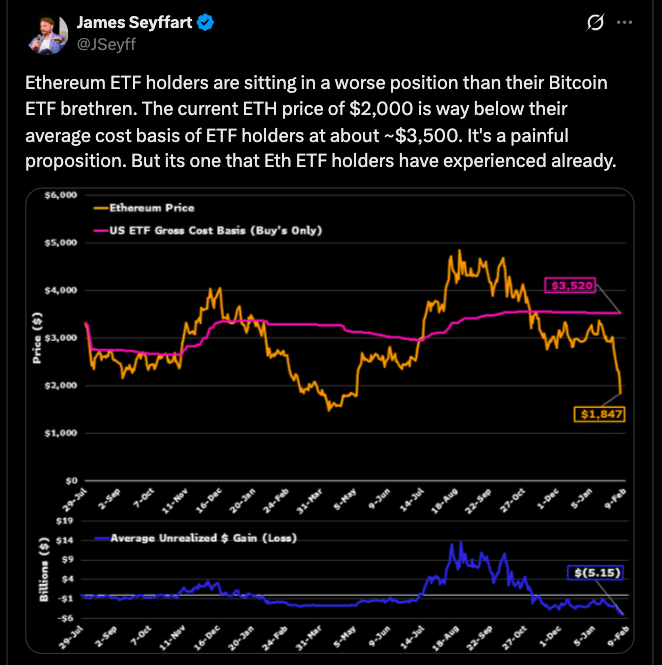
Since these ETFs are held in a lot of the old financial accounts; the “loss” component becomes more potent when compared to holding ETH directly.
Ethereum is not alone. The overall crypto market cap has fallen by about $2 trillion since late 2025, and not just Bitcoin but also other large coins have been under pressure.
Flows Flip: to Outflows and the Rare Inflow
The capital flows in and out of Ethereum ETFs has changed direction noticeably in February. Institutional capital also showed signs of making a sharp U-turn from Ethereum ETFs this past week, with about $129.1 million in net outflows on February 11th driven by large issuers including Fidelity’s FETH and BlackRock’s ETHA funds taking the brunt of out-flows.
A number of Bitcoin ETFs also saw large outflows during this period, pointing to a wider wane in risk appetite among institutional wallets.
This trend reversal comes after a short period earlier in the month on February 10th, where Ethereum ETF flows saw a $13.8m net inflow indicating that some investors were adding Ethereum exposure while prices were down.
However, the bigger pattern through February reveals that ETF flows have been alternating between small inflows and larger outflows, suggesting no clear direction.
Then there are days in which the value of flows is zero, or close to, indicating absolute indecision among the institutionals.
What Drawdown Means for ETFS Holders
Analysts and traders are paying attention to where many Ethereum ETF holders sit relative to their cost basis.
If the average cost basis is in fact close to $3,500, then a move back toward that level could influence what funds do next. Seyffart pointed out that reaching break-even levels could prompt some holders to take profits, a phenomenon distinct from technical price support or resistance.
That means two potential price reactions: a bounce back up to higher levels may get resistance as investors sell out at cost parity, or more selling could encourage more outflows as ETFs fail to hold support.
This obscuration of price action that is sentiment vs institutional flow driven. (coinmarketcal. com)
Price Testing Key Support Below $2,000
Even though Ethereum held briefly above the $2,000 psychological level, the price action has seen a test towards support of $1,900-1,950, particularly after large redemptions from ETFs.
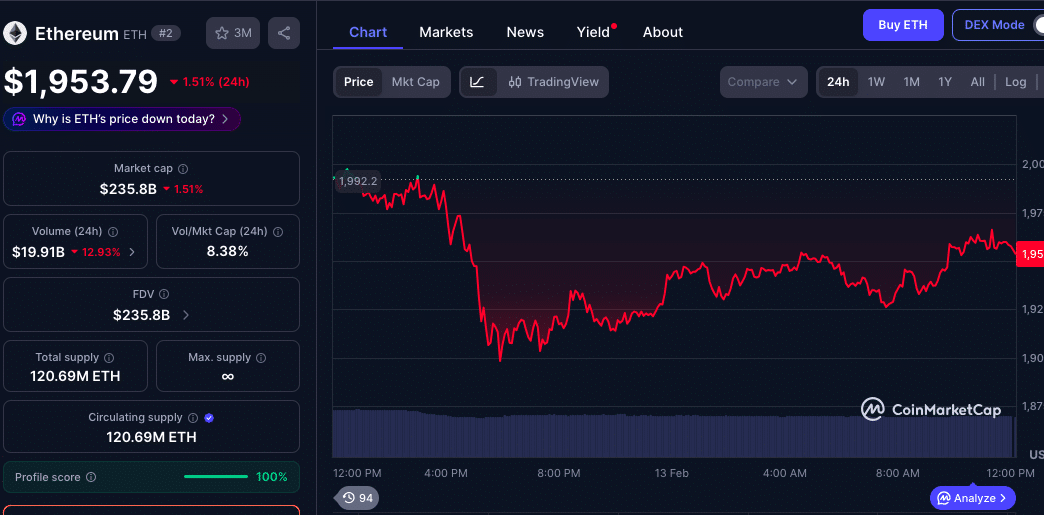
Some technicals suggest that downside momentum has been triggered because important moving averages have been breached.
Market watchers are also eyeing the descent to $1,800 a level that observers have mentioned as one where price might be “retested again” if institutional flows soften further.
Macro factors are contributing too. Larger equity risk-off sentiment, particularly in U.S. tech stocks has seeped over into crypto, and is affecting the way digital assets like Ethereum trade in correlation with legacy markets.
What Ethereum ETF Flows Tell About Investor Confidence
The argument over the impact of the ETF-era means for Ethereum still continues. ETFs provide easy access for traditional investors, to be sure, but that convenience comes at a cost: Crypto prices can move with conventional risk cycles rather than independent crypto-native patterns.
The fact that significant outflows from Ethereum ETFs have coincided with market drawdowns suggests that institutional capital may be treating crypto more like equities during stress periods.
The price pressure can increase when ETF holders feel the paper loss and want to rebalance by selling shares of the ETF rather than moving ETH holdings.
On the other hand, days with net inflows show that the community has not completely lost interest in buying on the dips. The sentiment is surely mixed but tinged with caution; certainly not capitulation.
Conclusion
Ethereum price drop exposes how Ethereum ETF flows in 2026 are manipulating the market. With billions in paper losses for institutional holders and capital jumping into and out of ETF products, this is more than price.
ETF flow data showing alternating inflows and outflows shows the reality that institutional activity is now deeply intertwined with Ethereum’s performance.
As of mid-February, the price of Ether is testing important supports levels and it is very probable that ETF flows will continue determining the attitude of investors and therefore the range between support and resistance.
Glossary
Ethereum ETF flows: The movement of capital into and out of exchange-traded funds holding Ethereum positions through the year.
Spot ETF: A fund that holds the basic asset (Ethereum, in this example) instead of derivatives, giving investors direct exposure to price moves.
Net inflow: When more capital enters an ETF than is redeemed on a given day.
Net outflow: The situation where more capital leaves an E.T.F. than enters.
Break-even point: When an investment is at a price where the investor neither makes nor loses money relative to their entry cost.
Frequently Asked Questions About Ethereum ETF Flows
What is meant by Ethereum ETF flows?
Ethereum ETF flows are the net amount of money moving in and out of exchange-traded funds that invest in Ethereum, a possible gauge for institutional demand or disinvestment.
Why did Ethereum ETF holders face such big losses?
Since many investors accumulated the funds when prices were higher, recent deep drawdowns to the $2,000 territory have left them sitting on big unrealized losses.
Are Funds Flowing into Ethereum ETFs?
The answer is yes, but the flows have been uneven. Though some days see modest inflows, bigger outflows have dominated the broader market sessions.
Does ETF flow impacts the price of Ethereum?
Yes. Massive outflows can place pressure on price to fall as institutional investors enter and exit their investments, while inflows may maintain the stability of the price.
References
CryptoSlate
Blockchain News
Crypto Economy
Coin Edition