
Multisig Bitcoin wallets also referred to as shared or multi-signature wallets; are becoming an increasingly popular method for safeguarding cryptocurrency. While a regular wallet is based on one private key; a shared wallet uses multiple keys managed by different people. This decentralizes trust and lowers the risk of a single point of failure.
A multisig Bitcoin wallet consists of multiple keys (like 2-of-3) to authorize a transaction; thereby reducing the risk of getting lost or stolen; compared to a standard wallet which contains only one key.
What Is a Shared Multisig Bitcoin Wallet?
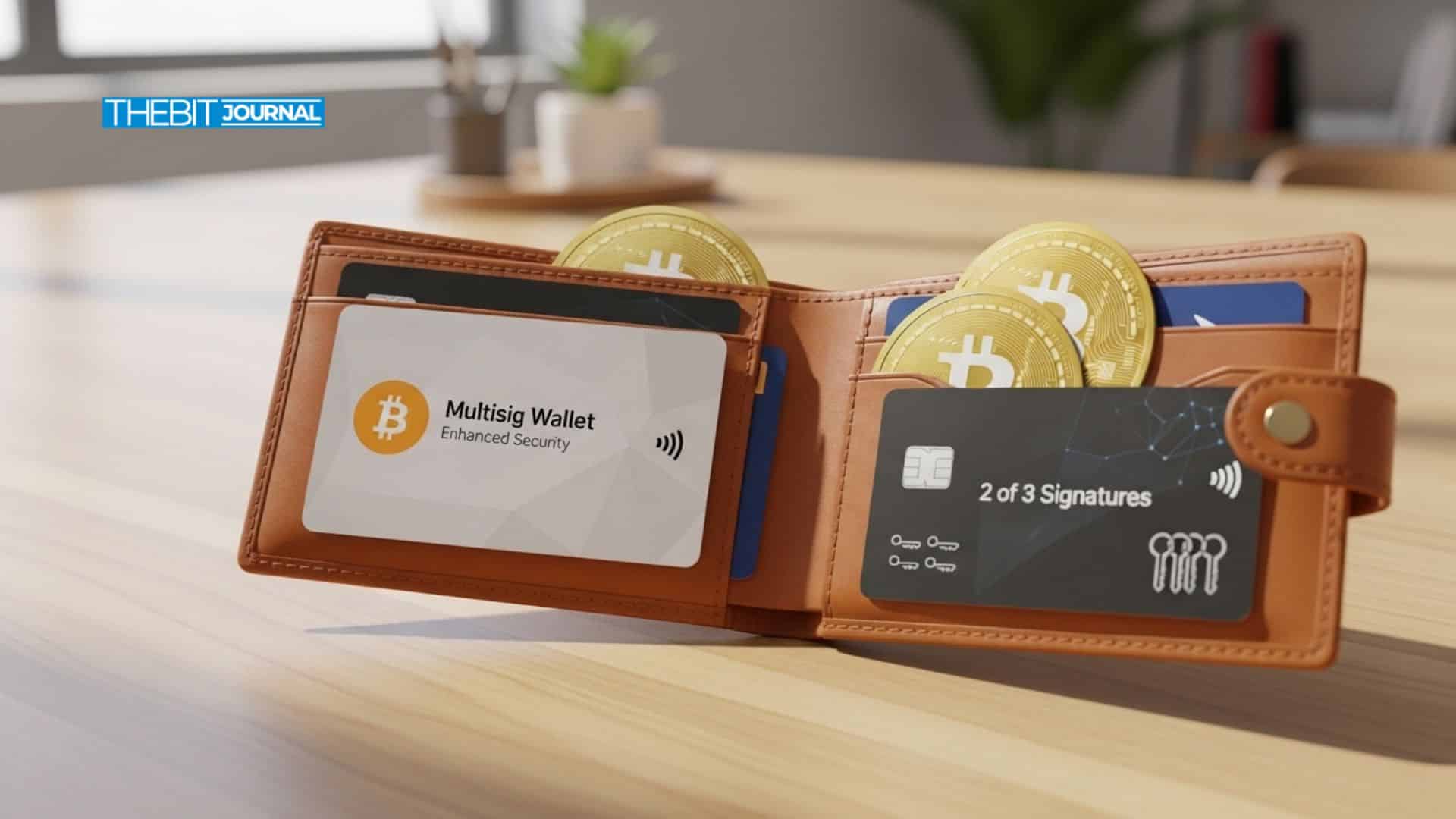
A shared multisig Bitcoin wallet is a type of wallet that requires more than one private key to access funds. Most Bitcoin wallets use a single private key to sign transactions. In a multisig wallet; M-of-N signatures are required: for instance in a 2-of-3 wallet; any two of the three participants must approve the transaction.
What this really means is that multiple people (or devices) each hold their own key, and they must “co-sign” a transfer. Private keys in shared wallets are usually assigned to other individuals, referred to as participants.
That is, if one builds a 3-of-5 wallet, there are five keys and only any three are needed to access funds. In many apps, the M-of-N ratio (up to 6-of-6) is configurable.
This multi-key setup takes care of two main problems. The first is that it removes single points of failure. This means that if one signer’s key is lost or compromised, the others can still run the wallet. it
Second, it requires joint control and supervision. One can’t unilaterally make transactions that involve the agreement of other holders. A multi-signature wallet lowers single-key risk through requiring independent approvals from multiple parties. This essentially divides control across several private keys that can be held by different people or systems so no one key has the ability to move funds.
This makes multisig wallets a perfect fit for families, business treasuries or any use-case where joint decision-making is preferred.
How Does a Shared Multisig Wallet Function?
Shared multisig wallets use standard Bitcoin scripts (usually pay-to-script-hash or P2SH) to implement the M-of-N rule. The system generates N public keys (one per participant) and creates a multisig address when the wallet is created. Only when M of those keys yield valid signatures on a transaction can the funds sent to that address be spent.
To illustrate, three family members can create a 2-of-3 wallet. The way it works is that each person’s Bitcoin address is linked to a private key stored in their wallet app or hardware device. When a payment is required, two of them sign the transaction; their wallet apps combine signatures and send out the transaction. Multisig transactions cost less in terms of fees and appear like normal transactions on-chain, hiding the complexity.
Importantly, if one of the signers goes offline or loses a key, as long as M (the threshold) are still there, the funds are safe and usable. A 2-of-3 or 3-of-5 arrangement distributes authority over the transfers across devices or teams and minimizes the likelihood that any single compromise or mistake results in an unauthorized transfer. The threshold can be safely met even if one signer is offline or a device fails.
Most modern multisig wallets are actually built around Partially Signed Bitcoin Transaction (PSBT) workflows. This means that one person creates an unsigned transaction and submits it through the app or a file to the co-signers. Each co-signer adds a signature using their private key. Once the threshold is reached, one of them publishes the fully-signed transaction.
This is normally done by the wallet software (like Electrum, Casa or mobile apps), and users do not see raw Bitcoin scripts. To the participating parties all that matters is that the agreed M-of-N gets confirmed.
Why Use Multisig Wallets? Key Benefits
The primary advantage of multisig Bitcoin wallets is security by distribution. Here are the best reasons to create one today:
Removes Single Point of Failure: As mentioned, multiple keys means losing/exposing one key does not lose your Bitcoin. Multisigs offer greater control and help mitigate risks in comparison with single-key or custodial solutions.
Resilience Against Attacks: An attacker needs to compromise M devices or keys in a multisig system, not just one. This greatly increases the difficulty of theft. So, for instance, if there’s a 2-of-3 on a $1M wallet, a thief cannot drain it by just threatening one person; they will have to blackmail or hack two individuals. This distribution is a defense to things like “wrench attacks” (physical coercion) because no one person possesses enough information alone.
Shared Control and Governance: Multisig is like corporate or family governance. Multisig copies traditional corporate governance structures where an initiator must seek co-signatures before moving money. This is beneficial for joint savings or business funds as parents and teenagers can share a wallet, reviewing transactions before approval of course; or a company treasury can require the signatures of multiple officers.
Regulatory and Audit Advantages: As multisig transactions occur on-chain they can provide an audit trail. This visibility is also in line with institutions’ compliance requirements. Multisig allows on-chain validation and makes it possible to have a clean audit trail. Multisig provides on-chain validation unlike opaque MPC schemes.
User-Friendliness and Security Match: Most modern wallets (mobile and desktop) are knowledgeable about multisig setup with user-friendly interfaces. For example, some wallet apps now enables crypto novices to create a shared wallet simply by scanning QR codes. Open-source wallets such as Nunchuk bring together mobile convenience and advanced multisig features. This means that even less technical users can benefit from multisig security.
How to Set Up and Use a Shared Wallet
The process of setting up a multisig wallet usually goes like this:
Pick your software: Download a wallet that you know will support multisig, it could be Electrum desktop, Casa mobile app, Sparrow desktop, etc.
Create a new shared wallet: Within the app, look for the option “shared” or “multisig.” Enter Bitcoin (BTC) and your M-of-N parameters (eg. 2-of-3).
Create invitation for participants: A QR code or link will be generated from the wallet. Each co-signer either scans it or imports it into their copy of the app. They usually fill out a generic name/alias, which others would see.
Store keys securely: Each participant should take their individual seed phrase or key backup and write it down and store it securely. Each seed is secret, and no one should share their private seed.
Prepare transactions: In sending BTC, one party constructs a transaction and sends the others the partially signed file. Co-signers then sign, and when they’ve reached M the final signed transaction is broadcast.
Follow prompts for confirmations: Most apps make it simple; they just display “Pending transactions” until someone else signs. Funds move once the required signatures are collected.
Ensure that all the signers agree on a recovery plan for lost keys and know their roles. The key to smooth operation lies in good backups and clear communication.
Leading Shared Multisig Wallet Platforms
There are many different platforms and tools that support multisig functionality. Here’s a 2026 comparative look at top shared Bitcoin wallets:
| Platform/Wallet | Multisig Type | Custodial? | Cost | Notable Features |
| Casa crypto wallet | 2-of-3, 3-of-3, up to 6-of-6 (Bitcoin, Ethereum) | No (non-custodial) | Subscription ($2100/yr premium) | Seedless model (no mnemonic needed); high-end security; clean UI; supports multiple chains |
| BitGo | 2-of-3 default; configurable up to 5-of-5 | Yes (institutional custodian) | Fees per transfer; insurance-backed | MPC-style with multi-sig; SOC2 audits; insured custody; strong regulatory compliance focus |
| Electrum wallet | 2-of-2 up to 15-of-15 | No (self-custodial) | Free (open-source) | Desktop wallet; hardware wallet support; highly configurable; mature and widely used for Bitcoin multisig |
| Nunchuk wallet | 2-of-3 up to 6-of-6 (Bitcoin only) | No (self-custodial) | Free (open-source app) | Mobile wallet; Taproot & Miniscript support; simplicity-focused; proven at large scale usage |
| Sparrow Wallet | Up to 16-of-16 | No (self-custodial) | Free (donations) | Desktop (macOS, Windows, Linux); hardware wallet integration; advanced features (coin control, custom scripts) |
| BlueWallet (Shared) | 2-of-2, 2-of-3 | No (self-custodial) | Free (open-source) | Mobile wallet; supports Bitcoin & Lightning; shared wallet via PSBT; user-friendly interface |
There are pros and cons to each solution. Institutional users often favor custodial setups like BitGo (with insurance) or Casa (with support). Those with experience might reach for more sophisticated tools like Electrum or Sparrow if they want fine-grained control. Mobile-first users may be drawn to Nunchuk or BlueWallet’s common features.
Importantly, all of those platforms offer the option to create M-of-N schemes: You choose (N) co-signers and you determine how many must sign for a transaction to go through (M), customizing security according to your needs.

Downsides and Considerations
While multisig has advantages, it also comes with trade-offs:
More complex setup: Multisig wallets are a bit of work to set up, compared to single key wallets. It is essential that all participants understand key storage, backups and the signing process. If an organization employs 3-of-5, all five must have secure devices. The complexity can reduce the smoothness compared to one-click spending in simple wallets. Most modern apps however, do this without any issues.
On-Chain Fees: Each multisig transaction adds one or more extra public keys to the script, and therefore slightly higher fees on the Bitcoin network. The few extra dollars in fees may not make or break a large transfer, but are worth noting.
Single Point in Governance: While keys are distributed, when using a multisig service like Casa or a custodian, the provider becomes an attack target. Fully non-custodial setup where each user has control over a hardware wallet; bypasses this completely, but custodial multisig (e.g. BitGo’s insured service) requires trust in the provider’s key management processes.
Limited Chains (Mostly Bitcoin): Some multisig solutions support only Bitcoin. One may need different wallets if they hold other cryptocurrencies. With EVM or Lightning multisig also supported by many services, the options are wider.
Conclusion
Shared multisig Bitcoin wallets are seen as an increasingly important tool by experts. Security-focused leaders emphasize multisig for high-value Bitcoin holdings.
In shared multisig Bitcoin wallets, many users jointly own several private keys; and spending from these wallets requires an M-of-N signatures. They eliminate single points of failure, introduce oversight and harmonize governance models.
Shared multisig Bitcoin wallets are becoming more popular for high-value Bitcoin among institutions and families. These wallets allow for more resilient regulated custodian-friendly custody. They’re growing into a baseline for secure crypto storage.
Glossary
Private Key: A secret number- like a password that proves ownership of Bitcoin. The holder of the key can then spend the Bitcoins. With multisig there are multiple private keys that belong to one wallet.
Public Key/Address: This is what you give to receive Bitcoin. In multisig, multiple public keys are combined to form a shared address.
M-of-N: The multisig configuration. N = total keys/participants; M = number of dogmatic signatures. 2-of-3 means 3 keys exist but only 2 signatures are needed.
Partial Signed Bitcoin Transaction (PSBT): A file format allowing a transaction to be built up. A single person can make a particular PSBT then pass it to other individuals for signing.
Non-Custodial: Users hold their own keys. This is because no third party would be able to spend the funds, since it is a non-custodial multisig wallet.
FAQs About Shared Multisig Bitcoin Wallets
What is a multisig Bitcoin wallet?
A wallet which is a multisig (multi-signature) wallet, requires more than one private key to authorize outgoing transactions.
What’s the difference between a shared wallet and a single-key wallet?
In a standard wallet, a single private key has the power to spend funds and if that key is lost, the funds are forever gone. In a multi-signature wallet, multiple keys are created and each is held by different people or devices. The wallet can survive one key being lost or stolen, avoiding the single point of failure problem.
Can I use any wallet app with multisig?
No, multisig is not supported by all wallets. You require a wallet that support shared or multisignature functionality explicitly. Some of the most famous wallets include Electrum, Sparrow, Casa, Nunchuk etc.
Are multisig wallets without risks?
Multisig is more secure, but also comes with complications. Risks include losing multiple keys; if too many keys are lost, funds may become inaccessible, and complex backup procedures. A co-signer losing internet or hardware access means transactions will not be able to go through until the threshold is satisfied.
References