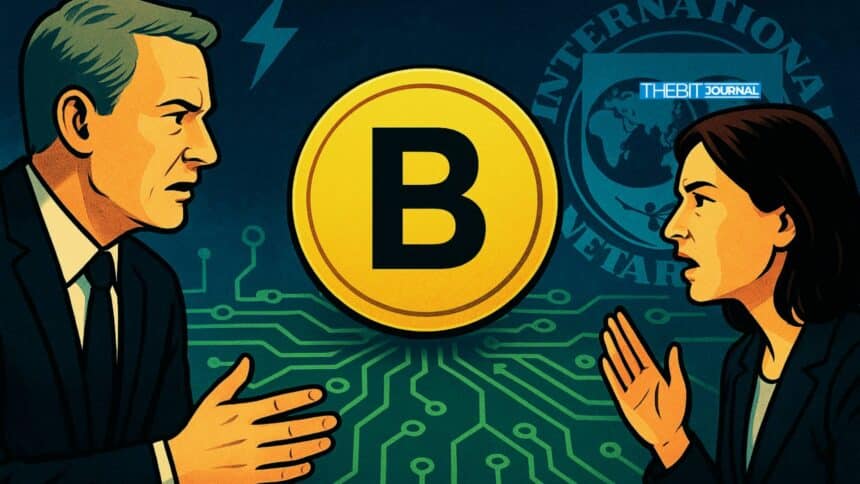

BlackRock tokenization is being presented by the world’s largest asset manager as the biggest change to financial markets since the early days of the internet. This view comes at a time when BlackRock and the International Monetary Fund clearly disagree on what this shift means for the global financial system.
One side focuses on faster, more efficient markets, while the other warns about rising risks and instability. This clash of views has now become a major issue in today’s financial discussions.
What does BlackRock tokenization actually mean?
At its core, BlackRock tokenization means turning traditional assets like funds, bonds, and credit products into digital tokens stored on blockchain systems. These tokens make it possible to transfer ownership almost instantly without waiting for slow settlement processes.
BlackRock’s leadership compares this shift to the move from paper records to electronic trading. In simple terms, the goal is to reduce settlement delays and move closer to instant T+0 transactions.
Why do BlackRock and the IMF disagree on tokenization?
The gap exists because each institution looks at risk from a different role. BlackRock tokenization is described by CEO Larry Fink and COO Rob Goldstein as a major infrastructure upgrade, similar to the launch of SWIFT in 1977.
They believe shared digital ledgers can cut manual errors, lower costs, and help global markets run in sync. The IMF, however, looks at tokenization as a fast-moving financial system that can spread shocks at machine speed.
In its recent explanation, the IMF warned that flash crashes, liquidity problems, and automated smart contract liquidations could turn small issues into worldwide problems before people can react. These views do not cancel each other out. They reflect the difference between driving innovation and protecting the financial system.
How large is the tokenized market right now?
Data shows that the wider tokenized market is now close to $300 billion, with most of that value coming from dollar-backed stablecoins like $USDT and $USDC. Outside of stablecoins, the regulated real-world asset sector is estimated at around $30 billion.
This includes tokenized government bonds, private credit, and corporate debt. Real products already live in the market. BlackRock’s tokenized government bond fund BUIDL and similar products from Ondo are now actively trading.
Tokenized precious metals, including digital gold, are also seeing steady activity. This confirms that BlackRock tokenization has moved beyond ideas and is now part of real financial infrastructure.
Can tokenization grow into a multi-trillion-dollar market?
Predictions for this market are very different. Some analysts at RedStone Finance believe on-chain real-world assets could grow to $30 trillion by 2034. Others, like McKinsey, take a more cautious view and say the market may only double as funds and treasuries slowly move onto blockchain systems.
For BlackRock tokenization, even this slower growth would still mean a multi-trillion dollar shift in how global finance works. BlackRock sees faster settlement, shared digital systems, and wider global access as the next major step for large financial institutions.
Why does the IMF fear an atomic domino effect?
The IMF’s main worry is atomic settlement. In the traditional system, most trades are settled at the end of the day, and only the final balance is moved between institutions. With atomic settlement, every trade must be fully paid for right away.
This setup works fine when markets are calm. The trouble starts when pressure builds. If money suddenly becomes tight, automated systems can begin forcing assets to be sold across linked platforms.
The IMF warns that once this chain reaction begins, losses could spread fast, before regulators even realize what’s happening. This is the risk side of BlackRock tokenization that global policymakers are now closely reviewing.
Could tokenization become the next major liquidity engine?
Many supporters believe the next major phase of financial growth will not be driven by memecoins, but by institutional yield strategies instead. Products like tokenized private credit, enterprise debt, and programmable treasury tools are seen as potential new sources of steady returns.
From this angle, BlackRock tokenization is more than a technology upgrade. It represents a fresh path for liquidity at a time when traditional bond markets are offering limited returns. Still, regulation remains a major hurdle.
Under Basel III Endgame rules, some digital assets are placed in the Group 2 category, which carries heavy capital requirements and discourages banks from taking large positions. Until regulators clearly define the line between risky cryptocurrencies and regulated tokenized securities, much of the big institutional money is likely to stay on the sidelines.
Conclusion
BlackRock tokenization sits at the center of a growing divide between market innovation and systemic caution. The conflict between BlackRock and the IMF is not about whether tokenization will exist. It already does.
The real question is how far and how fast it will reshape global finance. BlackRock tokenization reflects a push toward instant settlement, wider global access, and programmable markets.
The IMF, meanwhile, acts as the brake system, warning that speed without proper control can turn efficiency into systemic risk. The outcome now depends on whether regulators, financial institutions, and infrastructure providers can agree on clear standards for disclosure, risk management, and interoperability.
Glossary
Smart Contracts: Blockchain programs that automatically handle financial deals.
Real-World Assets: Traditional assets like bonds or credit are represented digitally.
BUIDL Fund: BlackRock’s tokenized bond fund for instant trading.
Atomic Domino Effect: Small failures that trigger a chain reaction across the system.
Systemic Risk: When one problem in finance spreads and affects the whole market.
Frequently Asked Questions About BlackRock Tokenization
How does tokenization work?
Tokenization turns financial assets like funds or bonds into digital tokens that can be moved instantly, cutting out long wait times for settlements.
Why is BlackRock pushing tokenization?
BlackRock sees tokenization as a way to speed up markets, reduce errors, cut costs, and make financial systems worldwide run smoothly.
Why is the IMF cautious about tokenization?
The IMF warns that tokenization can spread risks really fast, potentially causing sudden market crashes, liquidity shortages, or automated failures that impact global markets.
How big is the tokenized market now?
The market is around $300 billion mostly from stablecoins. While real-world tokenized assets make up roughly $30 billion.
Are there actual tokenized products available?
Yes, products like BlackRock’s BUIDL fund, Ondo’s tokenized bonds, and digital gold are already live and trading today.
Sources



















![Best Yield Farming Strategies Right Now [November 2025]](https://thebitjournal.com/wp-content/uploads/2025/11/Best-Yield-Farming-Strategies-Right-Now-November-2025-420x280.jpg "Best Yield Farming Strategies Right Now [November 2025] 49")