







This article was first published on The Bit Journal.
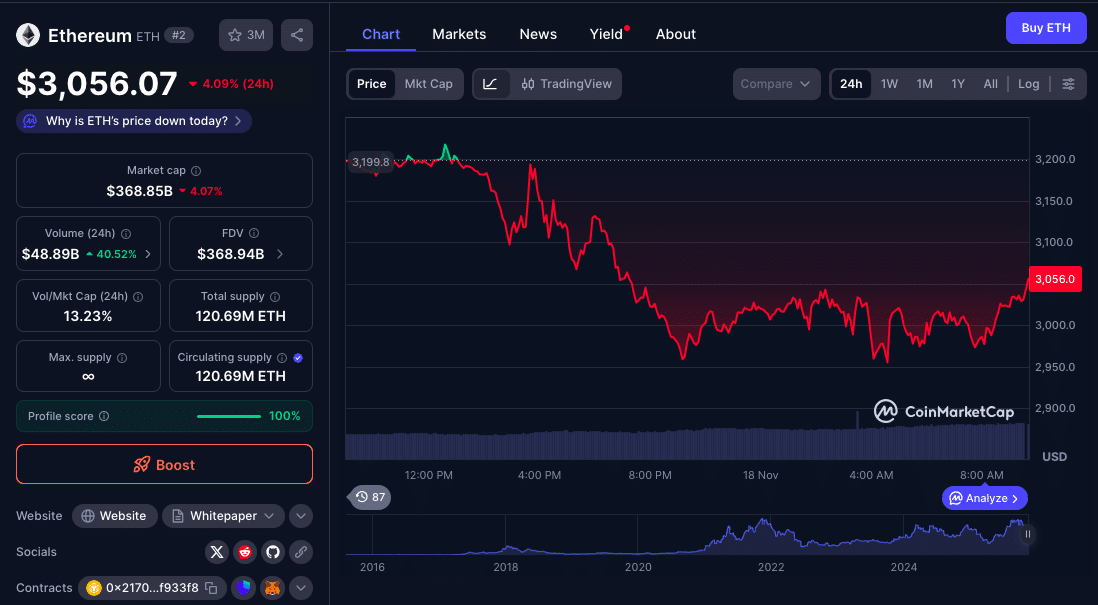
Ethereum (ETH) has recently crumbled below $3,000 to touch a four-month low, eliciting fears across the entire crypto market. This decline is in spite of exponential growth in the Layer-2 scaling networks, as well as the rising importance of Ethereum for tokenization and stablecoins.
Multiple factors from market-wide liquidation cascades to ETF outflows to a cooling macro backdrop are conspiring to weigh on $ETH, analysts say. But as sharp as the drop was, some on-chain signals indicate that this may not be the end of Ethereum’s long-term upside.
ETF Outflows and Seller Pressure from Holders
A near-term cause of Ethereum’s decline is the exodus from U.S.-listed ETH spot ETFs. Since late October 2025, more than $1.4 billion has exited these ETFs, CoinDesk reported. Based on reports, a $1.01B crypto market liquidation also triggered ETH long squeezes.
Meanwhile, long-term ETH holders have been ramping up selling. Data from blockchain analyst Glassnode indicates holders of 3-10 year old coins are dumping approximately 45k ETH per day, the most since early 2021.
This pressure of large institutional redemptions and long-term holder exit has been a strong headwind on $ETH price that has helped drag valuations down below $3K.
Ethereum’s fundamental usage is cooling. On-chain data suggests that activity is falling away, impacting demand for $ETH as there are fewer transactions to pay for gas.
DeFi, historically Ethereum’s strongest suit, is similarly deflating. Recent reports reveal that more than $36 billion DeFi assets were annihilated, and the drop in medium fell by Total Value Locked (TVL) on their network.
In addition, reports say, Ethereum’s TVL decreased to $74 billion, representing a 13% decrease from the previous month, and DEX trading volume dropped approximately 27%.
Economic Model Pressure and Layer-2 Exodus
Although Layer-2 networks such as Base, Arbitrum and Polygon are seemingly thriving, their growth might be siphoning economic activity from Ethereum’s base layer.
Some analysts contend that this is fracturing value capture because more transactions are being conducted on L2, fewer users pay fees on the mainnet, lessening base-layer demand for $ETH.
This is supported by academic research; a study into MEV dynamics reveals that optimistic MEV on L2 networks (Base, Optimism and Arbitrum) are spending more gas than they produce, despite these transactions paying a disproportionately low percentage of total gas fees meaning there is uncertainty around just how much revenue actually flows back to Ethereum’s base layer.
In short, Ethereum is scaling but the very scaling may be undercutting the economic incentive for owners of ETH.
Macroeconomic Strain and Risk-Off Sentiment
The global macro risks are putting further sell pressure on $ETH. With geopolitical and economic uncertainty on the rise, investors are getting a bit more nervous, pulling back on risk.
$ETH’s slide came as part of a broader selloff in markets, with equities selling off and expectations of tight liquidity not to mention lessened future ammunition from the U.S. central bank, weighing on sentiment, CoinDesk reported.
This risk-off sentiment is especially detrimental to Ethereum as its speculative demand side is more sensitive than most other defensive assets to macro conditions. With on-chain demand falling and DeFi activity in retreat, ETH is feeling that macro chill keenly.
$3,000 Defense and Accumulation Signaling
Although there is an accumulation and buyer defense not too far above $3,000. Sources say the Spent Output Profit Ratio (SOPR) for $ETH has recently fallen to approximately 0.96, which suggests that a substantial portion of investors are selling at a loss, a sign traditionally associated with capitulatory or bottoming behavior.
In addition, on-chain supply dynamics are strong. Ethereum’s exchange supply is at a nine-year low, suggesting fewer $ETH are in storage for quick access. Whale accumulation has also played a role.
News reports that large holders acquired around 394,682 ETH ($1.37B) during a three-day span in the beginning of November after likely recognizing the dip as an opportunity over the long term.
The data points show that the demand is solid at these levels with investors saying no to “crypto winter”.
Conclusion
The slide below $3K for Ethereum price drop points to a combination of macro pressure, institutional outflows, weakening on-chain demand and unintended economic consequences from Layer-2 scaling.
But the narrative isn’t all bearish as strong accumulation by whales, a decreasing $ETH supply on exchanges, and profit-taking behavior indicates that there are traders who think this is a dip to buy.
Whether this decline is the beginning of a bear market or the end of one will depend on how these fundamentals and macro trends play out.
Glossary
Ethereum (ETH): The leading competitor to Bitcoin and a decentralized smart contract blockchain.
Total Value Locked (TVL): Sum of all the assets held in DeFi meaning usage and demand.
Layer-2 (L2): Scale solution of the Ethereum to increase speed and lower fees.
MEV (Miner Extractable Value): Amount of value a validator/sequencer can extract by sequencing transactions into a block.
SOPR (Spent Output Profit Ratio): An indicator that displays whether addresses are selling at a profit or loss; below 1 indicates many addresses are selling at a loss.
On-chain activity: The count of transactions, active addresses and the other network usage on the blockchain itself.
Frequently Asked Questions About the Ethereum Price Drop
Why did Ethereum Price drop below $3,000?
The decline is primarily attributed to massive ETF outflows, long-term holders selling and low on-chain activity alongside macro risk.
Is Ethereum suffering as a result of the Layer-2 migration?
As L2s scale Ethereum, they could be siphoning transaction volume from the base layer and reducing demand for base-layer gas fees.
Do whales see the low prices as a new buying opportunity?
According to on-chain data, whales purchased roughly 394,682 ETH ($1.37 billion) amid the dip suggesting they are confident for the long term.
Is the bull run over?
Not necessarily. The drop is steep, but accumulation signs and diminishing exchange supply indicate that some are viewing what has transpired as a deep corrective phase, not something that will ultimately crush the market.
Can Ethereum recover?
The recovery might hinge on macro conditions improving and more on-chain activity returning particularly if DeFi or institutional demand for ETH picks up again.
References