













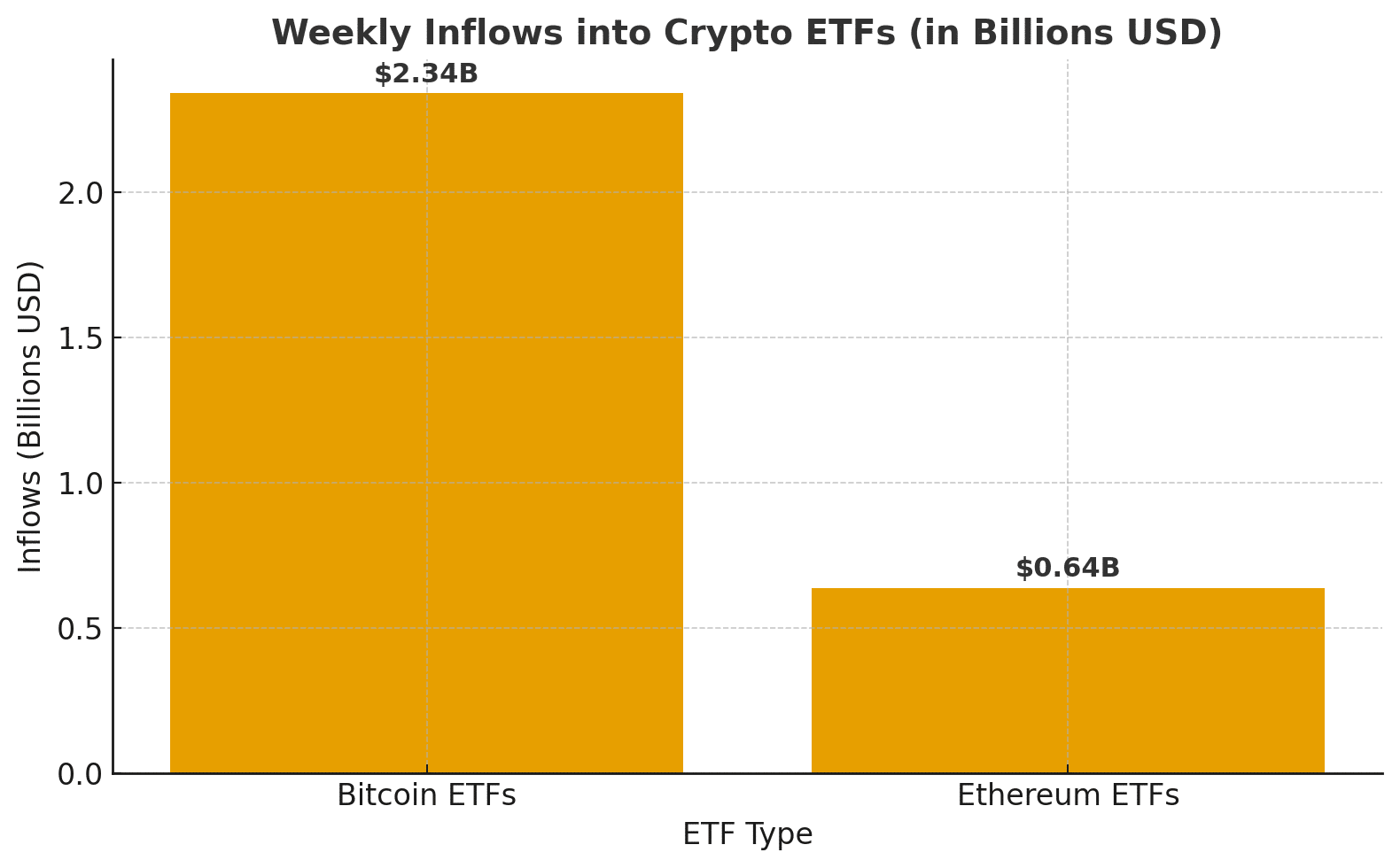
The past week has been a turning point for crypto adoption. Institutional investors poured $2.34 billion into Bitcoin ETFs, while Ethereum ETFs added another $638 million. These numbers are not just statistics, they reflect a clear shift in how big money views digital assets. As traditional finance weighs inflation data and the Federal Reserve’s next move, regulated crypto products are becoming the preferred entry point.
Bitcoin ETFs Lead the Charge
Bitcoin stole the spotlight with inflows into Bitcoin ETFs topping $2.34 billion in just seven days. That momentum has helped Bitcoin hold steady above $115,000, a level many analysts now see as critical support.
Michael Saylor, executive chairman of MicroStrategy, captured the mood when he said, “Inflows of this size show that institutions are no longer testing the waters, they are making long-term commitments to Bitcoin.” His remarks highlight what traders already sense: Bitcoin ETFs are now the bridge connecting Wall Street to the digital economy.
Ethereum ETFs Find Their Footing
Ethereum didn’t sit on the sidelines. With $638 million in inflows, Ethereum ETFs bounced back after weeks of uneven demand. The token itself has been holding near $4,500, supported by steady growth in decentralized applications and smart contract use.
Joseph Lubin, Ethereum’s co-founder, recently wrote, “Ethereum is becoming the settlement layer of the internet. The inflows into regulated ETFs prove that institutions recognize its role.” That recognition is crucial. While Bitcoin ETFs lead in scale, Ethereum’s rebound shows a broader appetite for exposure across major digital assets.
Why These Inflows Matter
These inflows carry more weight than simple numbers. They are a signal that institutions now view crypto as a long-term allocation rather than a speculative experiment. The expansion of assets under management in Bitcoin ETFs has added liquidity and reduced barriers for large funds, while Ethereum’s recovery suggests diversification is firmly in play.
Technical indicators back up the optimism. Bitcoin’s consolidation above $115,000 is a healthy sign of support, while Ethereum’s renewed inflows have flipped market sentiment. For traders watching closely, ETF flows are becoming one of the most important signals for price stability and growth.
The Bigger Picture: Macro Trends and Regulation
Institutional money does not flow in a vacuum. Recent inflation data and the growing belief that the Federal Reserve may soften its stance on rates have made digital assets more attractive. In uncertain times, Bitcoin ETFs offer a regulated way to hedge against traditional market risks.
Regulation has also opened the door. ETF approvals earlier this year lowered entry barriers for professional funds that previously hesitated to step into crypto. The result is a feedback loop: inflows support prices, higher prices attract attention, and more capital follows.
Summing Up
Last week’s $2.34 billion surge into Bitcoin ETFs, paired with $638 million for Ethereum ETFs, marks another milestone for the industry. It’s clear now that institutions are not just participating, they are shaping the market. With Bitcoin consolidating above $115,000 and Ethereum regaining momentum, the message is simple: crypto is no longer on the fringe. It is moving into the heart of mainstream finance.
FAQs about Bitcoin ETFs
Q1: Why are Bitcoin ETFs important?
They let investors gain Bitcoin exposure through regulated, familiar investment tools without having to hold the asset directly.
Q2: How much did Bitcoin ETFs attract last week?
They secured $2.34 billion in inflows, one of the strongest weeks since their launch.
Q3: What about Ethereum ETFs?
Ethereum ETFs saw $638 million in inflows, showing growing confidence after weeks of weaker demand.
Q4: What’s driving this surge in inflows?
A mix of regulatory clarity, macroeconomic uncertainty, and rising institutional interest is fueling demand for ETFs.
Glossary
Bitcoin ETFs: Exchange-traded funds that track Bitcoin’s price and allow regulated investment.
Ethereum ETFs: Investment funds that provide exposure to Ethereum within traditional markets.
Institutional Inflows: Large-scale capital investments from financial firms or funds.
Consolidation: A price pattern where assets trade sideways before breaking out.
Settlement Layer: A blockchain that underpins and finalizes digital transactions, like Ethereum.
Hedge: An investment designed to protect against market swings and inflation.