





The line between passive income and active strategy in crypto has never been thinner. In 2025, investors face a familiar question with new complexity, Yield Farming vs Staking, which one really pays better?
As decentralized finance matures, both methods have evolved far beyond their early days of trial and error. Staking now offers institutional-grade stability, while yield farming promises higher returns wrapped in risk and innovation. The contrast is sharper than ever, yet the smartest investors are no longer choosing sides, they are blending both worlds to maximize reward without losing sleep.
The landscape now: staking isn’t boring, farming isn’t free
Staking began as a safe, steady way to earn yield. You lock up tokens, help secure a network, and receive rewards. Yield farming, by contrast, sends you into decentralized finance (DeFi) gear: providing liquidity, farming tokens, chasing incentive programs, hopping across protocols.
By mid-2025, many institutions will treat staking as baseline income. According to a recent analysis, large Ethereum staking pools are generating 2.5 % to 7 % returns annually, depending on conditions. Staking offers predictability, though not explosive upside. Yield farming offers more upside and more volatility.
A study on Ethereum’s liquid staking tokens (stETH/wstETH) found they are actively reused in DeFi protocols, revealing the blending of staking into yield farming strategies. In effect, staking is no longer separate, it now often forms part of a layered yield approach.
Key indicators to watch
When comparing Yield Farming vs Staking, consider these metrics:
Annual Percentage Yield (APY/APR): Straight yield on your capital. Staking yields are often stable; yield farming yields fluctuate with incentives, fees, and competition.
Compounding frequency: In farming, many platforms auto-compound your returns. That boosts real yield vs nominal yield.
Impermanent loss/price divergence risk: In liquidity pools, if paired assets diverge in value, you suffer loss relative to simply holding. Staking sidesteps this.
Token incentive emissions/dilution: Some farming rewards issue new tokens, which dilute value if demand does not keep up.
Smart contract risk and protocol risk: Farming often involves multiple contracts. Every layer adds risk.
Lockup periods/liquidity constraints: Some staking requires multi-month commitments. Farming is often more liquid (though not always).
Gas or transaction costs: Frequent moves in yield farming can erode profits, especially on congested networks.
Market sentiment and token momentum: Farming can benefit from token hype, a factor absent in pure staking.
Yield Farming vs Staking: what recent news says
In late 2025, institutional players are combining staking and DeFi strategies. Some allocate ETH to staking for stable base yield, and a portion to yield farming for upside.
A recent research paper introduced “yield tokenization,” a mechanism that breaks yield-bearing assets into principal and yield parts, allowing hedging and structured exposure. That innovation could shift how returns in Yield Farming vs Staking are priced and traded.
Also, a study showed that as staking rewards shift, smaller solo stakers are more sensitive to yield changes than institutional or liquid staking providers, meaning staking markets may centralize further.
These developments point to a future in which staking and farming overlap. Liquid staking already gives you staked tokens you can farm with. That hybrid is increasingly common.
What pays better: under various scenarios
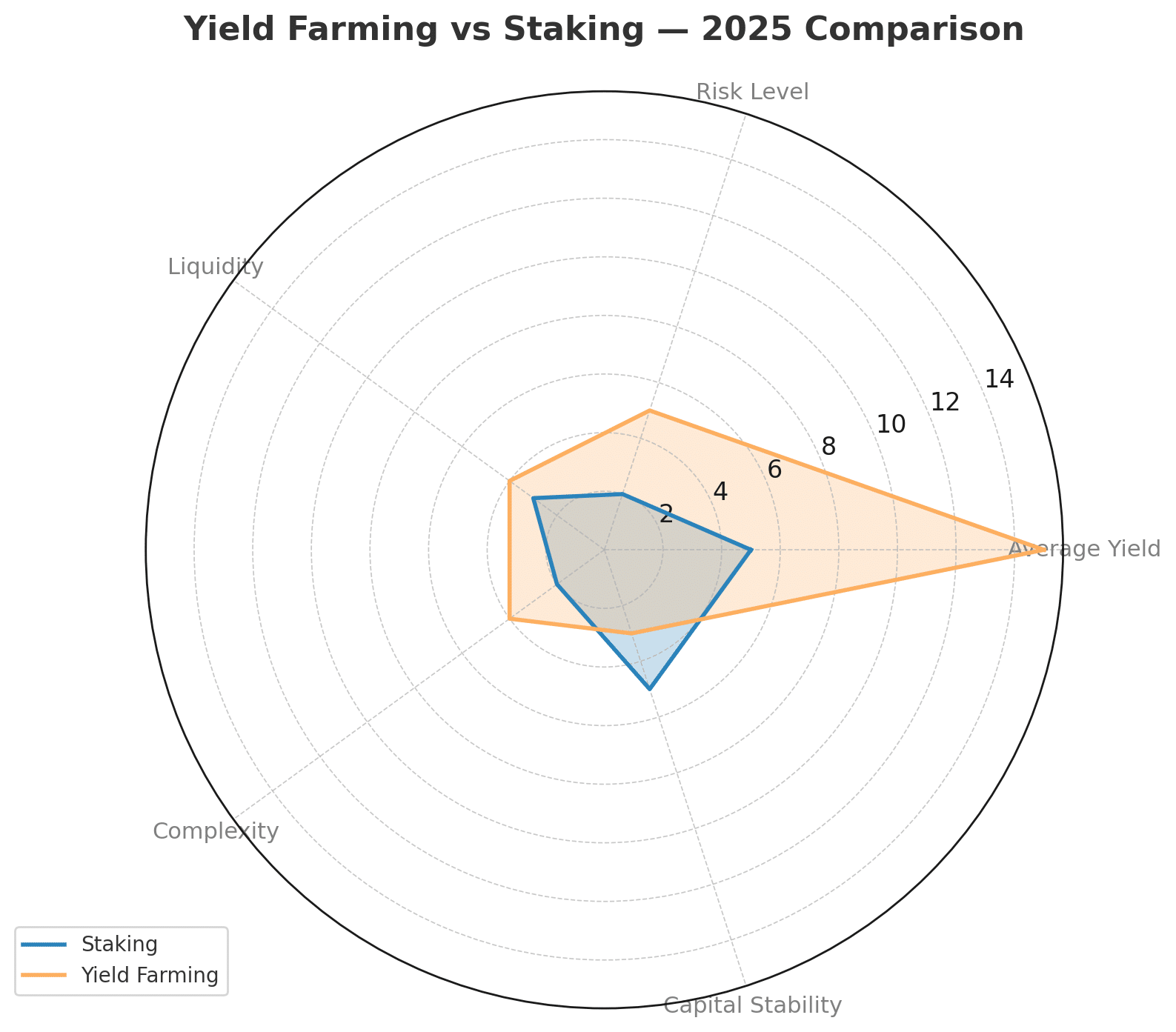
If one picks a stable, highly regarded chain (such as Ethereum, Solana, or a mature L1), staking yields might hover in the low single digits (3%-7 %). Meanwhile, yield farming in aggressive pools might aim for double digits, 10 %, 20 %, or more, especially when incentive tokens are thrown in.
But that extra yield comes at a cost: volatility, dilution, protocol risk. In years past, many chasing extreme farming yields lost capital to exploits, rug pulls, or impermanent loss.
A balanced strategy in 2025 is: allocate core capital to staking (the stable foundation) and reserve a tactical slice for yield farming. Over time, the compounding in farming may outperform, but it is not a one-way bet.
And thanks to liquid staking derivatives, your staked assets can still participate in yield farming. That shrinks the divide between Yield Farming vs Staking.
Voices from the industry
Ethan Tang, a strategist at a mid-size crypto fund, recently posted on X: “We now see staking as the baseline. Farming is for alpha, excess returns, yes, but you pick spots carefully.” That sums up the prevailing view.
On a developer forum, Lido’s community member “stETH_fan” said, “I stake ETH to get stETH, then deploy that into Curve pools. Staking was never meant to limit me.” That speaks to how staking and farming intertwine.
The final word
In 2025, Yield Farming vs Staking is less a boxing match and more a dance. Staking provides reliability, capital preservation, and minimal complexity. Yield farming offers upside, modular strategies, and excitement, at higher risk. The better path is not “which pays more” but “how to combine them smartly.”
If forced to choose one, staking wins for capital you cannot afford to lose. But for the yield-hunters, farming is worth a slice of exposure. The sweet spot lies in blending, stake bravely, farm selectively, and adapt as innovations like yield tokenization and liquid staking reshape the yield landscape.
Frequently Asked Questions about Yield Farming vs Staking
1. Is yield farming safer than staking?
No. Staking is generally safer because it involves fewer moving parts. Yield farming introduces contract layers, volatility, and token incentive risks.
2. Can one stake and farm simultaneously?
Yes. With liquid staking derivatives, you can stake tokens and still deploy the staked tokens into farming strategies.
3. How high can yield farming returns go in 2025?
They can range from modest (5 %–10 %) to extreme (20 %–50 %+), depending on incentives, competition, and risk levels, but those extremes carry significant danger.
4. What is impermanent loss?
Impermanent loss happens when assets in a liquidity pool diverge in price relative to simply holding them. It reduces yield compared to holding single assets.
Glossary of Key Terms
APY / APR
Annual Percentage Yield or Rate — the yearly return on an investment before fees and taxes.
Liquid Staking
A form of staking where you receive a token (like stETH) that represents your staked share and remains usable in DeFi.
Impermanent Loss
Loss incurred when you provide liquidity and the relative value of pooled assets changes.
Yield Tokenization
A mechanism where yield and principal are separated into distinct tradable components.
Protocol Risk
Risks stemming from bugs, exploits, governance issues, or economic design flaws in smart contracts.
Compounding Frequency
How often your earned yields are reinvested to generate returns upon returns.