

Crypto trading changed fast in 2025. Users moved more activity on-chain while big centralized platforms kept most of the volume. This shift sparked a clear question for new and seasoned traders alike. DEX vs CEX. Which setup fits better today?
The answer is not one-size-fits-all. It depends on custody, fees, liquidity, tools, and rules in each region. It also depends on risk tolerance and skill. This guide breaks that choice into plain language. It covers what each model is, where each shines, and how 2025 data and rules shape a smart pick.
What is a CEX?
A centralized exchange, or CEX, is a company that runs an order book and holds user funds. Users deposit assets, place orders, and the CEX matches trades. The company manages custody, security, and support. Most CEXs ask for KYC. Many offer fiat ramps, card buys, and mobile apps.
CEXs also list many coins and features. Spot, margin, and futures are common. Some add staking, earn products, and token launches. The trade-off is trust. Users entrust keys and personal data to a business.
What is a DEX?
A decentralized exchange, or DEX, is software on a blockchain. Users trade from wallets by signing transactions. Funds stay in self-custody until a trade runs. Many DEXs use automated market makers. Liquidity pools replace the old order book. Prices move with pool math and arbitrage.
DEXs run at chain speed and never ask for logins. There is no help desk. The trade-off is self-reliance. Users must manage wallets, fees, and chain risk. The upside is control. There is no centralized custodian holding keys.
DEX vs CEX: Key Differences
| Factor | CEX | DEX |
| Custody | Exchange holds funds; easy recovery if you lose access | You hold keys; full control and full responsibility |
| KYC/Accounts | KYC is common; easy fiat on-ramps | Wallet based; often no KYC; fiat ramps are separate |
| Liquidity | Deepest on majors; tight spreads | Strong on top pairs; varies by chain and pool depth |
| Fees | Maker/taker plus funding for perps; hidden costs possible | Gas plus swap fee; MEV and price impact can add cost |
| Speed | Fast internal matching; no chain wait | Chain speed; can slow at peak times |
| Features | Spot, margin, perps, staking, convert, earn | Spot swaps, LP, perps on some DEXs; on-chain vaults |
| Risks | Custodial hacks, account freezes, KYC leaks | Smart contract bugs, rug pulls, MEV, key loss |
| Support | Customer service and app UX | Do-it-yourself; tools and docs vary |
| Regulation | Clearer in many regions in 2025 | Evolving rules; Travel Rule touchpoints rising |
Costs and Liquidity in 2025
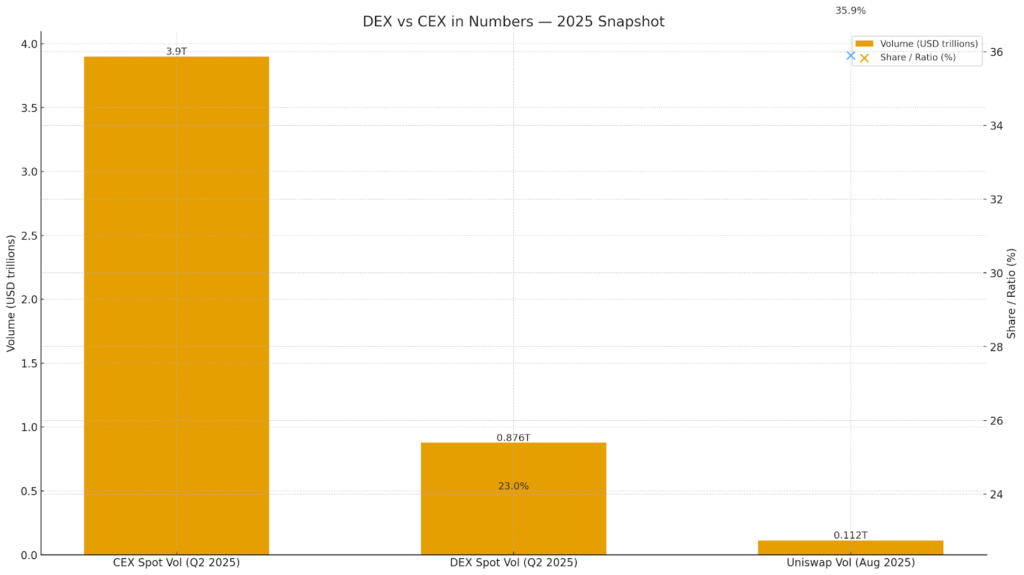
CEXs still process most spot volume. In Q2 2025, spot trading on top CEXs hit about 3.9 trillion dollars. That was down from Q1 but still far larger than DEXs. Binance kept the top share near 38 to 40 percent in mid-2025.
DEX spot volume hit a record share in Q2. The DEX to CEX spot ratio rose to 0.23, up from 0.13 in Q1. Top DEXs did about 876.3 billion dollars in Q2 spot volume. PancakeSwap surged after routing from Binance Alpha. It took about 45 percent of DEX spot trades that quarter.
Perp DEXs also grew. Total perp DEX volume reached about 898 billion dollars in Q2 2025, with Hyperliquid a major driver. This is still smaller than CEX derivatives, but the curve moved up.
What does this mean for users? CEXs usually have tighter spreads on majors like BTC and ETH. DEXs offer more long-tail assets early and often. Slippage and gas can add cost on DEXs during busy times. On CEXs, fees show as maker/taker and funding. Weigh both direct and indirect costs before picking a venue. The best deal is often pair- and time-specific.
Security: Custody, Hacks, and Risk
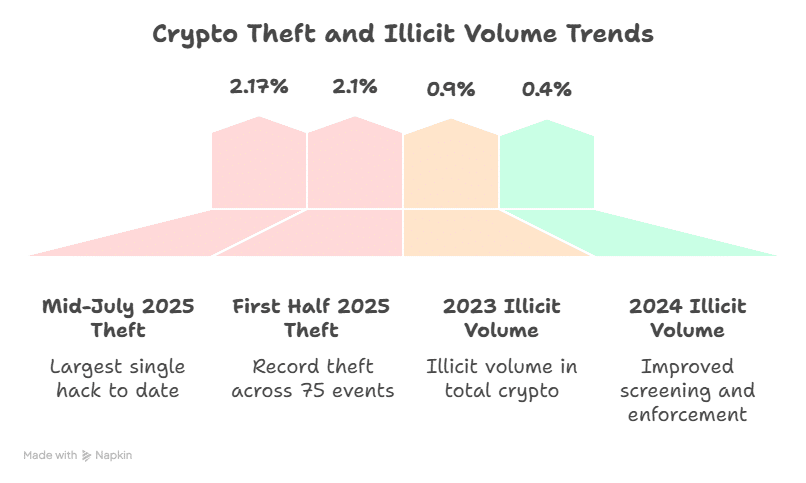
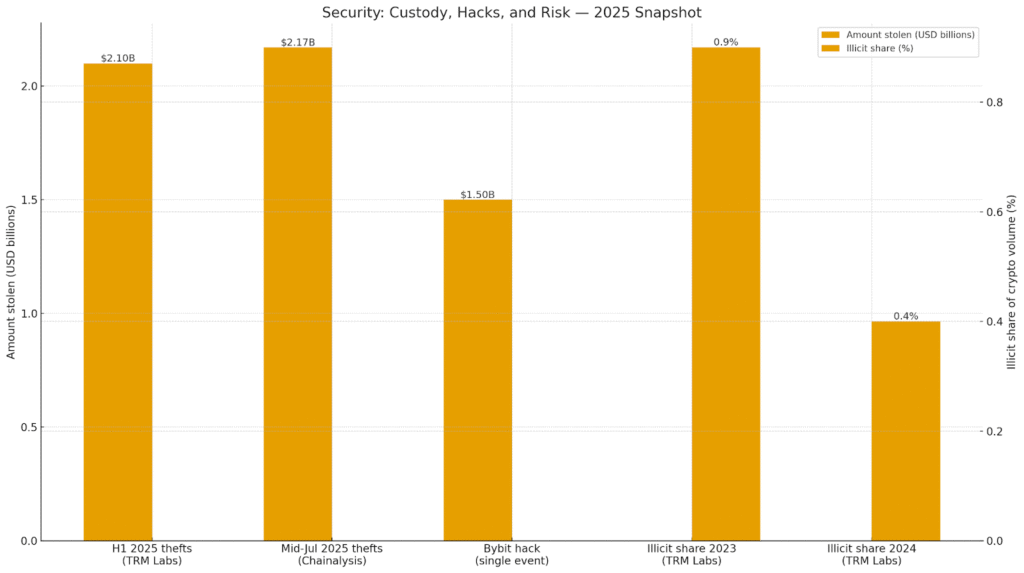
Custody is the core split. On a CEX, users face counterparty and platform risk. In 2025, large incidents reminded the market of that risk. Chainalysis counted more than 2.17 billion dollars stolen in crypto by mid-July 2025. The Bybit incident alone was about 1.5 billion dollars, the largest single hack to date.
TRM Labs reported a record 2.1 billion dollars stolen in the first half of 2025 across about 75 events. That nearly matched all of 2024 in six months. Attack types included key theft, front-end hijacks, and infrastructure hits. Losses were not limited to DeFi. Both centralized and decentralized services were targets.
On the other hand, the share of illicit volume in total crypto fell from 0.9 percent in 2023 to about 0.4 percent in 2024, per TRM Labs. That shows better screening and enforcement even as headline hacks continued.
For DEXs, the main risks are smart contract bugs, admin key misuse, oracle failure, and MEV. These risks feel technical, but the impact is simple. Funds can get drained or trades can execute at worse prices. Users can lower risk by sticking to audited protocols, using well known routers, and starting with small sizes.
For CEXs, the risks are different. They include security breaches, restricted withdrawals, and compliance freezes. Good practice is to use strong 2FA, whitelists, and withdrawal hygiene. Self-custody is still the safest default for cold storage. Trade on a venue that matches security standards and a risk budget.
Regulation and Compliance in 2025
Rules shifted in 2024 and 2025. In the European Union, MiCA took effect for stablecoin issuers in June 2024 and for other crypto assets and service providers in December 2024. That set clear licensing, disclosure, and market rules across the EEA. It raised the bar for CEXs and custodians serving EU users.
The FATF also updated Recommendation 16 in June 2025. The update sharpened payment transparency for cross-border transfers. It affects how VASPs and CASPs share originator and beneficiary data. This matters for Travel Rule compliance. It touches both centralized platforms and any regulated on- and off-ramps that link to DEX flows.
In the United States, the SEC’s tone shifted in 2025 with new leadership. Reporting points to a move away from aggressive enforcement on technical breaches and toward clearer rulemaking. Acting steps earlier in 2025 set up a crypto task force. Recent coverage also notes lighter treatment of some older actions and more focus on guidance. Details and final rules still evolve, but the new stance is notable for exchanges planning listings or new features.
For users, these moves have two effects. First, CEXs in major regions face tighter standards and clearer obligations. That can lift reliability and data protection, but it may raise KYC and surveillance. Second, DEX access remains open, but fiat on-ramps and off-ramps continue to enforce Travel Rule checks. Expect more wallet screening and risk scoring around DEX bridges and swaps. This is already common in Europe and is growing in the U.S.
Where a CEX Makes Sense
A CEX makes sense if the goal is deep liquidity on majors and simple fiat access. New users often prefer the app flow, support, and clear fees. CEXs also lead for large block trades in many pairs. They make tax reports and account statements easy.
Active derivatives traders still find the most tools on CEXs. Order types, margin settings, portfolio margin, and cross-collateral are mature there. This matters for hedging and basis trades. It also matters for pros who need low latency and API depth.
Where a DEX Shines
A DEX shines for self-custody and access to new tokens. Wallet to wallet swaps are fast and permissionless. There is no account hold or offboarding drama. On-chain perps and options grew a lot in 2025, led by Hyperliquid and other venues. That gives more choice to users who want to stay on-chain.
DEXs also help with composability. Users can route across chains, lend or stake without leaving custody, and build custom flows. This is powerful for power users. It does add mental load. Users should practice safe wallet ops and use reputable routers.
DEX vs CEX in Numbers
The 2025 data shows a clear split:
- CEX spot volume in Q2 2025: about 3.9 trillion dollars. Binance held the largest share.
- DEX spot volume in Q2 2025: about 876.3 billion dollars. DEX to CEX ratio reached 0.23, a record.
- Uniswap led DEX market share in August 2025 at about 35.9 percent, with about 111.8 billion dollars traded.
These numbers point to a trend. On-chain trading gained share. Centralized platforms still hold most activity. That balance is likely to keep shifting as on-chain UX improves and rules settle.
How to Choose: A Simple Framework
Start with custody. If self-custody feels right and wallet skills are strong, a DEX may fit. If account support and fiat ramps matter more, a CEX may fit.
Think about products. If spotting only on majors is the plan, both work. If perps, margin, and advanced orders are vital, a CEX still has the edge for tools. If on-chain perps and vaults appeal, a DEX may work.
Check costs in real time. Compare maker/taker and funding on CEX vs gas, swap fee, and slippage on DEX. Repeat checks for each pair. Conditions change hour to hour.
Review rules by region. EU users now face MiCA standards on service providers. U.S. users see a shifting SEC stance. Cross-border users need to watch Travel Rule checks. This can affect on- and off-ramp speed.
DEX vs CEX for Perpetuals and Advanced Trading
Perpetual futures still see the most liquidity on CEXs. They offer deep books, low spread, and solid risk engines. That said, perp DEXs set new highs in 2025. Hyperliquid and others crossed a combined 898 billion dollars in Q2. More users now hedge and speculate without leaving self-custody. Liquidity is pair-dependent. For niche pairs, CEXs still dominate.
For options, CEXs keep a lead on breadth and margin features. On-chain options exist, but spreads can be wider and legs harder to build at size. Expect this gap to narrow as on-chain RFQs and vaults improve.
Security Playbook for Each Path
On CEXs:
Use hardware keys for 2FA where supported. Set withdrawal whitelists and limits. Keep only trading balances on the exchange. Move long-term holdings to cold wallets. Watch for phishing domains and fake support.
On DEXs:
Use a hardware wallet. Keep a clean wallet for large funds and a hot wallet for daily use. Verify contract addresses. Favor audited, battle-tested protocols. Start small on new chains or features. Use tools that reduce MEV and check slippage before signing.
The Regulatory Context: What Users Should Expect Next
Expect more clarity, not less. MiCA set a high bar in the EU for service providers and stablecoin issuers. The FATF update in June 2025 pressures global Travel Rule adoption. U.S. policy signals a friendlier tone in late 2025, with a focus on clear rules over enforcement by lawsuit. Together, this means more identity checks on ramps, cleaner reporting, and more consistent exchange standards. Users should plan for that.
Common Myths to Drop
Myth 1: DEX fees are always lower.
Not always. Gas spikes and price impact can exceed CEX fees on thin pools. Check live quotes.
Myth 2: CEXs are always safer.
Custodial risk is real. Large platforms invest in security, but incidents still happen. Balance trust and control.
Myth 3: DEXs are only for pros.
Wallet UX improved a lot. Good guides and safer defaults help new users start small.
Myth 4: Regulation only hits CEXs.
Travel Rule and KYC checks touch ramps that serve DEX users. Expect more screening on both paths.
Security & Regulatory Snapshot (2025)
- Crypto stolen so far in 2025 exceeded 2.1 billion dollars by mid-year. One centralized platform hack counted for most of that. Users should not skip custody hygiene.
- DEX spot share hit a record in Q2 2025 as users shifted some activity on-chain. The DEX to CEX spot ratio rose to 0.23.
- MiCA is now live across the EEA. The FATF updated payment transparency rules in June 2025. The SEC in the U.S. signaled a move to clearer frameworks. Users should expect tighter controls at ramps and clearer exchange standards.
Quick Comparison Table
| Use Case | Better on CEX | Better on DEX |
| Fiat on-ramp | Yes | Usually no |
| Deep BTC/ETH liquidity | Yes | Often, but varies |
| Long-tail listings | Sometimes | Often |
| Perps with advanced risk | Yes | Growing fast |
| Self-custody | No | Yes |
| KYC-free access | Rare | Often |
| Tax and reports | Yes | DIY or third-party |
| Composability | Limited | Strong |
Conclusion:
In 2025, the DEX vs CEX debate is no longer about which model will win, but which best fits a trader’s needs. Centralized exchanges dominate liquidity, derivatives, and fiat access, while decentralized platforms are winning ground with self-custody, composability, and early access to long-tail assets. Regulation is tightening on both paths, security risks remain real, and fees are increasingly pair- and time-dependent. The smartest move isn’t to pick one side forever—it’s to mix strategies. For large trades and fiat ramps, CEXs lead. For control, innovation, and on-chain growth, DEXs shine. Balance both for resilience and opportunity.
FAQs About DEX vs CEX
Is a DEX safer than a CEX?
Safer for custody if keys are managed well. Risk shifts from counterparty to the user and the smart contract. Use hardware wallets and audited apps.
Which has lower fees, DEX or CEX?
It depends on pair, time, and size. CEXs have maker/taker and funding. DEXs have gas, swap fees, and price impact. Compare live quotes.
Can beginners use a DEX?
Yes. Start with a small swap. Practice on a test wallet. Learn to back up seed phrases and confirm contract addresses.
What rules affect me in 2025?
In the EU, MiCA sets rules for providers. The FATF update tightens cross-border data sharing. In the U.S., the SEC’s stance is shifting toward clearer rules. Ramps may ask for more info.
Are on-chain perps liquid enough now?
They improved a lot in 2025. Still, CEXs often have deeper books on many pairs. Check each market before trading.
Glossary
- AMM: Automated market maker. A pool that sets prices by math and balances.
- Bridge: A tool that moves assets between blockchains.
- CASP/VASP: EU and FATF terms for crypto service providers that must meet rules.
- CEX: Centralized exchange that holds user funds and runs the order book.
- DEX: Decentralized exchange that uses smart contracts and self-custody.
- KYC: Know Your Customer. Identity checks required by many platforms.
- MEV: Miner or Maximal Extractable Value. Profit from reordering or inserting trades.
- Perps: Perpetual futures. Futures with no expiry that track a price index.
- Slippage: The difference between the expected price and the executed price.
- Travel Rule: Rule that requires sharing sender and receiver info for transfers.
Summary
CEXs still dominate total crypto volume, with about 3.9 trillion dollars in Q2 2025 spot trades, but DEXs hit a record share. The DEX to CEX spot ratio rose to 0.23 as DEX spot volume reached about 876.3 billion dollars. Uniswap led DEX market share in August 2025. Perp DEXs also set highs near 898 billion dollars in Q2. On security, losses topped 2.1 billion dollars in H1 2025, including a 1.5 billion dollar CEX hack. Regulation advanced too. MiCA now applies across the EEA, the FATF updated payment transparency in June 2025, and the U.S. SEC signaled a shift toward clearer rules. Choose CEXs for deep liquidity, fiat ramps, and pro tools. Choose DEXs for self-custody, on-chain access, and composability.