





Decentralized finance has produced few tools as controversial as flash loans in crypto. They let a smart contract borrow assets without collateral, provided the funds and any fee return before the same transaction ends. That rule supports arbitrage, refinancing, liquidations, and trading, yet it can also magnify flaws in weak protocols. The loan is a tool, while the surrounding code determines whether it creates efficiency or exposes danger.
What Are Flash Loans in Crypto?
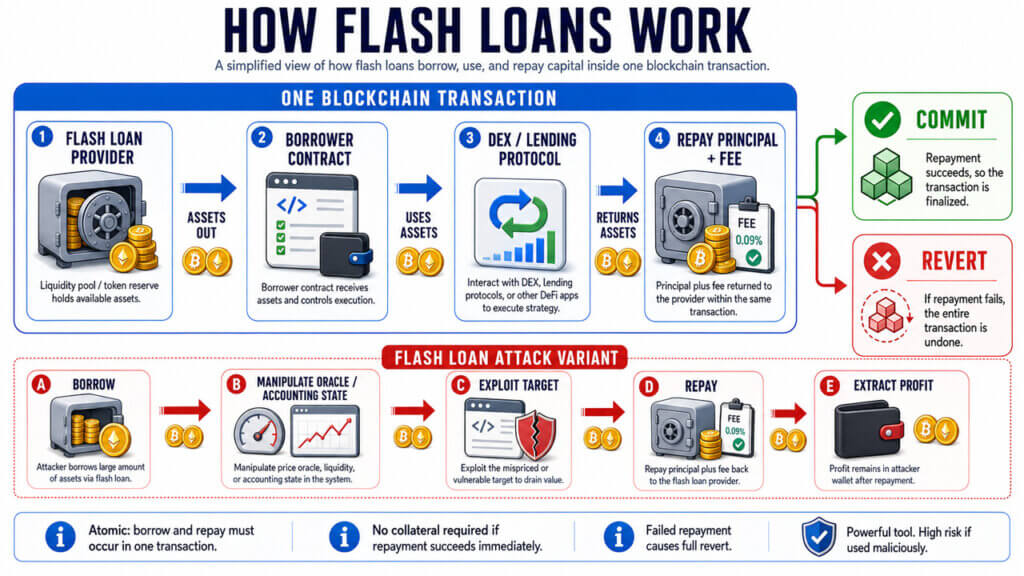
Flash loans in crypto are uncollateralized loans that last for one transaction. A borrower contract requests assets from a liquidity pool, uses them through programmed steps, and returns the principal plus the required fee before closing.
The structure works because blockchain transactions are atomic. Every instruction succeeds together, or the network cancels the sequence. When repayment fails, the transaction reverts, although the user may still lose gas fees. No credit score or repayment schedule is needed because unpaid capital never leaves the transaction permanently.
How One Transaction Can Move Millions
A developer first deploys a receiver contract containing the intended instructions. That contract requests a token and amount from a lending pool. Once the liquidity arrives, it may trade across decentralized exchanges, replace collateral, repay another position, or liquidate an undercollateralized account.
At the end, the contract returns or approves the amount owed. If the balance and fee are correct, the transaction is confirmed. If a swap fails or repayment is short, everything reverses.

Documentation shows that one major lending system initializes its flash-loan premium at 0.05%, although governance can change it. ERC-3156 also defines a standard interface for lender and borrower contracts.
Why Traders Use Flash Loans in Crypto
The best-known use is arbitrage. Suppose ETH trades at $2,000 in one pool and $2,050 in another. A contract could borrow ETH, buy at the lower price, sell at the higher price, repay the loan, and keep what remains after costs.
On paper, the trade looks easy as in live markets, flash loans in crypto face gas, slippage, protocol charges, changing liquidity, and bot competition. A visible $50 spread can disappear before confirmation, especially when rivals reorder or copy the opportunity through maximal extractable value strategies.
Liquidations offer another use as temporary liquidity lets participants repay risky debt and claim discounted collateral without holding a large reserve. Borrowers can also swap collateral or refinance debt in one operation.
Educational Comparison: Flash Loans and Standard Loans
| Feature | Flash loan | Standard crypto loan |
|---|---|---|
| Collateral | Usually none | Usually required |
| Duration | One transaction | Fixed or open-ended |
| Repayment failure | Transaction reverts | Position may be liquidated |
| Main user | Smart contract or developer | Retail or institutional borrower |
| Typical purpose | Arbitrage, liquidation, refinancing | Trading or longer-term liquidity |
| Main cost | Gas and protocol fee | Interest, fees, liquidation risk |
The comparison shows why these loans are not ordinary consumer credit. They are temporary infrastructure that exists only while a programmed transaction remains valid.
The Security Problem Is Usually Elsewhere
A flash loan does not automatically steal funds. It supplies temporary capital that can exploit another weakness, such as a price oracle, liquidation formula, governance vote, or accounting function.
Consider a small trading pool used as the only price source for a lending platform. An attacker borrows a large amount, pushes the pool price away from fair value, and uses the distorted figure to withdraw more than the collateral should permit. The attacker then repays the temporary loan and keeps the extracted value.
This is why flash loans in crypto resemble rented heavy machinery. The machinery is legitimate, but weak foundations may collapse when immense force arrives at once.
What the Euler Exploit Taught DeFi
A major 2023 lending exploit showed how severe this amplification can become. An attacker used temporary capital while abusing a flaw linked to donation, debt, and liquidation accounting. About $197 million in assets was taken across several transactions, although recoverable funds were later returned after negotiations.
The incident corrected a common misconception as flash loans in crypto enabled the scale and speed of the exploit, but the core failure sat inside protocol logic. Reviews that only search for coding mistakes may miss economic weaknesses when several contracts interact under extreme conditions.
Builders should test large trades, manipulated oracle values, borrowing loops, rounding effects, and rapid collateral changes. Audits must examine whether valid functions can combine into an invalid economic result.
Key Indicators Traders Should Examine
Before attempting flash loans in crypto, a trader must calculate the cost of execution. Net price spread should be measured after pool fees. Available liquidity matters because shallow pools create greater price impact, while expected slippage shows how far execution may move from the quoted rate.
Gas price matters because a reverted transaction can still consume fees. Traders should study congestion, contract complexity, loan premium, swap count, and MEV exposure. Another bot may front-run, back-run, or copy the trade. A realistic calculation must include every expense and room for sudden price movement.
Fake Bots Create a Separate Consumer Risk
Scammers often market copied contracts as guaranteed arbitrage systems. They may request ETH deposits, unlimited token approvals, or activation payments. Hidden code may send funds to the scammer instead of executing a trade.
Legitimate systems do not require a user to fund an unknown wallet merely to unlock borrowed liquidity. Any offer promising fixed returns, effortless profit, or secret access deserves caution. A contract should clearly identify the lender, assets, exchanges, repayment route, fee logic, and failure conditions.
Safer Design and Smarter Participation
Protocols can reduce risk through multiple price sources, time-weighted prices, borrowing limits, circuit breakers, and pause controls. Governance should prevent temporary balances from creating lasting voting power.
Users should favour contracts with audits, active monitoring, documentation, and bug-bounty programmes. An audit is not a guarantee because secure components may still behave unexpectedly together.
Conclusion
This model shows how finance becomes programmable as it can improve market efficiency, speed up liquidations, and help users reorganize positions without holding large idle balances. Yet instant liquidity can expose weak code quickly.
The sensible view sits between hype and fear. Flash loans in crypto are not free money or inherently malicious. Their outcome depends on sound engineering, realistic costs, and disciplined risk controls.
Frequently Asked Questions
Do flash loans require collateral?
No. Repayment is enforced within the same transaction, removing the lender’s normal default exposure.
Can beginners use a flash loan?
Technically yes, but flash loans in crypto usually require smart contract skills and a clear grasp of gas, slippage, and MEV.
What happens when repayment fails?
The transaction reverts, while the borrower generally loses the gas fee paid for the failed attempt.
Are flash loans illegal?
No. Legality depends on how they are used and the laws applying to the activity and jurisdiction.
Glossary of Key Terms
Atomic transaction: A transaction in which every action succeeds together or all actions are cancelled.
Arbitrage: Trading the same or related asset across markets to capture a price difference.
Slippage: The gap between an expected trade price and the final execution price.
Oracle: A system that supplies external price or data inputs to a smart contract.
MEV: Value extracted by changing transaction inclusion or ordering within a block.
Liquidity pool: Assets locked in a smart contract to support trading, lending, or other DeFi activity.
Disclaimer: This article is for educational and informational purposes only. Digital assets and DeFi protocols carry substantial risk.
Sources