






Why do millions of people open crypto wallets and use decentralized apps every day, and how can you ship your first one without getting lost in the tooling maze?
In 2025, decentralized apps will be used on a meaningful scale. DappRadar tracked an average of 18.7 to 24.3 million daily unique active wallets across Q2 to Q3 2025, even through the market chop. The developer base is resilient too. Electric Capital reports 39,148 new developers explored crypto in 2024, while long-tenured contributors hit all-time highs. Developer Report Capital and activity remain significant, with DeFi TVL around the $150 billion level in 2025. DeFi Llama. Meanwhile, broad adoption continues to rise, with estimates of 560 million global crypto owners in 2024.
This guide shows you exactly how to build your first dApp, from picking a chain and writing a smart contract to wiring up a wallet, shipping a front end, and adding basic security, analytics, and monitoring. Expect opinionated checklists, tool comparisons, and a realistic first project path. Also expect a few tiny jokes to keep the caffeine flowing.
The Core Anatomy Of A dApp
A decentralized application replaces the familiar pattern of calling a private server with logic that executes on a blockchain, which means that instead of relying on a company-controlled backend, you orchestrate interactions among components that are public, verifiable, and persistent, and you do so by coordinating three tightly coupled parts that together provide the full user experience from interface to execution.
Smart Contract
The smart contract functions as the application’s backend because it encodes the business rules, maintains the authoritative state, and exposes callable functions, and on EVM compatible networks you typically author this logic in Solidity so that, once deployed, the bytecode becomes effectively immutable, which in practice yields behavior that is consistent, transparent to outside inspection through a block explorer, and auditable by anyone who wishes to verify how inputs transform into on chain outcomes.
Blockchain
The blockchain itself serves simultaneously as the database that persists state and the runtime that deterministically executes contract code across many independent nodes, and every state transition is bundled into a transaction that must be validated by the network and included in a block, which is why any operation that modifies storage requires a payment of gas to compensate validators for computation and data inclusion while also imposing natural constraints that encourage efficient design.
Frontend With Web3 Provider
The frontend, often implemented with frameworks such as React or Vue, renders the interface that humans use and integrates a provider library together with a wallet so that the application can read on chain data through RPC endpoints, construct properly encoded function calls using the contract’s ABI, request explicit user authorization for sensitive actions, and finally submit signed transactions that the network can verify and execute without ever exposing private keys to your code.
Keep The Model In Mind
When you design flows, treat the user interface as the place where intentions are expressed in clear controls and status messages, rely on the wallet as the guardian that confirms identity and produces signatures for any action that changes state, and reserve the contract for the canonical rules that govern permissions and effects, because aligning responsibilities in this way produces systems that are easier to reason about, simpler to secure, and far more resilient under real world usage.
Your Starter Toolkit
You do not need many tools to begin. Pick a small, reliable set and learn it well.
Languages and libraries
- Solidity on EVM. Rust on Solana.
- Ethers.js or Web3.js for blockchain calls.
- React or Next.js for the frontend.
- OpenZeppelin for secure, standard contracts.
Frameworks for EVM
- Hardhat if you want a TypeScript and plugin-rich workflow. Great error messages, easy verification, many examples.
- Foundry if you want speed and Solidity-first tests. Fast compiles, strong fuzzing, minimal setup.
Many teams use both. Start with Hardhat for a smooth path, then add Foundry when you want faster tests and fuzzing.
Why Ethers.js is the default for many teams
Ethers uses promises cleanly, has a clear split between Provider and Signer, and ships a tidy BigNumber type. Web3.js is fine if your tutorial uses it, but Ethers tends to keep code smaller and easier to reason about.
Centralized vs Decentralized Apps
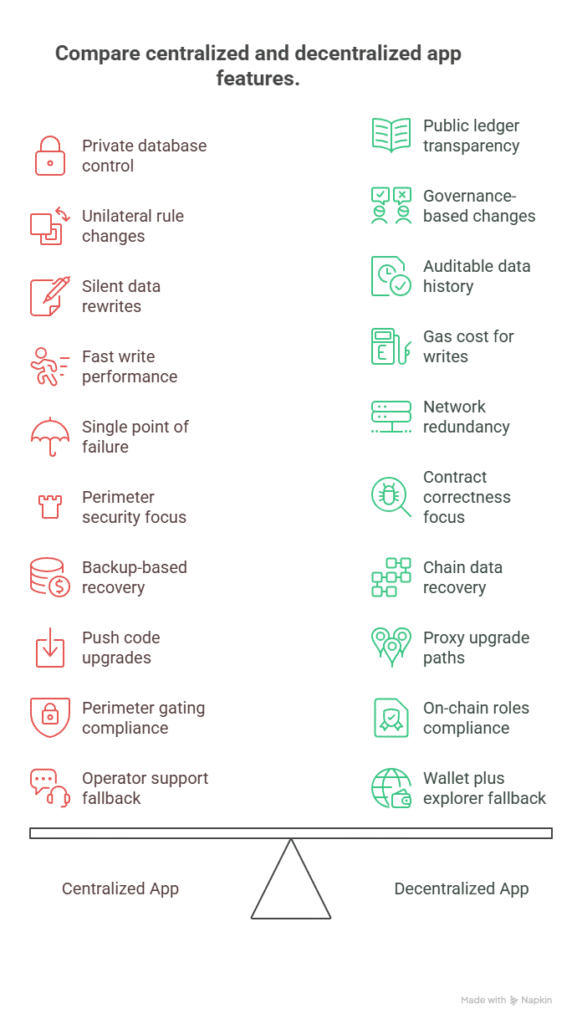
A traditional app calls a private server that one company controls, while a dApp calls a public smart contract that the network executes. Your frontend can still live on any host, but the source of truth for balances, permissions, and critical rules should be on chain. Many teams add a light server for search, caching, analytics, or notifications. That pattern is fine when the contract remains the final authority and any off-chain view can be rebuilt from events.
Architecture And Source Of Truth
In centralized designs the API and database define reality, so the operator can rewrite data or change rules at any time. In decentralized designs the contract defines reality, and every state change is recorded on a public ledger. Treat servers as helpers. Treat the chain as the arbiter. If a helper fails, the product should degrade gracefully rather than break core actions.
Trust And Governance
Centralized apps ask users to trust the operator to enforce rules and protect data. dApps shift trust toward transparent code and protocol consensus. This shift creates new duties. Plan upgrade paths early. Use clear governance, timelocks for sensitive changes, and public documentation of how and when upgrades happen.
Performance And Cost
Centralized apps batch writes cheaply and query large datasets quickly. dApps pay gas for writes and store data at higher cost, which encourages compact storage and minimal computation on chain. Reads are inexpensive at the contract level but still limited by RPC throughput, so interfaces benefit from caching, optimistic UI, and clear pending states during confirmation.
Security And Attack Surface
Centralized systems lean on perimeter defenses and operational controls. dApps succeed when on-chain rules resist adversarial inputs. Favor well-reviewed libraries, strict permission scopes, high coverage tests, and invariant checks. In hybrid stacks, never give your server powers that belong in the contract. If a helper is compromised, critical assets should remain safe because the contract enforces limits.
Observability And Recovery
Centralized recovery depends on backups and internal logs. dApp recovery depends on replaying blocks and contract events. Design off-chain services to subscribe to logs, store idempotent projections, and rebuild their view from genesis. That practice turns outages into time costs rather than data loss.
Upgrades And Migrations
A centralized operator can push schema changes in place. A dApp must upgrade through a proxy pattern or deploy a new contract and migrate state with explicit rules and user consent. Communicate the plan in the interface so users understand where balances and permissions move and how to verify the new address.
Compliance And Access Control
Centralized apps gate access at the perimeter and adapt logic in private APIs. dApps that need policy use allowlists, role-based controls, and on-chain registries that auditors can examine. When selective disclosure is required, pair on-chain checks with off-chain attestations or privacy-preserving proofs rather than hiding policy in a private database.
Hybrid Patterns That Work
Keep settlement, balances, and permission checks on chain. Let servers power discovery and convenience. If a server disappears, users should still perform critical actions with a generic wallet and a block explorer. This contract of responsibilities keeps the experience fast without undermining user ownership.
UX Implications
Wallet prompts replace password forms. Transactions are not instant,
so your UI must show intent, pending, success, and error states. Link to a block explorer after writes. Provide a network indicator and an easy way to switch to the correct chain. These small touches prevent most support issues.
Centralized vs Decentralized: At A Glance
Choosing The Right Model
Ask where trust should live and which properties your users value most. If credible neutrality and user ownership are central, place balances and permissions on-chain and let the contract be the judge. If the goal is pure speed on ephemeral data, keep the core centralized and expose narrow verifiable hooks. For many products the healthiest approach is simple. The interface serves humans. The wallet secures intent. The contract governs state. Any server you add should accelerate the journey without becoming the source of truth.
Transparency and uptime are strong. State lives on a shared ledger, not a single server. Anyone can read changes on a block explorer.
Pros And Cons Before You Start
Pros
- Open access for anyone with a wallet
- Verifiable behavior
- Easy to compose with other protocols
Cons
- New concepts to learn
- Gas costs for writes
- Upgrades require forethought
Use the chain for what must be public, durable, and verifiable. Keep bulky data off-chain for speed and cost.
Pick A Chain For Your First Build
For a smooth first experience, start on an EVM Layer 2 such as Base, Arbitrum, or Polygon PoS. Fees are low, wallets are common, and examples are everywhere. If you prefer Rust, Solana is a strong choice. If you want explicit resource semantics, Sui with Move is attractive.
| If you value | Pick | Why |
| Copy and adapt tutorials | EVM L2 | Low fees and many examples |
| Rust and high throughput | Solana | Fast confirmations and modern SDKs |
| Asset safety semantics | Sui | Resource types and clear ownership rules |
Project Shape That Stays Clean
Use two folders.
- contracts/ for smart contracts, tests, and deploy scripts
- web/ for the React or Next.js app
Keep keys in environment files. Add a short README that lists how to build, test, and deploy. You will thank yourself later.
A Hands-On Build: Your First ERC 20 Token dApp
<!– wp:paragraph -->
A token is a simple and useful starter. It touches everything you must learn. You will write a contract, deploy it, and hook up a small UI that reads a balance and lets the user interact.
Step 1. Initialize and install
# Create a workspace
mkdir my-token-dapp
cd my-token-dapp
# Init Node and add Hardhat
npm init -y
npm install –save-dev hardhat
# OpenZeppelin for audited ERC20 base
npm install @openzeppelin/contracts
# Create a Hardhat project
npx hardhat
Step 2. Write the contract
Create contracts/MyToken.sol:
// SPDX-License-Identifier: MIT
pragma solidity ^0.8.20;
import “@openzeppelin/contracts/token/ERC20/ERC20.sol”;
import “@openzeppelin/contracts/access/Ownable.sol”;
contract MyToken is ERC20, Ownable {
constructor(uint256 initialSupply)
ERC20(“PioneerToken”, “PION”)
Ownable(msg.sender) // OZ v5 pattern
{
_mint(msg.sender, initialSupply);
}
}
This inherits safe ERC-20 logic from OpenZeppelin and mints the initial supply to the deployer.
Compile it:
npx hardhat compile
Step 3. Deploy locally
Create scripts/deploy.js:
const hre = require(“hardhat”);
async function main() {
// 1,000,000 tokens with 18 decimals
const initial = hre.ethers.parseEther(“1000000”);
const Token = await hre.ethers.getContractFactory(“MyToken”);
const token = await Token.deploy(initial);
await token.waitForDeployment();
console.log(“Token deployed at:”, await token.getAddress());
}
main().catch((e) => {
console.error(e);
process.exitCode = 1;
});
Run a local chain and deploy:
# Terminal A
npx hardhat node
Hardhat prints 20 funded accounts with private keys. Leave it running.
# Terminal B
npx hardhat run scripts/deploy.js –network localhost
Copy the printed contract address. You will paste it into the UI.
Tip for MetaMask on localhost
- Add Network: HTTP RPC URL http://127.0.0.1:8545, Chain ID 31337, Currency symbol ETH.
- Import one of the private keys shown in Terminal A to get a funded account for testing.
Step 4. Build a tiny frontend
Create React app and add ethers:
cd ..
npx create-react-app client
cd client
npm install ethers
Copy the ABI file from backend to frontend:
- From my-token-dapp/artifacts/contracts/MyToken.sol/MyToken.json
- To client/src/MyToken.json
Open client/src/App.js and replace everything with:
import { useEffect, useState } from “react”;
import { ethers } from “ethers”;
import tokenArtifact from “./MyToken.json”; // copied artifact
// Paste your deployed address from the deploy log
const TOKEN_ADDRESS = “0xYourTokenAddressHere”;
function App() {
const [account, setAccount] = useState(“”);
const [provider, setProvider] = useState(null);
const [signer, setSigner] = useState(null);
const [token, setToken] = useState(null);
const [symbol, setSymbol] = useState(“PION”);
const [balance, setBalance] = useState(“0.0”);
const [to, setTo] = useState(“”);
const [amount, setAmount] = useState(“”);
const [status, setStatus] = useState(“”);
// connect wallet and init contract
const connect = async () => {
if (!window.ethereum) {
alert(“Install MetaMask to continue”);
return;
}
try {
const prov = new ethers.BrowserProvider(window.ethereum);
await prov.send(“eth_requestAccounts”, []);
const s = await prov.getSigner();
const addr = await s.getAddress();
const c = new ethers.Contract(
TOKEN_ADDRESS,
tokenArtifact.abi,
s
);
setProvider(prov);
setSigner(s);
setAccount(addr);
setToken(c);
} catch (e) {
console.error(e);
setStatus(`Connect error: ${e.message}`);
}
};
// read symbol and balance
const refresh = async () => {
if (!token || !signer) return;
try {
const [sym, balRaw, me] = await Promise.all([
token.symbol(),
token.balanceOf(await signer.getAddress()),
signer.getAddress()
]);
setSymbol(sym);
setBalance(ethers.formatEther(balRaw));
setAccount(me);
} catch (e) {
console.error(e);
setStatus(`Read error: ${e.message}`);
}
};
// transfer tokens
const transfer = async () => {
if (!token || !amount || !to) return;
try {
setStatus(“Sending transfer…”);
const tx = await token.transfer(to, ethers.parseEther(amount));
setStatus(`Pending tx: ${tx.hash}`);
await tx.wait();
setStatus(`Success. Tx: ${tx.hash}`);
await refresh();
} catch (e) {
console.error(e);
setStatus(`Transfer error: ${e.message}`);
}
};
useEffect(() => {
if (token && signer) refresh();
}, [token, signer]);
return (
<div style={{maxWidth: 720, margin: “40px auto”, fontFamily: “system-ui”}}>
<h1>My ERC-20 dApp</h1>
<p>Contract: <code>{TOKEN_ADDRESS}</code></p>
{!account ? (
<button onClick={connect}>Connect Wallet</button>
) : (
<p>Connected: {account.slice(0, 6)}…{account.slice(-4)}</p>
)}
<hr />
<h2>Balance</h2>
<p>{balance} {symbol}</p>
<button onClick={refresh} disabled={!token}>Refresh</button>
<hr />
<h2>Transfer</h2>
<div style={{display: “grid”, gap: 8, maxWidth: 480}}>
<input
placeholder=”Recipient address”
value={to}
onChange={(e) => setTo(e.target.value)}
/>
<input
placeholder=”Amount”
value={amount}
onChange={(e) => setAmount(e.target.value)}
/>
<button onClick={transfer} disabled={!token}>Send</button>
</div>
<p>{status}</p>
<p style={{marginTop: 24, fontSize: 14, opacity: 0.8}}>
On localhost there is no explorer, but you can view tx hashes in the status above.
</p>
</div>
);
}
export default App;
Start the UI:
npm start
In MetaMask, switch to the localhost network you added earlier. Import one of the Hardhat accounts if you have not already. You should see your token balance and be able to transfer between accounts.
Step 5. Try to approve and allowance
You can add two quick helpers to exercise the ERC-20 allowance flow. Place these inside the same App component and add minimal inputs.
const [spender, setSpender] = useState(“”);
const [allowAmt, setAllowAmt] = useState(“”);
const [allowance, setAllowance] = useState(“0”);
// approve spender
const approve = async () => {
if (!token || !spender || !allowAmt) return;
try {
setStatus(“Sending approve…”);
const tx = await token.approve(spender, ethers.parseEther(allowAmt));
setStatus(`Pending tx: ${tx.hash}`);
await tx.wait();
setStatus(`Approve success. Tx: ${tx.hash}`);
} catch (e) {
setStatus(`Approve error: ${e.message}`);
}
};
// read allowance
const readAllowance = async () => {
if (!token || !spender || !signer) return;
try {
const me = await signer.getAddress();
const a = await token.allowance(me, spender);
setAllowance(ethers.formatEther(a));
} catch (e) {
setStatus(`Allowance read error: ${e.message}`);
}
};
Add simple inputs and buttons to the JSX where you like:
<hr />
<h2>Approve and Allowance</h2>
<div style={{display: “grid”, gap: 8, maxWidth: 480}}>
<input placeholder=”Spender address” value={spender} onChange={(e)=>setSpender(e.target.value)} />
<input placeholder=”Approve amount” value={allowAmt} onChange={(e)=>setAllowAmt(e.target.value)} />
<div style={{display:”flex”, gap:8}}>
<button onClick={approve} disabled={!token}>Approve</button>
<button onClick={readAllowance} disabled={!token}>Check Allowance</button>
</div>
<div>Current allowance: {allowance} {symbol}</div>
</div>
Optional. Deploy to a public testnet later
When you are ready, add a Sepolia config and use an RPC from Alchemy or Infura plus a testnet private key in .env. Then run:
npx hardhat run scripts/deploy.js –network sepolia
Replace TOKEN_ADDRESS in the React app with the new address. On a testnet you can link tx hashes to Etherscan.
What you learned
- How to create a real ERC-20 using OpenZeppelin
- How to deploy with Hardhat to a local chain
- How to read balances and send transactions from a React UI with ethers
- How to handle approvals and allowances for integrations
This small stack is everything you need to extend into mints, crowdsales, token gates, and dashboards.
Security That Protects Users And You
Bugs are costly in money, reputation, and time, so build guardrails from day one and treat security as a product feature rather than a last-minute patch, because users will only trust your dApp if the on-chain rules hold under pressure and the off-chain pieces fail gracefully without putting funds or permissions at risk.
The Checks Effects Interactions Discipline
Adopt Checks Effects Interactions on every state-changing function so that you validate all inputs and permissions first, update internal storage second to reflect the new truth, and only then make any external calls to untrusted contracts or addresses, which reduces the chance of reentrancy and makes your contract easier to reason about during reviews and audits.
// SPDX-License-Identifier: MIT
pragma solidity ^0.8.20;
import “@openzeppelin/contracts/security/ReentrancyGuard.sol”;
contract SafeWithdrawal is ReentrancyGuard {
mapping(address => uint256) public balances;
// Accept deposits and credit internal accounting
function deposit() external payable {
balances[msg.sender] += msg.value;
}
// Checks: read and verify prerequisites
// Effects: update storage before any external call
// Interactions: transfer value last
function withdraw() external nonReentrant {
uint256 amount = balances[msg.sender];
require(amount > 0, “Nothing to withdraw”);
balances[msg.sender] = 0;
// Use call pattern and check result
(bool ok, ) = msg.sender.call{value: amount}(“”);
require(ok, “Transfer failed”);
}
}
This pattern pairs well with the pull payment approach where users withdraw their own funds rather than receiving unsolicited pushes, which further limits risk because recipients initiate transfers when they are ready and after they have connected a wallet that can receive the value safely.
Access Control And Emergency Powers
Restrict privileged actions to the smallest group possible and prefer a multisig for anything that controls funds, parameters, or upgrades, since single key administration creates a dangerous single point of failure and increases the blast radius of mistakes. Add a pause switch for emergencies that halts sensitive functions without blocking safe operations like withdrawals, and document clearly which roles can pause and under what conditions they may use that power so users understand your governance model.
// SPDX-License-Identifier: MIT
pragma solidity ^0.8.20;
import “@openzeppelin/contracts/access/AccessControl.sol”;
import “@openzeppelin/contracts/security/Pausable.sol”;
contract Controlled is AccessControl, Pausable {
bytes32 public constant PAUSER_ROLE = keccak256(“PAUSER_ROLE”);
bytes32 public constant OPERATOR_ROLE = keccak256(“OPERATOR_ROLE”);
constructor(address admin, address pauser, address operator) {
_grantRole(DEFAULT_ADMIN_ROLE, admin);
_grantRole(PAUSER_ROLE, pauser);
_grantRole(OPERATOR_ROLE, operator);
}
function pause() external onlyRole(PAUSER_ROLE) { _pause(); }
function unpause() external onlyRole(PAUSER_ROLE) { _unpause(); }
function sensitiveAction() external onlyRole(OPERATOR_ROLE) whenNotPaused {
// business logic
}
}
When you move to upgradeable patterns, treat upgrades as production incidents that require the same rigor and visibility as code releases, and combine timelocks with transparent announcements so the community can review changes before they take effect.
Static Analysis, Testing, And Fuzzing
Run automated checks on every commit because small regressions hide in plain sight until they interact with unusual inputs or sequences. Use a static analyzer such as Slither to catch obvious smells and misconfigurations, measure test coverage and push it high across both happy paths and failure paths, and add fuzzing or invariant tests with tools like Foundry or Echidna so that random inputs and long sequences try to break your assumptions. Favor unit tests for precise behavior, property based tests for protocol rules that must always hold, and integration tests that simulate the whole read write loop including wallet prompts and event consumption.
Event Design And Observability
Emit events for every material state change, include indexed topics for efficient filtering, and avoid storing data on chain that you can reconstruct reliably from events, because a clean event log is your best source for analytics, off chain indexing, and postmortems. Subscribe to events in your backend or data worker and build idempotent projections that you can replay from genesis, which turns recovery into a bounded exercise rather than a fire drill with partial data.
Oracle And External Call Hygiene
Treat every piece of off-chain data and every external contract as untrusted and stale until you have checked freshness, bounds, and failure modes, since a misconfigured oracle or a paused dependency can create incorrect settlements or denial of service. Validate timestamps and round IDs, guard against zero or nonsense values, and add explicit circuit breakers that reject prices or readings outside credible ranges, while documenting exactly how your system behaves during oracle outages so that users understand the risk envelope.
Upgrade And Storage Layout Safety
If you choose an upgradeable proxy, lock down storage layout with explicit gaps and avoid variable ordering mistakes that corrupt state, and never mix upgrade patterns in the same codebase without a clear migration plan. Keep an on chain version number and a public function that returns the implementation address so users and explorers can verify what code governs their assets, and accompany upgrades with human-readable changelogs that explain what changed and why it was necessary.
Private Keys And Operational Security
Store deployer and admin keys on hardware wallets, require multisig approvals for sensitive transactions, and separate roles across distinct signers so that no single device failure or compromise can harm users. Rotate API secrets for RPC and pinning services, scope them tightly with least privilege, and keep all dependencies pinned to exact versions to avoid pulling breaking changes that alter behavior silently.
Practical Threats And Mitigations
| Threat or mistake | How it shows up | Practical mitigation |
| Reentrancy through external calls | Unexpected reentry drains balances during a state change | Use Checks Effects Interactions, apply nonReentrant, convert push payments to pull patterns |
| Privileged key compromise | Sudden parameter change or upgrade that steals funds | Move admin to a multisig, add timelocks on upgrades, publish change plans and grace periods |
| Oracle manipulation or staleness | Trades or settlements at incorrect prices | Validate freshness and bounds, use medianized or aggregated feeds, add circuit breakers |
| Storage corruption on upgrade | Users see wrong balances or failing reads | Follow upgradeable storage rules, reserve gaps, write migration tests before deployment |
| Gas griefing and denial of service | Functions revert due to excessive gas or loop costs | Avoid unbounded loops, cap list sizes, use events and off chain indexing for heavy work |
| Insufficient input validation | Reverts in edge cases or silent truncation | Validate lengths, ranges, and addresses early with clear require messages |
Your Minimal Checklist With Reasons
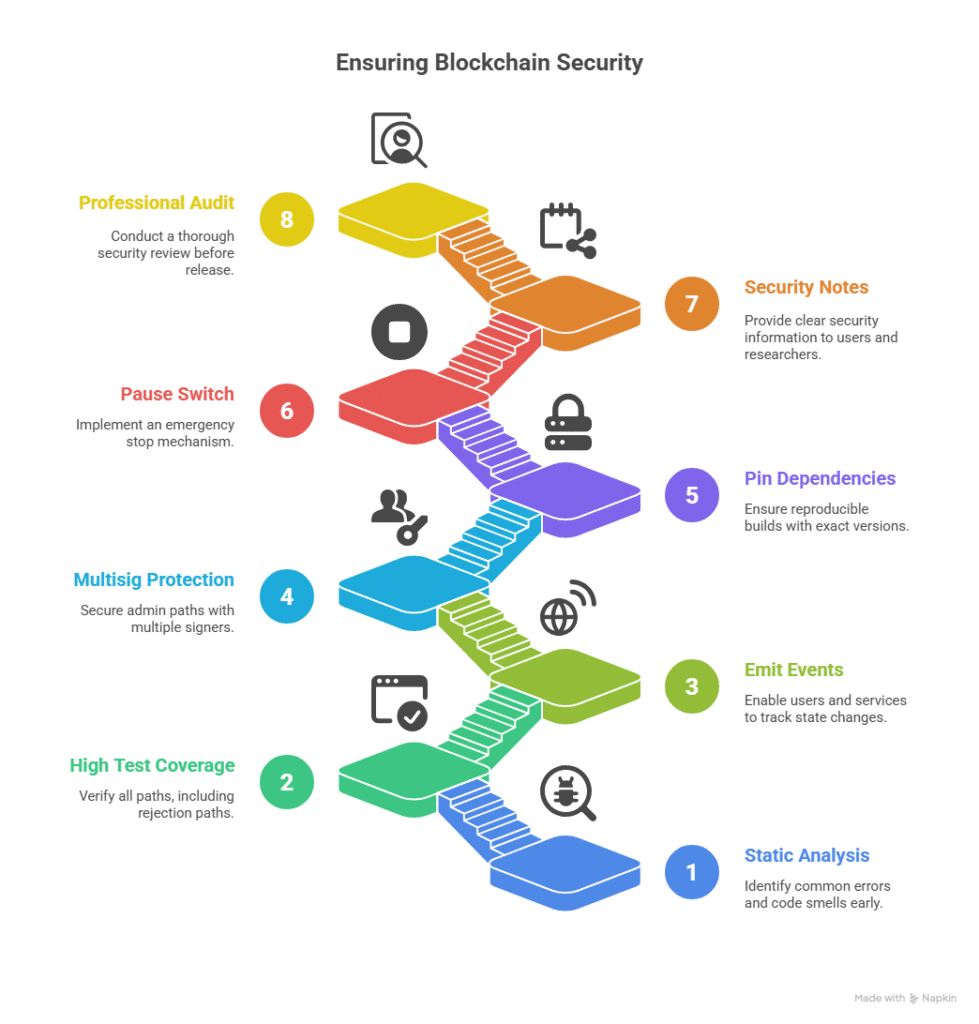
- Run static analysis for Solidity so common errors and code smells surface before review.
- Aim for high branch coverage in tests so not only the happy paths but also the rejection paths are verified repeatedly.
- Emit events for every important state change so users, indexers, and downstream services can reconstruct truth without reading storage directly.
- Protect admin paths with a multisig when funds or upgrades are at stake so no single signer can harm users.
- Pin dependencies to exact versions so builds are reproducible and surprise updates do not alter behavior.
- Keep a pause switch for emergencies so you can stop risky functions while still allowing safe withdrawals or reads.
- Publish a short security notes page and a contact email so researchers know how to disclose issues responsibly and users know how to verify contract addresses.
- For serious value, schedule a professional audit before a full mainnet release and treat the findings as requirements rather than suggestions, because the cheapest time to fix a bug is before it meets real assets.
Troubleshooting You Will Actually Use
- If a read fails, check provider URL, chain ID, and the contract address.
- If a write fails, open the transaction on the explorer and read the revert reason.
- If events do not appear, confirm you emitted them and filtered the right topic.
- If balances look wrong, double check decimals and BigNumber math.
Most bugs trace back to a small mismatch between ABI, address, and network.
Conclusion
You have a clear plan to build your first dApp and let real users try it. Start small, choose a beginner-friendly chain, and write a single smart contract that performs one visible task reliably. Connect it to a lightweight React interface that can read state, submit a simple transaction, and show a link to the block explorer so users can verify results themselves. Develop on testnets to keep costs near zero, host the frontend on a static platform, and pin only lightweight metadata to IPFS while you iterate.
Treat security as a core feature from the beginning. Follow Checks Effects Interactions, emit events for every important state change, pin dependencies to exact versions, and include a pause switch for emergencies. When real value is involved, protect admin actions with a multisig and schedule a professional audit before a broad mainnet release. Ship early, observe real behavior, fix rough edges, and repeat until the core loop feels effortless.
FAQs About Build Your First dApp
1) Do I need Web3.js to build my first dApp?
No. Web3.js works, but Ethers.js has a clean API and is widely used. The core flow is the same. Create a provider, create a contract instance, read, write, confirm.
2) Which chain should I pick for my first dApp?
Use an EVM Layer 2 for low fees and abundant guides. If you prefer Rust, try Solana. If you want explicit resource semantics, try Sui.
3) How much does a basic launch cost?
You can run a prototype on free tiers. Your mainnet cost is gas, so keep early functions small. Host the UI statically and pin small JSON or images on IPFS.
4) Can I host the frontend on a normal server and still call it a dApp?
Yes. The decentralization test is where the rules and state live. If the smart contract holds the important logic, the app qualifies as a dApp.
5) When should I consider audits?
If your contract will manage real value, bring in an auditor before a wide mainnet release. For demos, follow the checklist and limit risk.
Glossary
- ABI
The machine-readable interface that describes how to call contract functions and decode results.
- ABI
- BigNumber
A numeric type used to handle token amounts and balances without losing precision.
- BigNumber
- Block explorer
A website that shows transactions, logs, and contract data for a network.
- Block explorer
- CEI pattern
Checks, Effects, Interactions. A safe order of operations to reduce reentrancy risk.
- CEI pattern
- Faucet
A service that grants free test tokens on a public testnet.
- Faucet
- Gas
The fee paid to execute a transaction or run contract code.
- Gas
- Multisig
A wallet that requires multiple approvals for sensitive actions.
- Multisig
- Provider
A connection to a node that handles reads and broadcasts signed transactions.
- Provider
- RPC
A protocol that lets your app query chain data and submit transactions.
- RPC
- Testnet
A public network that mirrors mainnet behavior with valueless tokens for safe testing.
- Testnet
Summary
To build your first dApp, choose a beginner-friendly chain, start on an EVM Layer 2 for low fees and abundant examples, or choose Solana or Sui if their languages match your goals. Create a compact contract with OpenZeppelin, test and deploy with Hardhat or Foundry, then connect a clean React UI through Ethers.js. Cache reads, keep writes small, and store bulky files off chain to control cost. Emit events, handle pending states, and surface clear errors and confirmations. Keep secrets in env files, document contract addresses, and verify deployments on a block explorer. When the demo feels stable, add a minimal security checklist and plan an audit before wide mainnet exposure.