






Smart contract development turns clear business rules into code that executes on public networks. Teams want predictable behavior, measurable risk controls, and transparent outcomes that anyone can verify. A disciplined approach delivers those results with fewer incidents and lower operating cost.
This guide offers a practical blueprint for teams that ship production contracts. It organizes the work from requirements to monitoring, with concrete patterns and checklists. It includes examples that developers can lift into real projects without heavy translation or guesswork.
The advice favors clarity over clever tricks that raise maintenance costs. It aims for readable code, explicit limits, and safe defaults. It also covers audits, testing depth, upgrade plans, and emergency recovery procedures that protect users and treasuries.
What Smart Contract Development Involves
Smart contract development includes design, implementation, testing, deployment, and ongoing operations. The contract encodes rules, enforces permissions, and records events. Callers interact through transactions that modify state or return data. Every change becomes part of a public ledger that persists forever.
Most teams start on EVM networks because tooling and standards are mature. Solidity remains dominant, with Vyper growing in specific niches. Other ecosystems use Rust or specialized languages, yet many practices remain similar. The goal stays constant across stacks, which is safe code and predictable outcomes.
Ground Rules and Engineering Principles
Strong projects follow a short set of principles that guide daily decisions. These principles keep the codebase safe under pressure and easy to extend.
- Prefer minimal scope over feature creep that raises attack surface.
- Make permissions explicit and visible near function definitions.
- Emit events for every state change that matters to operators or users.
- Favor pull payments over push payments to reduce reentrancy risk.
- Write code that a new teammate can understand within one focused session.
- Treat gas as a constraint, yet never sacrifice safety for tiny savings.
- Assume every external call can fail or behave in surprising ways.
Requirements Before a Line of Code
Good requirements reduce bugs and avoid design changes mid sprint. Capture clear preconditions, postconditions, and failure modes. Document each role, each permission, and each state transition. Map unusual cases like paused states, fee changes, or oracle stalls.
Define numerical limits that guard against accidental extremes. Caps on supply, rate limits on minting, cooldowns on sensitive actions, and bounds on input parameters help a lot. Better limits mean smaller blast radius when a component misbehaves.
Threat Modeling and Attack Surfaces
Threat modeling should start as the first design conversation, not after coding finishes. Identify assets such as treasuries, governance rights, and mint permissions. Enumerate threats across reentrancy, price manipulation, privilege escalation, denial of service, and griefing.
Write down mitigations for each threat, then verify them in tests and reviews. The threat model informs code structure, event design, and operational runbooks. It also shapes the audit scope and test priorities across fuzzing and invariant checks.
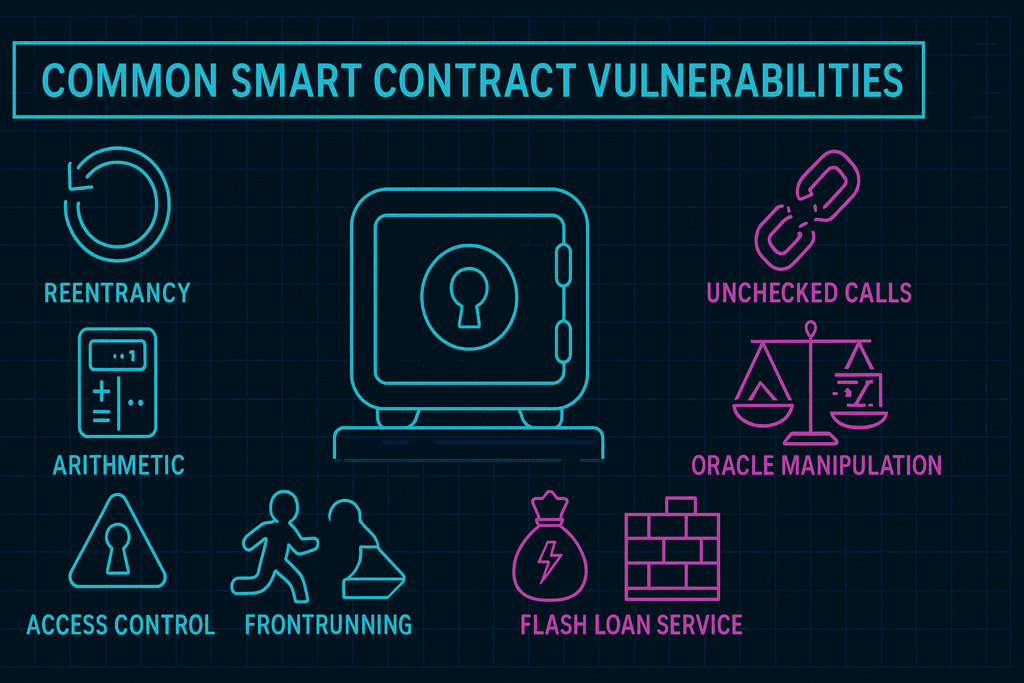
Know the Common Vulnerabilities
Teams reduce incidents by planning for known classes of bugs. The following list highlights what to expect and how to prepare.
Reentrancy
Occurs when an external call reenters the contract before state updates complete, enabling unintended repeated actions. Use checks-effects-interactions, add simple reentrancy locks, and favor pull payments so users withdraw funds themselves.
Unchecked External Calls
External calls can revert or quietly return false, breaking assumptions and masking failures during execution. Always verify return values or use interfaces that revert, and surround calls with explicit error handling and minimal assumptions.
Arithmetic Pitfalls
Solidity’s built-in checks reduce underflow and overflow, but risky math still slips through during refactors. Use unchecked only when profiling proves meaningful savings, and add tests that hammer boundary values and failure cases.
Access Control Mistakes
Missing modifiers or scattered role checks open doors to privilege abuse and accidental misuse. Centralize authorization in a single contract with small helpers, and test every sensitive function against each unauthorized role.
Frontrunning and Ordering Risks
Profits tied to transaction order invite manipulation by faster bidders or private relays. Close gaps with commit-reveal flows and signatures that bind parameters, limiting harmful slippage and sandwich opportunities.
Oracle Manipulation
Stale or skewed data can trigger unfair liquidations, drains, or broken invariants. Use robust oracles with medianization, staleness checks, and grace periods or minimum observations before sensitive updates execute.
Flash Loan Exploitation
Transient liquidity can distort markets and invariants within a single block, enabling profitable drains. Defend using time-weighted prices, circuit breakers, sanity checks on deltas, and limits that avoid single-block assumptions.
Denial of Service
Unbounded loops or user-controlled iterations can make functions revert or exceed gas, halting operations. Avoid loops over unbounded arrays, enforce caps, and include escape hatches that reset state without iterating large sets.
Secure Design Patterns That Earn Their Keep
A small set of patterns solves many real problems while keeping code readable. Each pattern includes a short summary that explains why it helps.
Checks-Effects-Interactions
Update internal state before making any external call to contain side effects and reduce reentrancy risk. Pair this order with a simple non-reentrant guard whenever funds move to external addresses.
Pull Over Push
Record balances and let users withdraw on demand, avoiding surprise transfers during unrelated calls. Pull-based payouts isolate risk, improve observability, and simplify alerting for high-value movements.
Circuit Breaker
Allow a designated role to pause sensitive functions when anomalies appear, buying time to investigate safely. Use a multisig, emit a clear on-chain reason, and document unpause criteria publicly.
Role-Based Access Control
Assign narrow, named roles to addresses and contracts so each permission has a clear owner. Centralized helpers and explicit checks limit blast radius if a single key or component fails.
Timelocks and Delayed Actions
Delay impactful changes so users can review, react, or exit before execution occurs. Announce changes publicly, emit events, and pair delays with audits for upgrades and parameter shifts.
Rate Limits and Quotas
Cap how much value or how many actions can occur within defined windows to curb mistakes. These throttles slow attackers, bound worst-case losses, and surface anomalies earlier in monitoring.
Standards and Interfaces
Reusing standards builds user trust and reduces audit scope. ERC twenty, ERC seven twenty one, ERC eleven fifty five, and ERC four six two six move value across the ecosystem. Follow reference implementations and document any deviations in clear terms.
Design interfaces that are small and predictable. Separate read paths from write paths to improve caching and analytics. Include view functions for state that users or frontends require frequently.
Tooling That Boosts Reliability
Modern toolchains improve speed and safety when used consistently. Hardhat and Foundry dominate EVM development today. Both support unit tests, mainnet forking, and scripting that automates repetitive work.
Add static analysis and property testing to every repository. Slither finds common issues through fast checks across the codebase. Echidna or Foundry fuzzing explores edge cases that humans often miss. Manticore helps with symbolic execution when deeper confidence is needed.
Integrate gas reporters to catch expensive changes early. Capture bytecode sizes and deployment costs in automated reports. Visibility on cost makes tradeoffs explicit during design conversations with product teams.
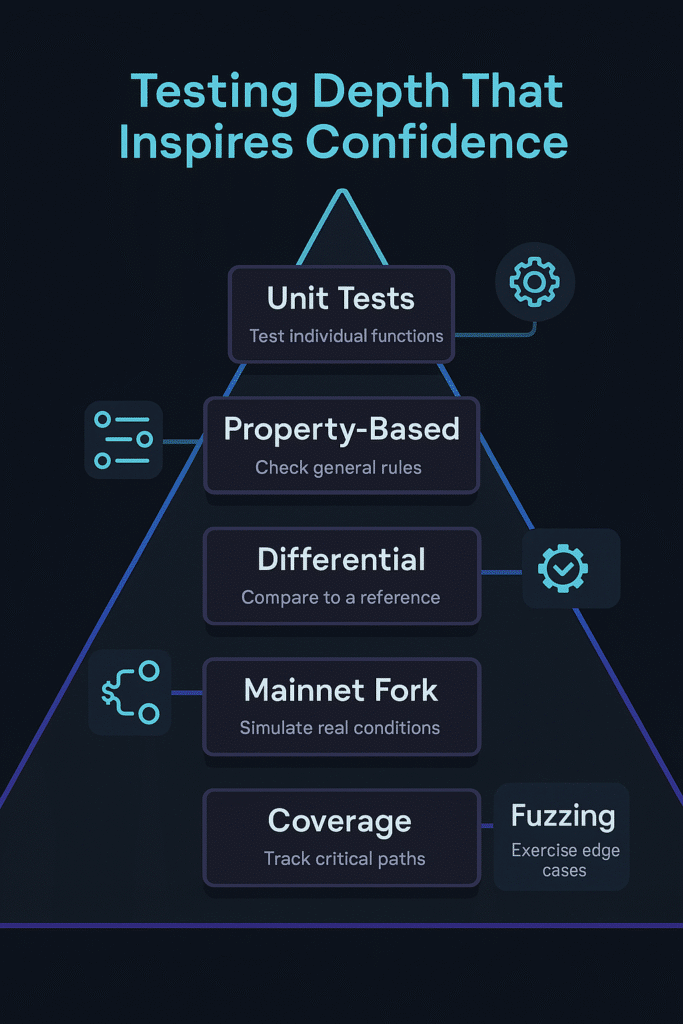
Testing Depth That Inspires Confidence
Treat tests as the primary consumer of your contracts during development. Tests should read like documentation that explains how the system behaves. They should also break on purpose at boundary conditions and failure cases.
- Unit tests verify each function with success and failure scenarios. Include permission tests that assert which roles can call sensitive actions. Add tests for paused states, timelocks, and rate limits to prove they work.
- Property based tests search for violations in rules that must always hold. Invariants like conservation of supply or ordered balances are helpful. Fuzz inputs within reasonable ranges to catch unexpected interactions.
- Differential tests compare a new implementation against a trusted reference. Matching behaviors across random inputs reveals drift that humans miss. This method is useful for math heavy components like swaps or auctions.
- Mainnet fork tests simulate real conditions with real liquidity and oracles. Fork tests reduce surprises during deployment to production networks. They also clarify risks from external dependencies and upstream contracts.
Aim for coverage that tracks critical paths rather than chasing one hundred percent. A smaller suite with sharp invariants often provides more value. Keep tests fast to encourage frequent runs during local development.
Formal Specifications and Verification
Some systems benefit from formal specifications that encode the rules precisely. Even simple specifications improve reasoning and prevent misinterpretations. Annotate functions with preconditions, postconditions, and invariants in human friendly form.
Push deeper when stakes are high and the math is tricky. Use verification tools that check properties against the bytecode or the source. Start with a small set of high value properties that protect funds and rights. Keep proofs updated as code evolves, or else they become stale and misleading.
Upgradability Without Surprises
Upgradable contracts trade simplicity for flexibility and must be handled with care. Storage layout must remain consistent across versions. Breaking layout introduces subtle bugs that appear months after an upgrade.
Use proven proxy patterns and document them for auditors and users. Reserve storage gaps to allow future variables without collisions. Place initialization logic in an initializer function that runs once. Protect upgrade functions with a multisig and a timelock to reduce governance risk.
Provide a clear downgrade path for emergencies. Record which versions are deployed and verified across environments. Communicate upgrade schedules in advance to let integrators prepare calmly.
Composability and External Integrations
Smart contracts rarely live alone, which introduces new behaviors and risks. Whenever a contract calls out, it accepts risk from the external system. Defend with input validation, sensible defaults, and strict interface expectations.
Wrap integrations behind small adapters that you can swap if needed. Make adapters return structured errors that contribute to observability. Test adapters with mainnet forks and fuzzing that targets external return values.
Oracles and Off-Chain Data
On-chain logic often depends on off-chain data provided by oracles. That dependency introduces freshness and integrity concerns that require attention. Always check for staleness, missing data, and unexpected price swings.
Use multiple sources where possible, with medianization and fallback logic. Validate that updates fit within plausible ranges compared to previous observations. For sensitive operations, require multiple blocks of consistent data before acting.
Gas Optimization That Keeps Safety First
Gas optimization follows the rule of measure, then refactor. Changes should begin with profiles that identify true hotspots. Do not micro-optimize code paths that run rarely or only during initialization.
Prefer calldata for function parameters on external calls to reduce copies. Pack struct fields to reduce storage slots and repeated SSTORE operations. Use immutable and constant where values never change after deployment. Consider custom errors to save gas on revert messages without losing clarity.
Reach for inline assembly only after safer options fail to deliver. Assembly can reduce gas and bytecode size, yet raises maintenance costs. Include extra tests and documentation around assembly blocks to lower future risks.
Documentation That People Actually Read
Documentation helps new contributors, auditors, and integrators move faster. It also functions as a user manual for power users and operators. Treat docs as a living artifact that stays current with releases.
Use NatSpec comments on public functions and important events. Include parameter meanings, return values, and failure reasons. Provide diagrams for state machines and permission graphs where applicable.
Write a top-level README that explains setup, scripts, deployments, and roles. Include a glossary that defines project-specific terms without ambiguity. Keep a changelog that records what changed and why each change happened.
Deployment Procedures That Reduce Risk
Deployments benefit from the same discipline used in code and tests. Scripts should create contracts, verify them, and configure roles deterministically. The process should run the same way across testnets and mainnets.
Use separate keys for development, staging, and production networks. Protect production keys with hardware devices and multisig arrangements. Run a small canary on a testnet with identical parameters before the main launch.
After deployment, verify source code on explorers immediately. Publish addresses, ABIs, and role assignments in a single location. Announce the activation schedule and the emergency procedures with clear language.
Monitoring and On-Chain Observability
Monitoring turns events into awareness and response. Emit events for sensitive changes like role grants, parameter changes, and upgrades. Capture critical state in indexed events that dashboards can track in real time.
Set up alerts for unusual volumes, rapid price changes, and repeated reverts. Monitor Oracle freshness and deviations from expected ranges. Watch withdrawal patterns for unusual bursts that indicate abuse or fear.
Use tools that simulate transactions before sending them when possible. Preflight simulations catch reverts and show expected state changes. Pair simulations with on-chain analytics to understand user behavior over time.
Governance, Keys, and Human Factors
Key management and governance design matter as much as code quality. A missing key recovery plan becomes a latent risk that eventually bites. Define the multisig structure, signer policies, and rotation procedures early.
Use least privilege across operational keys for daily tasks. Grant broader powers to timelocked multisigs for exceptional actions. Review signer availability and incident response expectations before shipping.
Plan public communication for upgrades, pauses, or incident investigations. Users trust teams that share timely updates and clear timelines. Document decisions and publish postmortems to reduce repeated mistakes.
Audits and Independent Reviews
External audits provide a second pair of eyes that improve safety and confidence. Treat audits as a conversation rather than a checkbox. Share threat models, invariants, and diagrams with auditors before they start.
Fix findings quickly and request re checks on meaningful changes. Publish the report and your responses to build public trust. Remember that audits reduce risk but never eliminate it. Keep monitoring and staged rollouts even after a clean report.
Incident Response and Recovery
Incidents require calm procedures and rehearsed steps. The playbook should define who can pause, who communicates, and who investigates. It should also define time budgets for triage and decisions under uncertainty.
Practice drills on testnets to validate the playbook and reduce stress. Keep templates for public notices and postmortems ready to go. Record each step during an incident to support later analysis and learning.
Migration and Versioning Strategy
Projects evolve, so plan migration paths that respect user expectations. Version contracts with clear names and tagged releases in the repository. Keep public mappings or registries that show which version is active.
When deploying a new version, publish a change summary that highlights risks. Include any new permissions, new limits, or behavior changes that matter. Provide a deprecation period for older versions when practical and safe.
Cross-Chain Considerations
Bridges and cross-chain messaging add complexity that merits careful design. Treat every message as untrusted until verified by your chosen protocol. Protect against replay attacks with nonces and strict domain separation.
Cap the value at risk per window to reduce worst case losses. Provide controls that disable cross chain actions during investigations. Monitor relayer health and message delays to spot emerging issues quickly.
Operational Playbooks That Teams Actually Use
Runbooks should be short, current, and reachable by everyone on duty. Include steps for pausing, rotating signers, and failing safe. Include a section for verifying explorers and contract metadata after upgrades.
Store contact methods for exchanges, market makers, and partners. Practice the runbook during quiet periods to remove ambiguity. A practiced playbook turns chaos into a controlled response that saves value.
Phase Checklists for Real Teams
Before coding
• Write roles, permissions, and state transitions with edge cases.
• Draft a threat model that lists assets, threats, and mitigations.
• Define numerical limits and timeouts for sensitive operations.
During implementation
• Add NatSpec and events while writing functions.
• Keep authorization checks near function headers for clarity.
• Avoid unbounded loops and external calls inside critical flows.
Testing and review
• Cover happy paths, auth failures, and boundary conditions.
• Add fuzzing on math components and state machines.
• Run static analysis on each pull request and fix findings quickly.
Pre deployment
• Script deployments, role grants, and verifications end to end.
• Simulate on a fork with realistic liquidity and oracle conditions.
• Prepare announcements and schedule with a mild buffer.
Post deployment
• Enable monitoring dashboards and alert policies immediately.
• Verify code on explorers and publish addresses with ABIs.
• Review logs for anomalies during the first hours of activity.
Conclusion
Smart contract development rewards teams that keep scope tight and safety visible. The best systems use patterns that limit blast radius and recover quickly. Strong tests and monitoring lower incident counts and shorten investigations. Clear documentation helps users, operators, and auditors move with confidence.
The path described here trades short term speed for long term resilience. It gives teams a template to design, build, test, ship, and operate responsibly. It does not promise perfection, yet it delivers systems that behave predictably under pressure. That predictability is what users need when value moves at block speed.
FAQs About Smart Contract Development
What should teams finalize before writing any code?
Lock roles, permissions, state transitions, numerical limits, and a first-pass threat model. Capture odd states like pauses, fee changes, and oracle stalls so nothing surprises you later.
How much testing is “enough” for production?
Cover success, failure, and boundary cases, then add fuzzing and invariants for critical rules. Run mainnet forks to expose integration risks you will not see on local chains.
Do audits replace strong internal reviews?
No. Audits find issues, but they do not guarantee safety. Keep staged rollouts, dashboards, and alerting even after a clean audit report.
When are upgradable proxies worth the tradeoff?
Use them when policy or economics must evolve. Protect upgrades with multisig and timelocks, preserve storage layout, and publish version notes ahead of time.
How should teams plan for incidents?
Write a short, practiced playbook. Define who pauses, who communicates, and how triage runs. Keep templates for notices and postmortems ready.
Glossary
- Access Control: Rules that decide who can call sensitive functions.
- Checks-Effects-Interactions: Order that updates state before external calls.
- Circuit Breaker: Pause switch for risky functions during emergencies.
- Event: On-chain log entry that monitoring tools and users can track.
- Fuzzing: Randomized testing that searches for unexpected failures.
- Invariant: A rule that must always hold, like total supply conservation.
- Mainnet Fork Test: Local test that reuses live chain state and liquidity.
- Oracle: Data feed that brings off-chain prices or facts on chain.
- Proxy Upgrade Pattern: Separation of storage and logic to allow upgrades.
- Timelock: Delay that gives users time to react before changes apply.
Summary
This guide turns smart contract work into a repeatable path from requirements to monitoring. Teams start with clear roles, limits, and a living threat model, then design for minimal scope, explicit permissions, and events that raise useful signals. Testing drives confidence: unit tests, fuzzing, invariants, and mainnet forks catch failures before users do. Tooling stays standard with Hardhat or Foundry, plus Slither for static checks and gas reporters to surface costly changes. Upgrades use documented proxy patterns, protected by multisig and timelocks, with versioning and deprecation windows. Integrations sit behind adapters, and oracle data faces staleness checks, medianization, and circuit breakers. Deployments are scripted and verified, followed by dashboards and alerts for paths that matter. Governance leans on least privilege, practiced playbooks, and communication during incidents. Audits remain essential yet incomplete, so staged rollouts and monitoring continue. The result is predictable behavior, blast radius, and resilient systems that survive pressure.