







Despite the dropping demand in Bitcoin futures and falling open interest to multi-quarter lows, Bitcoin has been seen holding its ground as price action holds at key levels around $67,000.
A number of factors have influenced the recent moves. Geopolitical tensions in the Middle East caused a sharp volatility at the beginning of March; with Bitcoin briefly dipping beneath $64,000 following coordinated U.S. and Israeli actions against Iran.
The cryptocurrency subsequently recovered to hover in the mid-$60K range; indicating that the markets are processing news flows differently than they have in past cycles.
In this regard, demand for Bitcoin futures has remarkably contracted. Open interest has plunged across major exchanges compared to prior months. One major catalyst of this has been deleveraging from speculators fearful of prolonged volatility and uncertain macro conditions.
What Weak Demand for Bitcoin Futures Is Telling Us
Bitcoin futures demand describes how much leverage and exposure is being taken by traders in the futures markets. Falling futures demand often indicates that traders are reluctant to build positions, especially long ones, during choppy or directionless markets.
And now, in the current situation, this dwindled interest is happening despite Bitcoin price stabilizing, still meaning that momentum players and those who are depending on plastered capital have pulled back.
Other market indicators are also showing that large leveraged positions were unwound in late February and early March as news of the escalating conflict depressed sentiment.
Open interest on Binance and other major derivatives exchanges has fallen sharply, with some reports suggesting that it is down about 25% on the year as traders have cut back exposure.
While Bitcoin price has remained relatively steady, this demand for futures follows a different pattern. The fact that Bitcoin has so far been able to hold above $66,000 may mean spot demand, or support from non-leveraged participants, cushioning the broader market.

Spot ETF Flows and Institutional Involvement
A Second factor that is guiding current Bitcoin price action is institutional money flows via spot ETFs. Spot Bitcoin ETFs have re-engaged institutional interest to some degree in the last several weeks following a long period of outflows that ran over months.
Newer reports show massive net inflows into the Bitcoin ETFs trading in the U.S., totaling hundreds of millions in net cumulative contributions over time.
Analysts have seen this trend as further proof that larger, institutional investors are quietly re-entering the market but preferring direct ownership over leveraged exposure.
Although the demand for Bitcoin futures may be weak, this recovery in Bitcoin ETF flows is basically indicating that institutional appetite to hold the basic asset remains strong. ETF inflows tend to reflect longer-term allocations at the expense of short-term speculative trades and can help support prices despite weakness in derivatives markets.
However, the prolonged U.S. spot Bitcoin ETFs outflows which saw billions move out over several months through earlier parts of 2026, reveal mixed sentiment from institutional holders.
Macro Forces and Geopolitical Stress Shape the Market
At the beginning of March; tensions in the Middle East sent fear through global markets, with reports observing volatile movements in cryptocurrency prices as traders responded to news of military activity. These developments prompted an initial sell-off; followed by some recovery as conflicting signals and weekend liquidity conditions worked through.
Such conditions tend to cause futures traders to fall back on risk positions, particularly when macro news introduces uncertainty. This helps to explain why Bitcoin futures demand has dropped despite the price not breaking significantly lower.
Meanwhile, Bitcoin’s strength in holding above critical support areas shows its more mature market structure compared to previous cycles, when geopolitical events tended to cause sharper breakdowns.
The Current Price Situation: A Balancing Act
As of now; Bitcoin trades around $66,000 to $68,000 after rebounding from prior intraday low prices. This stability despite lower futures demand means that spot purchasers are absorbing selling pressure and long-term holders may be entering again at key levels.
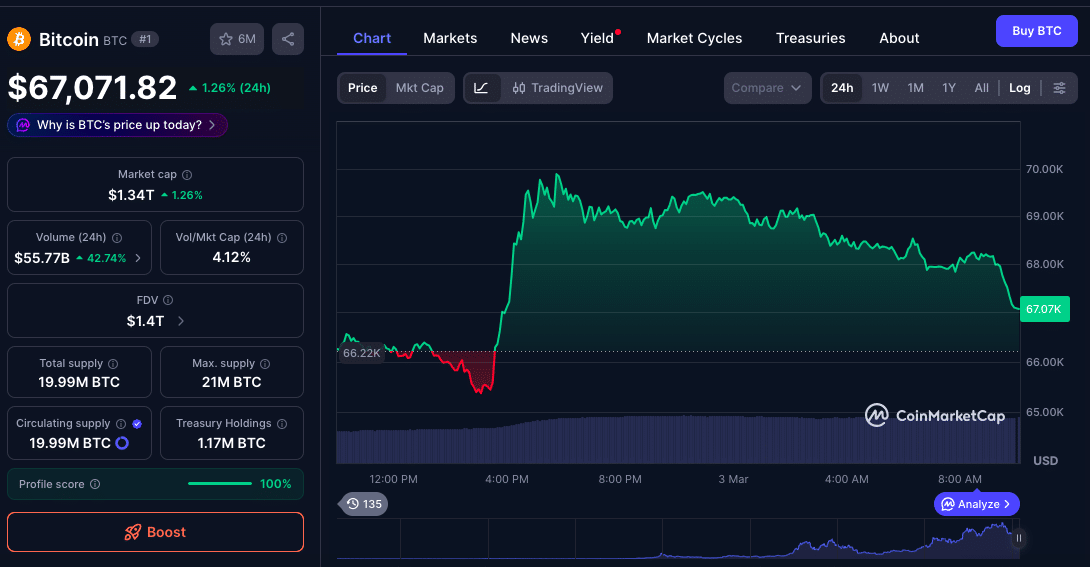
Trading volume has also revealed some sort of strength, as some analysts have referenced high measures of daily volume that are likely not exclusively retail-momentum driven and instead hint at institutional involvement.
The knowledge that Bitcoin can keep its footing even as leveraged demand declines speaks volumes to growing maturity in its market.
Conclusion
There has been a clear reduction in the demand for Bitcoin futures with an open interest reduction and a leveraged exposure trimming. This points to a cautious trading environment, shaped by economic uncertainty, geopolitical risk and macro shifts.
Bitcoin’s price, however; has shown amazing resilience still, stabilizing above the mid-$60,000 area in spite of these headwinds.
Spot ETF flows suggest that institutional interest has returned; but net flows are mixed over the longer term.
The gap between weak futures demand and steadier spot price tells of how the market increasingly often now finds itself in balance between risk aversion on the one hand, and opportunistic accumulation on the other.
Glossary
Bitcoin Futures Demand: Bitcoin futures demand is the overall level of participation and open interest in derivative exchanges for Bitcoin futures contracts.
Open Interest: The total number of futures contracts that are currently open and have not been settled or closed
Spot Bitcoin ETF: an exchange-traded fund that directly stores Bitcoin instead of derivatives; allowing institutions to gain exposure without needing a future derivative contract.
Direct exposure: refers to gaining a position through borrowed capital.
Frequently Asked Questions About Bitcoin Futures Demand
What signifies low demand on Bitcoin futures?
Lower demand for Bitcoin futures means that traders may be reducing leveraged positions; which is generally an articulation of some increasing volatility or uncertainty.
Are institutions leaving due to weak futures demand?
Not necessarily. ETF flows and trading volumes may show institutions shifting preference; from futures to direct spot holdings rather than leaving the market.
What is the current condition of Bitcoin price?
Bitcoin has recovered from being below $66,000 and remains strong amid other market concerns.
Why has open interest fallen?
Open interest declines when traders close positions; especially when risk sentiment shifts in response to macro or geopolitical events.
Is Bitcoin fundamentally weakening?
The market structure appears reasonably unchanged as speculative futures demand softens from its peak, according to current evidence.
References