



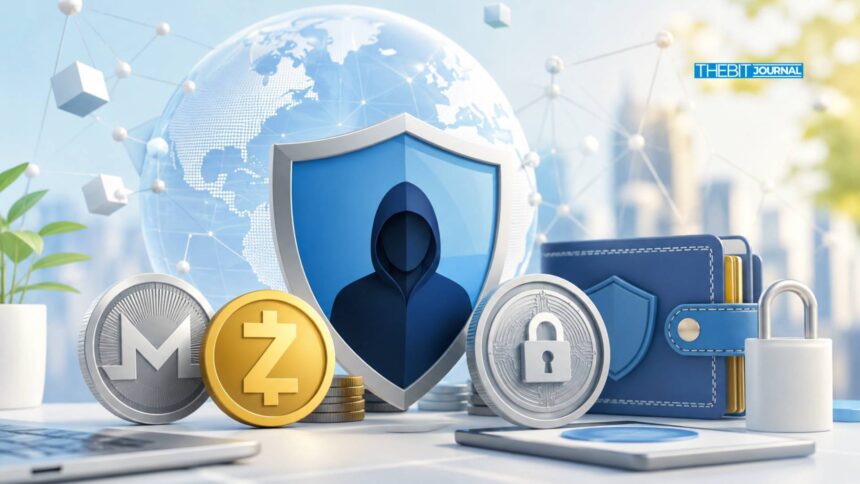

Privacy coins sit at one of the most debated corners of crypto. They promise financial privacy in a world where most blockchains leave a public trail, yet they also raise hard questions for regulators, exchanges, and everyday users. Bitcoin and Ethereum are often called transparent networks because wallet activity can be viewed on public explorers. Privacy-focused cryptocurrencies take a different route.
They use cryptography to hide, blur, or limit transaction details such as sender, receiver, and amount. That sounds useful for personal safety, business confidentiality, and financial freedom, but it also creates compliance risks when funds cannot be easily traced. This guide explains how privacy coins work, whether anonymous transactions are safe, and why privacy coin technology? has become a serious topic for investors, developers, and policymakers.
What Are Privacy Coins?
Privacy coins are cryptocurrencies designed to make blockchain transactions harder to trace. In simple terms, they try to bring some of the privacy of cash into digital money. A cash payment between 2 people does not automatically publish the payer, receiver, and amount to the public. Most blockchains do the opposite. They do not always show real names, but they show wallet addresses, balances, and transaction history.
That difference matters as a wallet address may look anonymous at first, but once it is linked to a person, exchange account, business, donation page, or social profile, much of that user’s financial activity can become visible. Privacy coins aim to reduce that exposure.
The best-known examples include Monero and Zcash, although their designs are different. Monero makes privacy the default setting by using systems such as ring signatures and stealth addresses. Zcash allows both transparent and shielded transactions, with shielded transfers using zero-knowledge proofs to verify activity without revealing key details.
Why Privacy Coin Technology? Matters Now
Privacy coin technology? matters because digital finance is no longer a small experiment. Crypto wallets are used by traders, businesses, activists, freelancers, and ordinary savers. Public blockchains can create transparency, but too much transparency can also become a weakness.
A company may not want competitors to track supplier payments. A worker may not want their full wallet balance exposed after receiving salary in crypto. A donor may support a legal cause without wanting public attention. In risky regions, financial privacy can even become a safety issue.
At the same time, regulators worry about money laundering, sanctions evasion, ransomware payments, and criminal markets. That is why privacy coin technology? is treated differently from regular crypto by many exchanges and regulators. The Financial Action Task Force has warned that anonymity-enhanced cryptocurrencies and other obfuscation tools can increase money laundering and terrorist financing risks, especially when virtual asset service providers cannot identify users or transaction flows.
How Anonymous Crypto Transactions Work
Privacy coins do not all work the same way. Some hide the sender. Some hide the receiver. Some hide the transaction amount. Stronger systems try to protect all 3.
Monero uses ring signatures to make it difficult to identify which participant signed a transaction. A ring signature lets one member of a group authorize a transaction without revealing exactly which member did it. Monero also uses stealth addresses, which create one-time addresses for recipients, making it harder to link payments to a public wallet identity. Its confidential transaction design helps conceal amounts while keeping the network verifiable.
Zcash uses zero-knowledge proofs, this allows the network to confirm that a transaction is valid without exposing private details such as wallet balance or transaction history. In Zcash, transparent transactions can still work like Bitcoin-style transfers, while shielded transactions add privacy protections. The most private format is shielded-to-shielded, where sender, receiver, and amount are encrypted.
This is where privacy coin technology? becomes more than a buzzword. It is not just “hiding money.” It is a set of cryptographic tools built to prove that a transfer is valid while limiting what outsiders can see.
Privacy Coins vs Bitcoin: The Big Difference
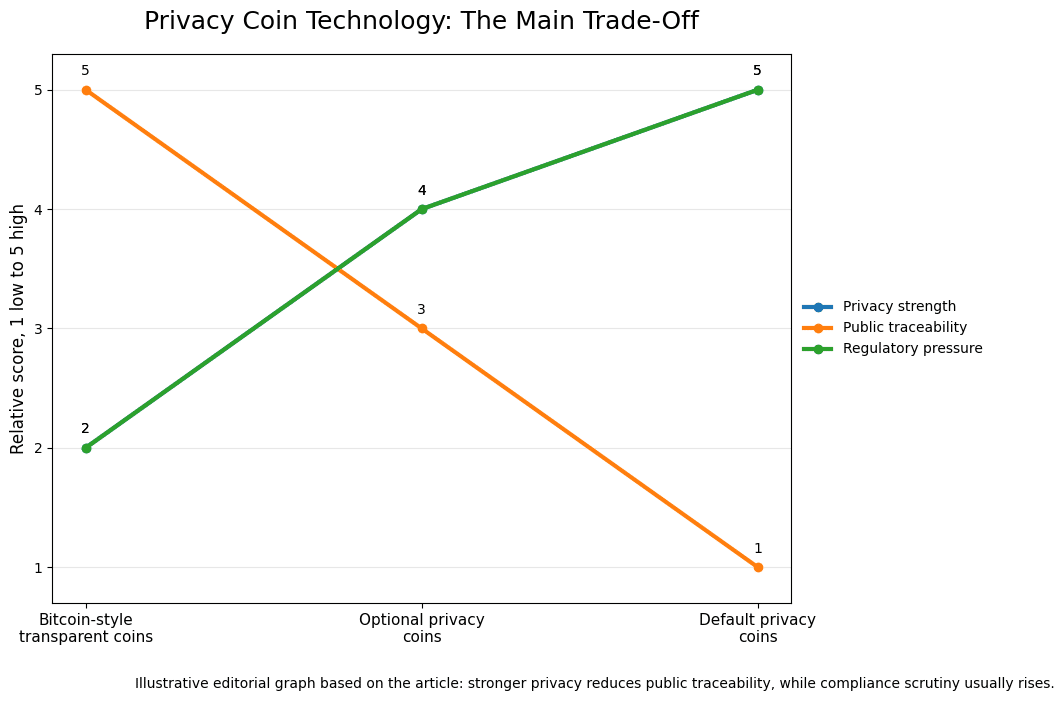
Bitcoin is often misunderstood as fully anonymous as it is not. Bitcoin is pseudonymous, meaning users transact through addresses rather than real names. Still, every transaction is recorded on a public ledger. If an exchange, investigator, or analytics firm links an address to a person, the historical trail may become visible.
Privacy coins try to break that easy link. They reduce the amount of public data available on-chain. In practice, this can make analysis harder, but not always impossible. Network data, exchange records, user mistakes, malware, wallet reuse, poor operational security, and off-chain behavior can still expose users.

So, privacy coin technology? should not be marketed as magic invisibility. A better way to frame it is stronger financial confidentiality. It can protect ordinary users from public tracking, but it does not remove every risk.
Are Anonymous Transactions Safe?
Anonymous transactions can be safe from a technical view when the protocol is well designed, wallets are used correctly, and users understand the limits. Yet safety has 2 meanings in crypto. There is technical safety, and there is legal or practical safety.
Technically, privacy coins can reduce risks linked to public wallet exposure. That can protect users from targeted scams, phishing, unwanted attention, and business intelligence leaks. If someone receives funds on a transparent chain, anyone who sees that address may inspect balances and related movements. Privacy tools can reduce that problem.
Legally, the picture is more complex. Some jurisdictions restrict privacy coins on regulated exchanges, while others focus on stronger anti-money laundering checks at the platform level. In the UAE, official guidance for licensed financial institutions has also highlighted that privacy coins can enhance anonymity and create concerns around customer and counterparty identification.
That is why privacy coin technology? is safe only when used for lawful purposes and with awareness of local rules. Privacy itself is not illegal by default, but anonymous payment tools can create compliance issues when used through regulated platforms.
Why Exchanges Often Delist Privacy Coins
Many exchanges do not want to carry assets that make compliance difficult. A regulated exchange usually needs to monitor deposits, withdrawals, suspicious activity, sanctions risk, and customer behavior. If a coin hides transaction flows by default, the exchange may face pressure from banking partners, regulators, or internal risk teams.
This is why privacy coins have faced delistings or restrictions in several markets. The issue is usually not that every user is doing something wrong. The issue is that regulated platforms must prove they can manage financial crime risk. When they cannot see enough transaction data, they may decide the asset is too hard to support.
For investors, this matters because exchange access affects liquidity. If fewer platforms list a coin, trading volume may fall, spreads may widen, and price moves can become sharper. privacy coin technology? may be strong from a privacy view, but market access is still shaped by regulation and compliance.
The Key Crypto Indicators Users Should Watch
A privacy coin should not be judged by price alone. Strong analysis looks at liquidity, exchange support, developer activity, security design, adoption, regulatory risk, and real transaction use.
Liquidity shows whether users can enter and exit positions without heavy slippage. Exchange support shows whether the asset remains accessible in major markets. Developer activity matters because privacy tech needs constant review, upgrades, and security research. A neglected privacy protocol can become risky over time.
Transaction activity is also important, but privacy coins are harder to measure than transparent chains. On a public chain, analysts can inspect flows, active wallets, and whale movements. With privacy coins, that data may be limited by design. This creates a trade-off. The same feature that protects users also makes market analysis harder.
Regulatory risk is another key indicator as a coin may have strong technology, but if exchanges remove it, institutions avoid it, or local rules restrict it, demand can change quickly. For this reason, privacy coin technology? should be evaluated as both a technical system and a market asset.
Legitimate Uses of Privacy Coins
Privacy coins can serve lawful and practical needs. A business can use them to protect supplier payments. A freelancer can avoid exposing income history to every client. A family can keep savings private. A nonprofit donor can avoid public profiling. A crypto user can reduce the risk of wallet-based targeting.
In traditional finance, privacy is normal. Bank accounts are not open public ledgers. Payment processors do not publish every customer’s spending history. Crypto changed that by making transparency part of the infrastructure. Privacy coins push back against that model.
This is why privacy coin technology? is often defended by privacy advocates. They argue that financial privacy is not suspicious by itself. The concern begins when privacy tools are used to hide crime, bypass sanctions, or move stolen funds.
Risks and Limitations Users Should Understand
Privacy coins come with real risks; first, they may be harder to buy or sell if exchanges restrict them. Second, some wallets and platforms may not support them properly. Third, users may face questions when moving funds to regulated exchanges, especially if the source of funds cannot be clearly explained.
There is also a false-confidence problem as a user may think a privacy coin makes every action untraceable, then reveal identity through an exchange account, reused address, browser leak, public post, or poor wallet handling. Privacy is not just a coin feature. It is a full behavior pattern.
Technical risk also exists as cryptography is powerful, but it is not immune to bugs, flawed assumptions, or future research. Older transactions on some privacy systems have faced analysis concerns in the past, showing that privacy strength can depend on protocol design, user behavior, and timing.
That is why privacy coin technology? should be handled carefully. It can improve confidentiality, but users should not treat it as a shield against every form of investigation, mistake, or legal duty.
Privacy Coins and the Future of Regulation
Regulation will likely decide how privacy coins evolve as authorities are not only looking at coins. They are looking at exchanges, wallets, bridges, mixers, decentralized platforms, and service providers. The compliance question is simple but difficult: can financial privacy exist while still allowing lawful oversight?
One possible future is selective disclosure. Some privacy systems already allow users to share view keys or transaction details with auditors, exchanges, tax professionals, or regulators when needed. This could help bridge the gap between privacy and compliance.
Another path is more exchange restrictions. If regulated platforms decide privacy assets are too risky, trading may move to less regulated venues, which may create even more concern. That would not be ideal for users, regulators, or serious builders.
The better outcome would be clearer rules, stronger user education, and privacy tools that support lawful transparency when required. privacy coin technology? is not going away, but its public role will depend on whether the industry can prove it has responsible use cases.
Are Privacy Coins Good for Investors?
Privacy coins are not suitable for every investor. They can be attractive because they serve a clear niche: confidential digital transactions. In a world of growing blockchain surveillance, that niche has real demand.
Still, investors should weigh the downside. Regulatory pressure can hurt access. Delistings can reduce liquidity. Public narratives can swing quickly between “privacy is a right” and “privacy coins are risky.” That makes the sector more sensitive than many large-cap crypto assets.
A careful investor would look beyond hype and ask practical questions. Is the coin widely supported? Does it have active development? Is privacy enabled by default or optional? Are there audit tools? Is liquidity deep enough? Is local ownership, trading, or transfer restricted? These questions matter more than social media noise.
In short, privacy coin technology? can support an important crypto use case, but it does not remove normal investment risks. Price volatility, regulation, custody, liquidity, and security still matter.
Conclusion
Privacy coins bring an uncomfortable but necessary debate into crypto. Public blockchains are useful because they are open and verifiable, but full transparency can expose too much. Privacy coins try to restore financial confidentiality through cryptography, giving users a way to transact without broadcasting every detail to the world.
The safety question depends on use, design, and law. Anonymous transactions can protect ordinary users, businesses, and donors, but they can also create compliance challenges when platforms cannot trace funds. That is why regulators, exchanges, and developers continue to circle the same issue from different angles.
The balanced view is simple. Privacy is not a crime, and transparency is not always protection. Yet privacy tools must be used responsibly. As crypto matures, privacy coin technology? will remain one of the clearest tests of whether digital finance can protect individual freedom while meeting the standards of a regulated financial world.
Frequently Asked Questions
What are privacy coins?
Privacy coins are cryptocurrencies that use privacy-focused cryptography to hide or limit transaction details such as sender, receiver, and amount. They are built to reduce public traceability on blockchain networks.
Are privacy coins legal?
Privacy coins are legal in some jurisdictions and restricted in others, especially on regulated exchanges. Users should check local rules before buying, selling, transferring, or accepting them.
Are anonymous crypto transactions completely untraceable?
No. Privacy coins can make tracing much harder, but user mistakes, exchange records, network data, wallet behavior, and legal investigations can still expose information.
Why do regulators worry about privacy coins?
Regulators worry because privacy coins can make it harder to detect money laundering, sanctions evasion, ransomware payments, and other illegal financial activity.
What is the difference between Monero and Zcash?
Monero uses privacy by default, while Zcash supports both transparent and shielded transactions. Zcash shielded transfers use zero-knowledge proofs to verify transactions without revealing sensitive details.
Can privacy coins be used for normal payments?
Yes, they can be used for lawful payments where financial confidentiality matters. However, acceptance, liquidity, and exchange support may be more limited than larger cryptocurrencies.
Glossary of Key Terms
Privacy Coin: A cryptocurrency designed to reduce transaction traceability and protect user financial data.
Pseudonymous: A system where users are identified by wallet addresses rather than real names, but activity may still be publicly visible.
Ring Signature: A cryptographic method that hides the true signer among a group of possible signers.
Stealth Address: A one-time address used to make it harder to link a payment to a recipient’s public wallet.
Zero-Knowledge Proof: A cryptographic method that proves something is true without revealing the private information behind it.
Shielded Transaction: A private transaction that hides key details such as sender, receiver, or amount.
AML: Anti-money laundering rules designed to detect and prevent illegal financial activity.
Liquidity: The ease with which an asset can be bought or sold without causing a large price movement.
Delisting: The removal of a cryptocurrency from an exchange or trading platform.
View Key: A tool that may allow selected parties to see certain private transaction details without giving control over funds.
Sources
Disclaimer: This article is for educational and informational purposes only. It is not financial, investment, legal, tax, or compliance advice. Cryptocurrency rules vary by jurisdiction, and users should consult qualified professionals before using, trading, or investing in privacy coins.


















![Best Yield Farming Strategies Right Now [November 2025]](https://thebitjournal.com/wp-content/uploads/2025/11/Best-Yield-Farming-Strategies-Right-Now-November-2025-420x280.jpg "Best Yield Farming Strategies Right Now [November 2025] 45")