






This article was first published on The Bit Journal.
The next battle among crypto exchanges may not be over which one will be the first to list the next big meme coin or AI token,It may be over who gets to list Apple first, before Nasdaq closes the day.
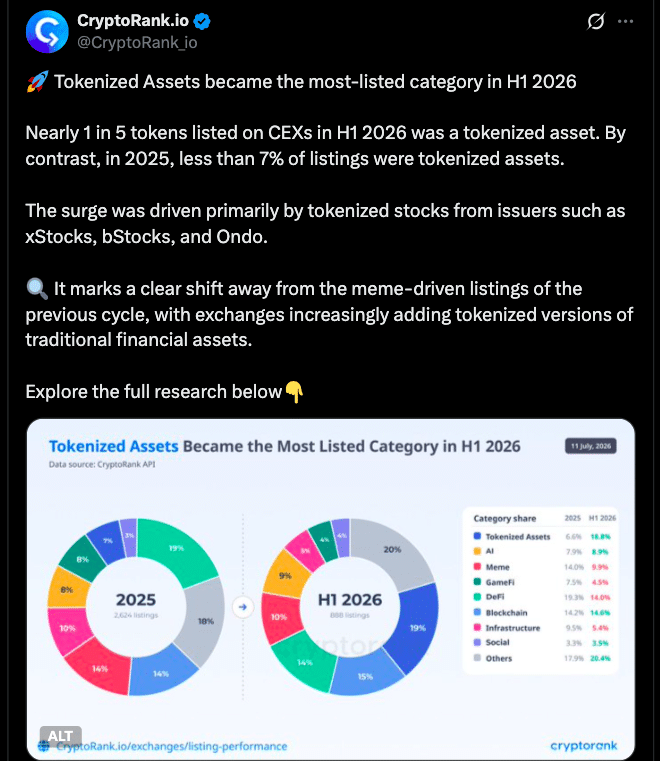
Looking at the numbers from the first half of 2026, tokenized assets now make up nearly one in five new listings on major centralized exchanges. Compared to a year ago, they only accounted for less than 7% of listings, according to information from CryptoRank data released this week.
Tokenized Assets Are Growing Faster Than Crypto Hype
The growth of tokenized assets is happening while traditional crypto listings are slowing down.
Major centralized exchanges only listed 351 new tokens in the second quarter of 2026, which is the lowest quarterly total since the third quarter of 2023. It is also the second quarter in a row since 2024 where delistings exceeded new additions.
Instead of replacing the missing volume with speculative trends, exchanges have turned towards listing tokenized versions of equities, commodities and other real-world assets.
CryptoRank tracked 42 tokenized asset listings on exchanges in the second quarter alone, making the category one of the fastest growing. Much of that growth is coming from platforms like xStocks, bStocks and Ondo’s tokenized products.
Meanwhile, some of the previous leaders in the market are now losing their edge.
Meme coin listings fell for the sixth consecutive quarter, dropping from 196 in the fourth quarter of 2024 to only 41 in the second quarter of 2026, a decline of 79%.
GameFi suffered an even bigger contraction. New gaming token listings plummeted by 84% from their peak in the second quarter of 2024 to just 15 listings in the latest quarter.
Trading Volume Shows Demand Is Real
Trading volumes for real-world asset perpetual futures on centralized exchanges surged 57% in June to a record $311 billion, according to data compiled by CoinDesk. Binance alone generated $245 billion in volume, accounting for 78.6% of the market.
Just months earlier, the category generated almost no activity at all.
This changed when investors started showing renewed interest in getting exposure to high-profile private companies like SpaceX through blockchain-based products and derivatives.
Beyond just futures markets, on-chain activity has been growing fast.
Data from RWA.xyz shows the tokenized stock market has grown by more than 470% over the past year to a value of around $1.87 billion.
Monthly transfer volumes have also climbed up to $8.4 billion, showing how active the market is.
The appeal is obvious because unlike traditional brokerages, crypto exchanges offer continuous trading, stablecoin settlement and fractional ownership from a single account.
Traditional Brokerages Are in a Tight Spot
The rise of these tokenized assets is being witnessed at a rough time for traditional brokerages, as retail participation in US equity markets is slowing down.
According to VandaTrack data, American retail investors purchased a net $13 billion in equities during the past month, the weakest figure since the early stages of the pandemic in 2020.
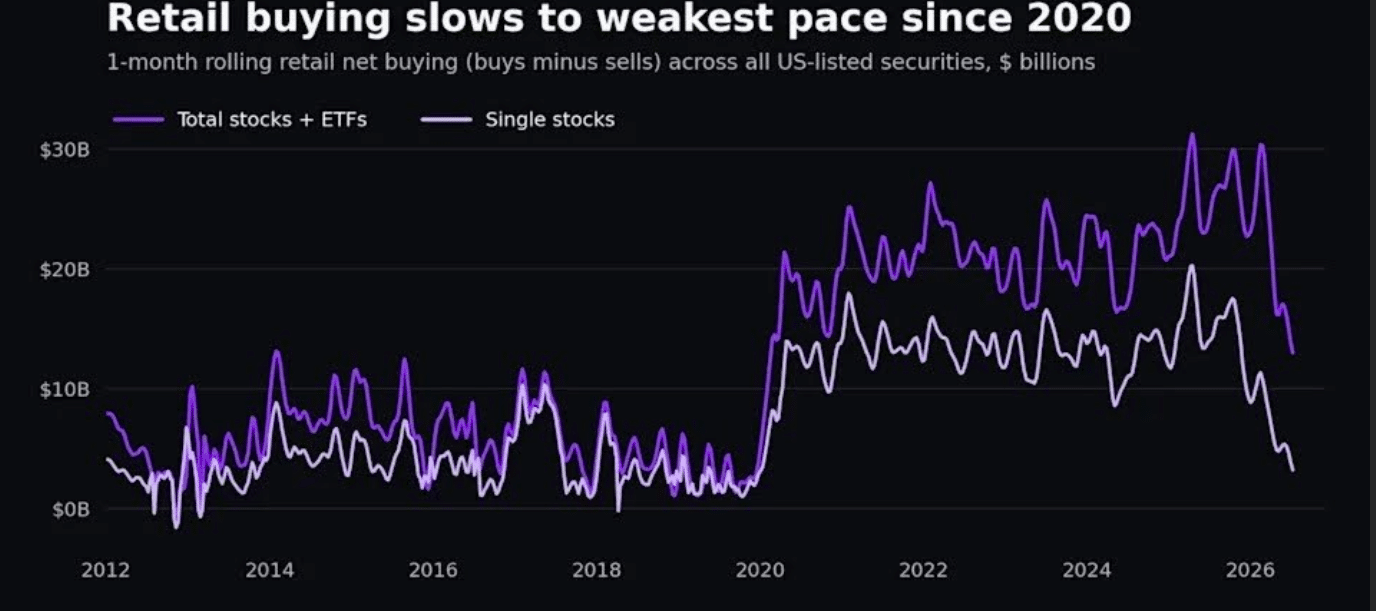
On top of that, net purchases fell by $18 billion, which is a 58% drop from levels recorded earlier in 2026. Buying of individual stocks also plummeted by 71%, down to just $3.2 billion.
Crypto exchanges are attempting to capture some of that demand by removing the restrictions associated with conventional brokerage infrastructure.
Tokenized equities can trade twenty-four hours a day, settle instantly and provide access to expensive assets through fractional ownership.
Reuters reported in June that the US Securities and Exchange Commission was exploring an “innovation exemption” that could let crypto firms offer blockchain-based stock trading products under certain conditions. Coinbase, Robinhood and Kraken are among the firms that could benefit if this all comes to fruition.
The Risks Behind The Opportunity Remain Real
Despite the momentum, tokenized stocks aren’t the same as owning traditional shares. Many of these products give holders economic exposure to an underlying asset, but no voting rights or shareholder privileges.
Some of these tokenized products even represent synthetic exposure, not the actual shares held in a trust account. There’s also the issue of availability; many tokenized stock products are still inaccessible to US residents, even if the company they’re interested in is listed on an American exchange.
Liquidity presents another challenge.
Recent academic research found that tokenization and liquidity are often confused, with many real-world assets remaining thinly traded despite their growing valuations.
So, while scale alone may not eliminate risk entirely, it is still a challenge.
Conclusion
Tokenized assets are becoming one of crypto’s most durable growth stories. Nearly one in five of the new listings on exchanges in the first half of 2026 came from the tokenized category, while tokenized stocks grew to about $1.87 billion and monthly transfers climbed to $8.4 billion.
As meme coins and GameFi continue losing shelf space, exchanges are standing as round-the-clock marketplaces for traditional financial products and not purely crypto-native assets.
Glossary
Tokenized Assets: Traditional financial assets like a stock or a bond, represented on a blockchain.
Real-World Assets (RWAs): Any physical or traditional financial assets brought onto a blockchain network.
Perpetual Futures: Derivative contracts that track prices without an expiration date.
Fractional Ownership: Ownership of a portion of an asset rather than the entire asset.
Frequently Asked Questions About Tokenized Assets
Why Are Crypto Exchanges Listing More Tokenized Assets?
Because there’s been a huge increase in demand for being able to buy into traditional assets like stocks and commodities using blockchain.
How Much Has The Tokenized Stock Market Grown?
The market has grown by over 470% in the past year, which works out to about $1.87 billion.
Do Tokenized Stocks Offer Shareholder Rights?
Not often. Many of these products don’t even come with voting rights or direct ownership privileges.
Are Tokenized Stocks Available To US Investors?
Many platforms restrict access for US residents due to regulatory requirements.
References