

Stablecoins promise something simple: a token that behaves like cash while moving like crypto. The hard part is keeping that promise when markets panic, banking partners wobble, or an issuer cuts corners. That is why lawmakers and supervisors have shifted from watching stablecoins to actively fencing them in. In 2026, the question is less about whether rules are coming and more about what those rules demand, and what changes for issuers, exchanges, and holders.
Stablecoin regulations in 2026: what readers need to know
Across major regions, stablecoin regulations are converging on a familiar trade: if a token is marketed as redeemable 1:1, the issuer must prove the backing, publish clearer disclosures, and operate under an accountable license. Europe has phased in its regional crypto framework, including rules for stablecoin categories that began applying in 2024, with some transition paths running into 2026.
The United Kingdom is using supervised testing to shape its final approach, with a regulatory sandbox cohort beginning in early 2026 and policymakers aiming to finalize stablecoin rules later in 2026. The United States also moved toward a federal focus on payment stablecoins in 2025, including compliance capabilities tied to lawful orders.
Those headlines matter, but the impact is more concrete. Stablecoin regulations are increasingly written like payment rules, not like the early guidance that treated stablecoins as a side feature of trading platforms. When regulators treat a stablecoin as money-like, they start asking money-like questions: where are the reserves, who checks them, who is accountable, and what happens on the worst day.
Why stablecoin regulations tightened after the last cycle
A token pegged to $1 can look boring until it fails, and then it can become contagious because it sits in trading pairs, collateral systems, and treasury operations. Regulators also worry about confusion. Many users experience a stablecoin inside an app that feels like a bank balance, even though the legal protections are different. Central banks have warned that widely used stablecoins may need treatment similar to money, partly to reduce the chance that consumers mistake them for insured deposits.
There is also a competitiveness angle. Jurisdictions want innovation, but they want control over the plumbing of payments. That tension explains why stablecoin regulations now mix consumer protection with enforcement tools.
What stablecoin regulations actually cover
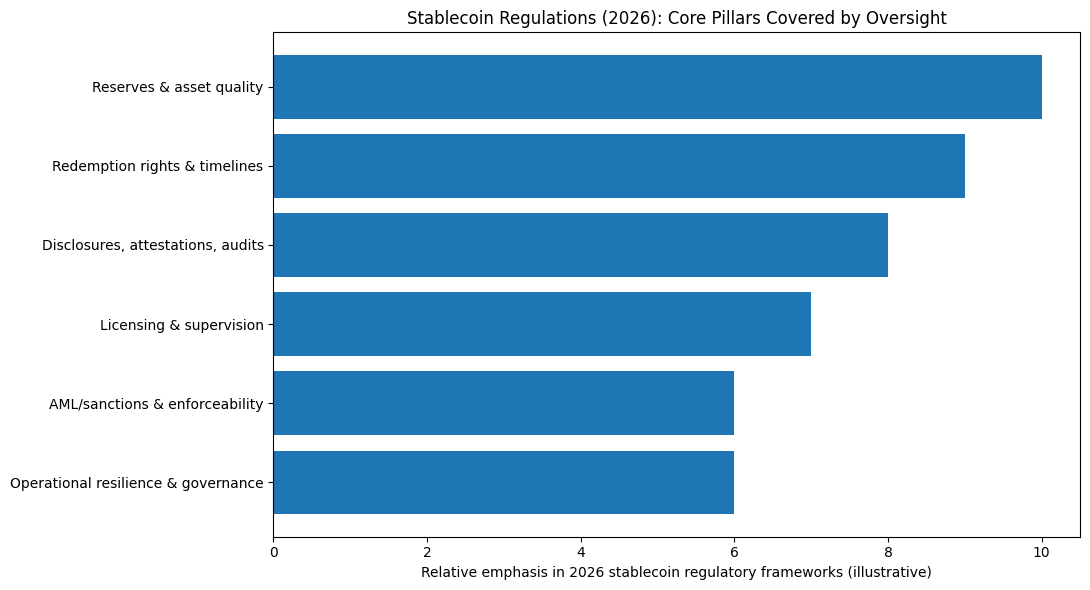
Most frameworks start with issuance and redemption. If a stablecoin is offered to the public and presented as redeemable, supervisors want to know who is allowed to issue it, what backs it, and how quickly holders can exit.
From there, stablecoin regulations expand into governance and operational resilience, including cybersecurity, conflicts of interest, incident response, and the controls that prevent reserve risk from creeping in quietly. Distribution matters too, so many regimes apply obligations through exchanges and custodians.
Reserves: where stablecoin regulations get strict
When stablecoin regulations talk about full backing, they generally mean high-quality, liquid assets that can be converted to cash quickly, with minimal price slippage. That tends to favor cash, short-dated government securities, and certain bank deposits, while discouraging long-duration credit and opaque instruments that need calm markets to stay liquid.
Reserve rules also address segregation and legal structure. If reserves are commingled with corporate funds, insolvency can turn a stablecoin into a creditor dispute. If reserves sit with one banking partner, concentration risk rises. Stablecoin regulations push issuers toward clearer custody arrangements, better documentation, and reserve management designed for a run scenario.
Redemption rights: the test holders feel first
A stablecoin can publish a strong reserve report and still fail holders if redemption is slow or restricted. For that reason, stablecoin regulations increasingly emphasize redemption terms: who can redeem, what fees apply, and how quickly the issuer must process a 1:1 claim. The goal is to prevent a hidden exit-door problem, where smaller holders discover that direct redemption is unavailable or gated behind minimum sizes that functionally exclude them.

Disclosures and audits: proving the peg instead of advertising it
Verification beats marketing, that is why stablecoin regulations increasingly require periodic disclosures and, in many cases, independent attestations or audits. The intent is practical: show what sits in reserves, how liquid it is, and how it is held. A monthly snapshot can miss intramonth stress, so supervisors often want the ability to demand data quickly, not just read a report after the fact.
Licensing and supervision: who is allowed to issue
Licensing is the gate as stablecoin regulations may require issuers to operate as banks, payment institutions, or purpose-built licensed entities, depending on how a jurisdiction defines the stablecoin’s role. The UK approach is a useful signal. In early 2026, regulators selected a small cohort of firms to test stablecoin products in a supervised sandbox, with findings meant to inform final rules later in 2026.
Singapore has also published a dedicated framework for certain single-currency stablecoins issued domestically, aimed at higher value stability and stronger reserve expectations. Europe’s framework sets stablecoin categories that determine which obligations apply and how supervision works across member states.
Compliance duties: AML, sanctions, and enforceability
As stablecoins move into payments, authorities expect controls closer to mainstream finance. Stablecoin regulations sit alongside anti-money laundering rules, sanctions screening, and recordkeeping requirements. Some laws require issuers to have technical capabilities to comply with lawful orders, influencing token design and operational processes.
For market participants, compliance risk becomes access risk. If an issuer cannot meet expectations, banking partners may step back, exchanges may limit availability, and liquidity can fracture across regions.
What to watch in 2026 as frameworks mature
In 2026, stablecoin regulations are moving from paper to enforcement. The questions that matter are simple: whether reserve disclosure becomes more frequent, whether redemption becomes easier for smaller holders, and whether supervisors publish clearer rules for stablecoins used in settlement and tokenized finance.
The UK has signaled active policy work in 2026 as it builds a stablecoin payments regime. Europe continues through transition timelines as service providers seek authorization under the regional framework.
Conclusion
Stablecoins still look like a simple product, but the stability promise is a public trust claim. Stablecoin regulations are turning that claim into a supervised obligation: credible reserves, clear redemption, stronger disclosures, and enforceable compliance. In practical terms, stablecoin regulations are pushing the market toward fewer surprises when stress hits and the peg is tested.
Frequently Asked Questions (FAQs)
What do stablecoin regulations try to achieve?
They aim to ensure that stablecoins marketed as stable can be redeemed reliably, are backed by high-quality reserves, and are issued under accountable supervision.
Do stablecoin regulations apply to every stablecoin?
Most regimes focus first on payment-oriented stablecoins and domestically issued coins, then extend coverage through rules on listing, custody, and distribution.
Why do regulators insist on high-quality reserves?
Because redemption surges can be fast. Illiquid or risky reserves can force losses or delays that undermine the 1:1 promise.
Can a stablecoin be frozen?
Some frameworks require compliance with lawful orders, which can include freezes or other controls depending on the legal regime.
Glossary of key terms
Attestation.
A third-party verification report about reserves at a point in time.
Audit.
A deeper independent examination of financial statements and controls.
Redemption.
The process of exchanging a stablecoin for the referenced fiat currency, typically 1:1.
Reserves.
Assets held to back a stablecoin and support redemptions.
Disclaimer
This content is for informational purposes only and does not constitute financial, legal, or investment advice. Rules vary by jurisdiction and can change, and readers should consult qualified professionals before acting.
Sources