

This article was first published on The Bit Journal.
In 2026, the rise of stablecoin payroll adoption is becoming the first point of call in how companies pay their employees’ salaries using cryptocurrency.
Stablecoins are increasingly appealing to employers and payroll platforms compared to volatile assets like Bitcoin because of clearer regulatory pathways, simplified adherence to wage reporting and tax laws, and inherent price stability.
Recent data has revealed that the number of employees being paid in crypto has increased over threefold since 2023, with a majority of payroll use cases centered around stablecoins.
Regulatory Basis for Stablecoin Payroll Adoption
Payroll systems are subject to the most strictly regulated processes in business, including labor laws that guarantee minimum wage levels, tax withholding and other employee protections.
Unlike trading, which is a non-mandatory activity, salaries need to adhere to government-mandated reporting and wage practices. That said, regulatory certainty plays an important role in determining whether or not digital assets make sense for payroll and how they can be used.
Recent legislative initiatives like the US GENIUS Act and Digital Asset Market Clarity Act (CLARITY Act) are seeking to clarify how stablecoins can be regulated and integrated within financial systems.
These laws home in on reserve backing, issuer licensing and transparency requirements that would make stablecoins more like traditional payments than speculative vehicles. In Europe, the Markets in Crypto-Assets (MiCA) regulation includes the full set of rules for crypto-service providers, including stablecoin issuers, to increase consumer protection and transparency of operations.
Regulatory frameworks do not mandate crypto payroll, but they create a compliant environment in which stablecoins can be integrated into payroll alongside traditional fiat systems.
By converting fiat payroll currency to stablecoins after running the standard, employers can ensure they are in compliance with labor laws while providing employees a digital-asset paycheck directly pegged to the value of local currency.
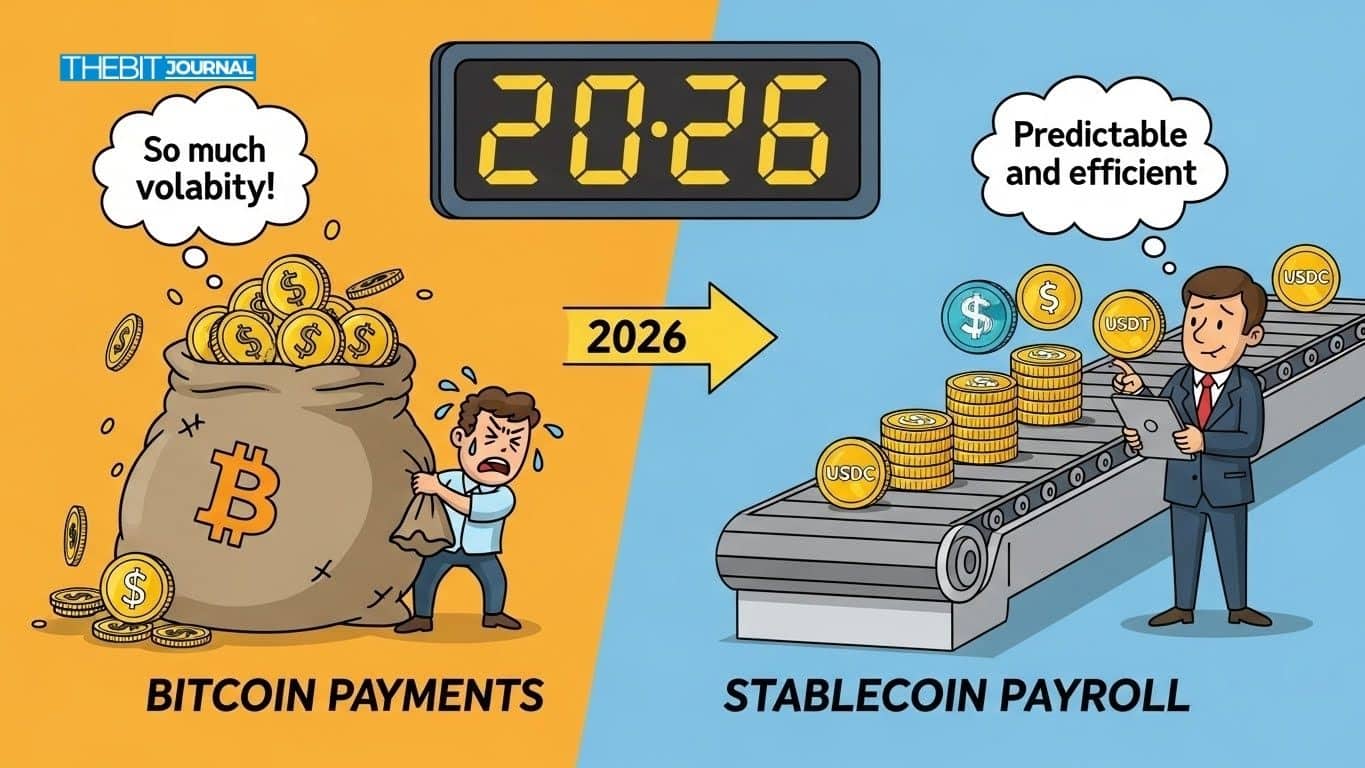
Stablecoins v. Bitcoin: A Question of Operations and Accounting
The main difference between stablecoins and Bitcoin boils down to price stability and regulatory alignment with payroll.
Stablecoins are created to be priced at a fixed point to fiat currencies, usually the U.S. dollar, and are supported by liquid assets, like cash or short-term government bonds.
This certainty is consistent with contractual commitments to pay wages and allows payers of wages or salaries to determine, report, and remit wages without having to constantly adjust them for revaluations.
Bitcoin, in contrast, is a highly volatile asset whose value can fluctuate from day to day. Most employment arrangements are in fiat terms and if the payment is made in BTC, there could be huge discrepancy between what was contracted for and reality.
That volatility may make payroll reconciliations, accounting systems, and compliance with wage laws more difficult, as employers would need to calculate the fair market value at the instant of paymen,t likely increasing administrative burden and legal risk.
Tax reporting reinforces the discrepancy, too. Many jurisdictions classify cryptocurrencies, including stablecoins, as property rather than cash.
But stablecoins’ close parity with fiat makes reporting earnings and tax-withholding duties easy to the extent that their value on the date of payment can be calculated.
In the case of Bitcoin, employers and employees have added complexity due to the fluctuation in tax basis that occurs while converting or disposing of the asset, requiring clear tracking and reporting obligations.
Adoption Trends and Real-World Usage of Stablecoin Payroll
Adoption of stablecoin payroll services is picking up across the crypto employment space. Recent research indicates that more workers are being paid at least partially in digital currencies, with higher numbers of employees paid in stablecoin like USDC.
According to data from Pantera Capital, the vast majority of employee payments were paid in stablecoins, which comprised around 63% of all crypto salary payments with USDC dominating, followed by USDT.
Combined, these two stablecoins accounted for more than 90% of crypto payroll transactions showing that companies and workers want stable value, not volatile digital assets.
Outside tech and Web3 startups, stablecoin payroll is also becoming more popular as a means of making cross-border payments in areas without well-developed banking systems. This is because stablecoins settle much faster, usually in minutes instead of days for a bank wire transfer, and at a lower transaction price, which is really good for operational efficiency across international teams.
These factors are most applicable to distributed workforces and international contractors.
Institutional and Infrastructure Support Enhances Stablecoin Payroll Adoption
A further force behind stablecoin payroll adoption is growth in financial infrastructure and institutional involvement. Leading payroll platforms and fintech providers are building stablecoin payment capabilities that work with existing payroll systems, making it frictionless to convert, store and comply.
Banks, custodians and payroll processors have all been incentivized to offer their fiat-to-stablecoin conversion services also due to regulatory clarity on stablecoin issuance and licensing, thus increasing access and usability.
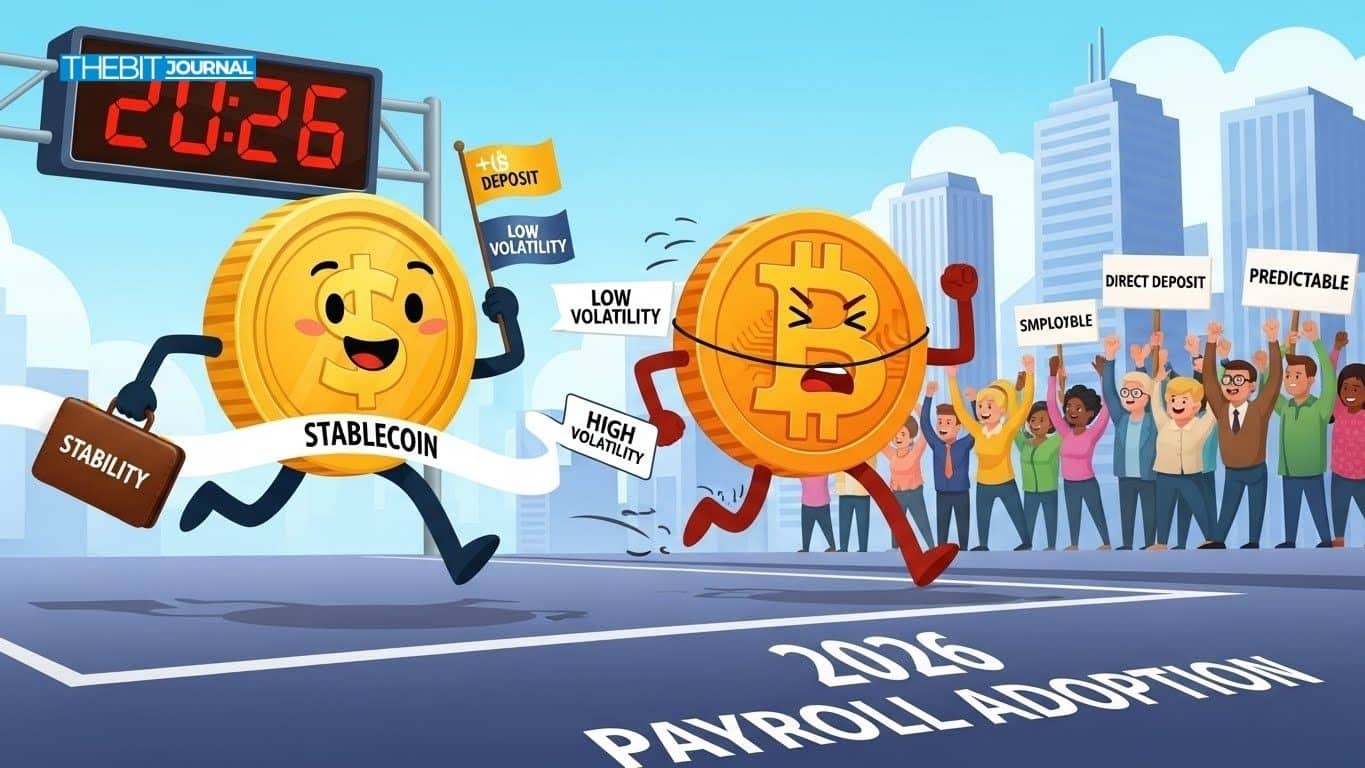
This institutional backing alleviates friction for employers who might be thinking about issuing payroll in crypto, by offering regulated and compliant venues through which to distribute stablecoin pay as one component of total compensation systems.
More and more mainstream payroll services and software accept stablecoins, such as USDC, allowing companies to satisfy legal wage requirements with a digital asset while giving employees optional access.
Stablecoins vs Bitcoin for Salary Payments
| Item | Stablecoins | Bitcoin |
| Price stability | Stays close to fiat value | Price moves frequently |
| Salary accuracy | Matches contract pay | Pay value can change |
| Tax calculation | Easy to value | Needs exact market pricing |
| Payroll compliance | Fits existing rules | Adds extra complexity |
| Institutional support | Widely supported | Mostly niche providers |
| Cross-border payments | Fast and predictable | Speed varies with price swings |
Conclusion
Stablecoin payroll adoption is accelerating as regulatory frameworks mature and practical operational advantages outweigh the challenges associated with volatile cryptocurrencies like Bitcoin.
For now, stablecoins, in their price stability, regulatory concurrence with wage and tax rules and backing by payroll infrastructure providers are better suited for salary payments than market-volatile tokens.
With research showing that crypto payroll is no longer an obscure practice, and crypto salaries tripling in recent years as well as stablecoins driving this trend, employers and employees continue to embrace stablecoins for pay.
Glossary
Stablecoins: Cryptocurrencies designed to keep a stable value through that fiat-asset backing.
Bitcoin: A digital currency whose value fluctuates based on supply and demand, making it less suitable for fixed wage payment.
Payroll Compliance: Requirements to comply with the law when it comes to wage payments such as tax withholdings, and reporting.
Regulatory frame: The laws and rules shaping how regulators such as the S.E.C. or the C.F.T.C. oversee digital assets like stablecoins.
Fair market value (FMV): The value of in terms of price at the time of payment paid or received as notation used for tax reporting.
Frequently Asked Questions About Stablecoin Payroll Adoption
What is stablecoin payroll adoption?
Stablecoin payroll adoption means the use of stablecoins for paying employee salaries because of the clear regulatory environment and stability.
Why pay salaries in Bitcoin instead of stablecoins?
Stablecoins maintain a specific value tied to fiat and could be used for wages calculation, tax collection, or compliance with labor laws. Bitcoin’s volatility complicates these processes.
Would employers still be withholding taxes with stablecoin payroll?
Yes. Even in the case of stablecoin payments, employers must still withhold income and payroll taxes from compensation paid via a stablecoin as if it had been paid with fiat at fair market value on date of payment.
Are stablecoin salaries legally valid globally?
Legal status differs among jurisdictions, with some permitting payments of wages in stablecoins while others require wages to be paid in recognized currency.
Is it easy for employees to convert stablecoin salaries into fiat?
Yes. More often than not, stablecoins enable easy conversion to local fiat via exchanges and payroll partners, so employees have the flexibility that they need.
Reference