






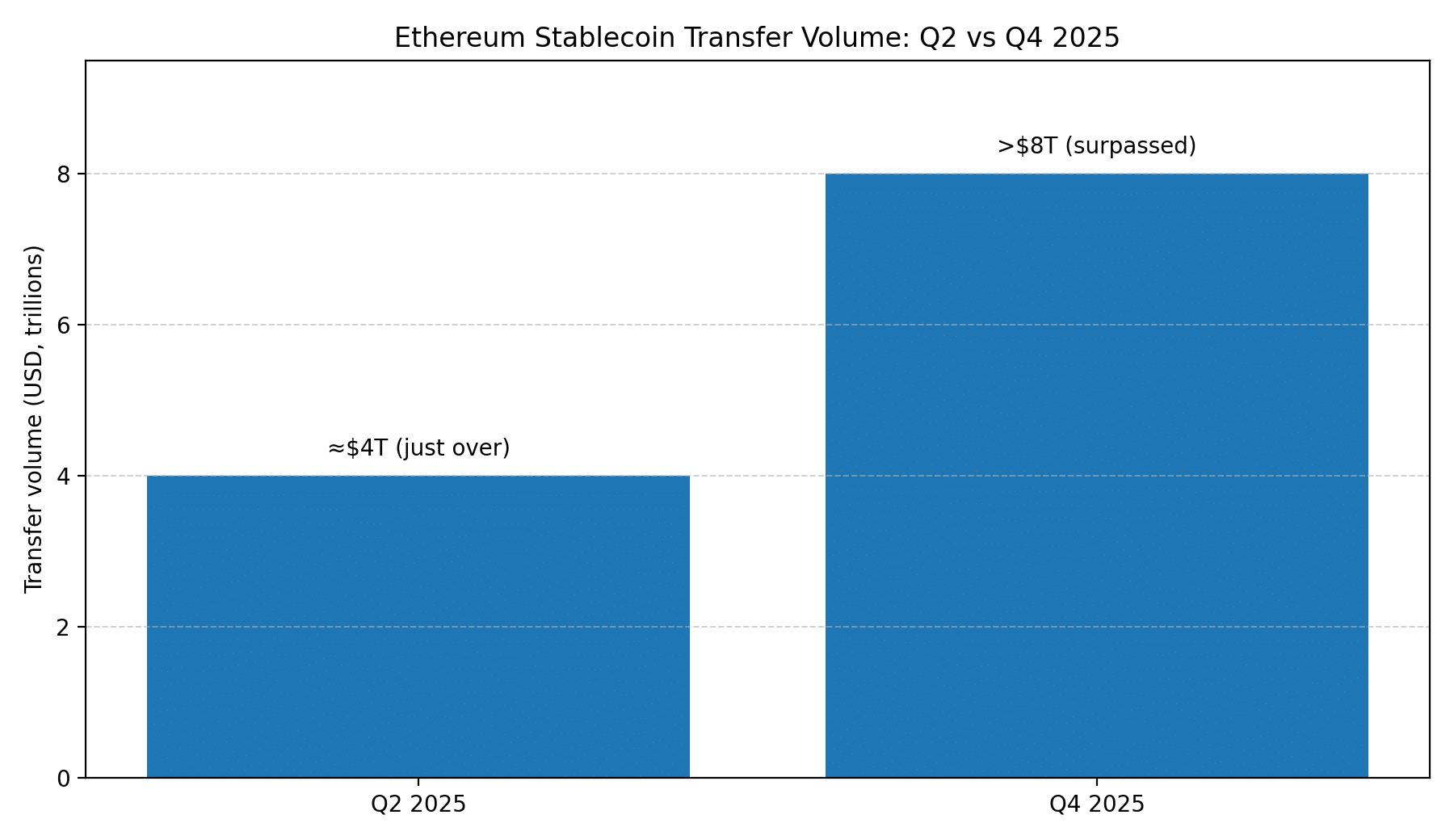
In Q4 2025, stablecoins moved more than $8 trillion across Ethereum, based on an on-chain dataset that tracks stablecoin transfer value. The figure is notable because it describes what market participants actually did with digital dollars, not what they said online. When settlement rails get busier, it usually means more collateral movement, more exchange and OTC settlement, and more day-to-day liquidity management.
The acceleration was sharp as the same data shows Q4 was close to double the transfer value seen in Q2 2025. That step-change is a useful signal for 2026, since stablecoins sit at the center of trading, lending, and payments across crypto.
Ethereum stablecoin volume and what the $8T quarter really signals
Ethereum stablecoin volume at $8T-plus is best read as “how busy the cash rail was,” not as a shortcut to price predictions. Stablecoins are the unit of account for most crypto markets, so rising transfer totals often reflect settlement between trading firms, margin top-ups, and rebalancing that keeps liquidity tight.
This is also why Ethereum stablecoin volume can rise when retail sentiment feels split. A market maker hedging inventory or a fund rotating collateral is behaving like a business managing cash across bank accounts, and the goal is stability rather than storytelling.
Growth in the underlying “cash pool” helps explain the scale. One research report estimates stablecoin supply is around $300 billion, up from under $10 billion about five years ago, with millions of blockchain addresses interacting with these assets. As that pool expands, Ethereum stablecoin volume has more fuel, because more digital dollars are available to move at any hour.
What likely pushed volumes higher in late 2025
The record quarter fits a pattern that is easy to recognize. Volatility pushes traders toward stablecoins as a parking spot. Derivatives markets lean on stablecoin collateral because it simplifies margin management. Cross-venue flows matter too, since stablecoins remain the fastest bridge between centralized exchanges, on-chain liquidity, and off-exchange settlement without waiting for banking windows.
Payment demand has been building in the background. An industry update on stablecoin payments reports rising payment activity across use cases, including business-to-business settlement, even as crypto prices remain volatile. When payments rise, Ethereum stablecoin volume tends to benefit because deep liquidity and integration reduce friction for large transfers.
Transfer value can still be noisy, because the same tokens can move multiple times in a short span. That is why trend durability, not a single quarter, is the real test.
The indicators that confirm the trend, and the ones that can break it
If Ethereum stablecoin volume is the headline, three supporting indicators help confirm whether usage is broad and sustainable.
Transaction throughput is the first check. A widely used block explorer chart shows Ethereum set an all-time high of 2,230,801 transactions on December 29, 2025. That matters because a value spike alongside higher transaction counts usually looks healthier than a spike driven by a handful of large transfers.

Fee pressure is the second check. Higher fees can signal demand, but persistent spikes can push everyday transfers to other layers or chains, changing where stablecoins settle. Even if Ethereum stablecoin volume stays large in dollars, fee friction can redirect smaller payments elsewhere.
Supply and distribution are the third check. Steady supply growth can reflect organic demand, while rapid expansions during leverage cycles can unwind quickly. Analysts often pair Ethereum stablecoin volume with exchange netflows and derivatives positioning to separate healthy settlement from short-term leverage churn.
The less comfortable side: issuer risk, regulation, and concentration
Stablecoins are only as strong as their reserves, governance, and redemption pathways. Concentration risk also matters, since liquidity can depend heavily on a small group of issuers and major venues, which creates bottlenecks and policy exposure.
Regulation can improve confidence when it increases transparency, but it can also add friction when rules are fragmented or unclear across jurisdictions. From a market structure perspective, the $8T quarter is less a trophy and more a reminder that crypto’s biggest mainstream product is financial plumbing.
Conclusion
Ethereum’s Q4 milestone points to a practical shift: stablecoins are not only a trading tool, they are a settlement rail for liquidity, collateral, and a growing share of payment-like flows. Transfer value above $8 trillion, close to double Q2 levels, suggests the rail is getting busier and more embedded in day-to-day market operations.
If Ethereum stablecoin volume stays elevated through 2026, attention will increasingly move to execution details, including fees, compliance clarity, and which networks can handle digital dollars cheaply and transparently at scale.
Frequently Asked Questions
What is stablecoin transfer volume on Ethereum?
It is the total value of stablecoin transactions that move across Ethereum over a period of time. It measures settlement activity rather than token price performance.
Does $8T in transfers mean $8T of new money entered crypto?
No. The same stablecoins can move multiple times, so the figure reflects value settled, not net inflows. The direction across multiple quarters is more informative than one print.
Why does transfer volume matter for traders and investors?
It often tracks liquidity conditions. When stablecoin settlement rises, markets tend to have more readily deployable collateral and faster rebalancing, even if token prices do not immediately respond.
Glossary of Key Terms
Stablecoin: A token designed to track a fiat currency value, most commonly the US dollar.
Transfer volume: The total value moved through transactions over a defined period.
Settlement layer: Infrastructure used to finalize transactions and move value between parties.
Gas fee: The fee paid to include a transaction on Ethereum, typically rising when demand increases.
Collateral: Assets posted to support leveraged positions or to back derivatives exposure.
Exchange netflow: A measure of assets moving into or out of exchanges, often used to infer near-term liquidity demand.
References
The price predictions and financial analysis presented on this website are for informational purposes only and do not constitute financial, investment, or trading advice. While we strive to provide accurate and up-to-date information, the volatile nature of cryptocurrency markets means that prices can fluctuate significantly and unpredictably.
You should conduct your own research and consult with a qualified financial advisor before making any investment decisions. The Bit Journal does not guarantee the accuracy, completeness, or reliability of any information provided in the price predictions, and we will not be held liable for any losses incurred as a result of relying on this information.
Investing in cryptocurrencies carries risks, including the risk of significant losses. Always invest responsibly and within your means.
For advertising inquiries, please email . [email protected] or Telegram