




DeFi is busy again. Total value locked hit a three‑year high near $153 billion in late July. That rise came with stronger ETH prices and fresh capital in new rate products. It set the stage for a clear look at the top DeFi Platforms for income in 2025.
This guide explains how yields work. It also shows where risk hides. The aim is simple. Help readers use DeFi yield farming with care, and avoid costly mistakes.
The list below focuses on depth, safety work, and real usage. It also folds in ten common needs: best DeFi platforms for beginners, low risk yield farming strategies, how to provide liquidity on Uniswap, safest stablecoin pools for yield, cross chain DeFi yield opportunities, DeFi portfolio risk management tips, gas fee saving tricks on Ethereum, how to avoid rug pulls in DeFi, tax reporting for DeFi earnings US, and staking vs liquidity mining explained.
What to Check Before Choosing a Platform?
Every yield has a source. Most come from trading fees, borrow interest, or staking rewards. Some come from tokenized Treasuries. If the source is unclear, skip it.
Match tools to goals. Short-term cash needs fit liquid and simple pools. Long-term plans fit staking and money markets. Check slippage, fees, and exit routes.
Costs matter. Gas, bridging, and price impact reduce net return. On Ethereum, simple gas fee saving tricks on Ethereum include batching moves, using rollups, and avoiding peak hours.
How Yield Farming and Liquidity Mining Work
Yield farming means depositing assets into a smart contract to earn fees or rewards. Liquidity mining pays for the act of making markets. Both can pay well when use is high.
Here is staking vs liquidity mining explained. Staking secures a network and pays from block rewards and fees. Liquidity mining supports trading and pays from swap fees or incentives. Staking risk leans on validators. Liquidity mining risk leans on price moves and pool design.
Use stablecoins when learning. Start with deep pools. Keep the size small. Add risk only after a month of clean checks.
The Top DeFi Platforms in 2025
This section highlights the Top DeFi Platforms that power today’s yield. Each profile shows how yield forms, who it fits, and what to watch.
Uniswap
Uniswap remains the largest DEX by volume. In August 2025 it held about 35.9 % share. Range orders let LPs target price bands and boost fee APR in tight markets. That same feature also raises risk when price moves fast.
Best for active LPs and traders who monitor ranges. Good place to learn how to provide liquidity on Uniswap with a stablecoin pair first.
Aave
Aave anchors on‑chain credit. Lenders earn interest from over‑collateralized borrows. In March, CoinDesk noted Aave’s cash holdings rose to about $115 million and its GHO stablecoin supply neared $200 million. That reflects product growth and stronger revenue.
Best for stablecoin lenders and loopers with strict limits. Watch borrow caps and liquidation buffers.
Pendle
Pendle splits deposits into principal and yield tokens. Users can lock a fixed yield or buy exposure to rising rates. Pendle’s TVL set records this summer as new rate products drew capital. DeFiLlama now tracks it as a top yield venue.
Best for rate seekers who want fixed yield or targeted rate bets. Read pool terms and expiry dates.
Maker and Spark
Maker and its Spark suite steer DAI into safer assets and tokenized funds. In March, Sky (formerly MakerDAO) said Spark would place up to $1 billion into tokenized Treasury products from BlackRock, Superstate, and Centrifuge. That move tightened the link between DeFi and real cash yields.
Best for cash‑style yield with clear backing. Watch issuer risk, custody layers, and policy changes that affect returns.
Lido
Lido remains a major home for ETH staking. Its market share eased to a record low near 24 to 25 percent in mid‑August, a healthy sign of competition. stETH stays a base building block across DeFi.
Best for long‑term ETH holders who want chain‑native yield and composability. Key risks include slashing, depeg stress, and smart contract bugs.
Curve
Curve built its name on low‑slippage stable swaps. In April 2025, Curve’s TVL moved back above $2 billion as crvUSD and lending use grew. The team also documented fixes after the 2023 Vyper compiler exploit, which drove upgrades across the stack.
Best for stablecoin farming and conservative LPs. Pick deep pools. Monitor pegs and debt tools.
GMX
GMX is a leading on‑chain perpetuals venue. V2 introduced isolated markets and improved fee mechanics to balance open interest and reduce LP skew. Third‑party risk work explains how V2 limits LP exposure compared with V1.
Best for LPs who accept trader flow risk and want funding plus fees. Size small and watch pool stats.
Balancer
Balancer offers flexible pools, including 80‑20 designs and Boosted Pools that route idle assets into ERC‑4626 vaults like Aave. The docs show how boosted stable pools lift base yield for LPs.
Best for index‑style LPs and projects that need custom pool shapes. Read pool docs and gauge rules before adding funds.
Kamino on Solana
Kamino bundles lending, auto LP, and vaults on Solana. A July governance report showed double‑digit monthly TVL growth and steady risk metrics, as Solana DEX activity hit records earlier in the year. CoinDesk also reported peak daily DEX volume on Solana in January.
Best for users who want fast rails and auto vaults. Watch hot money cycles and meme flows on Solana.
Frax
Frax runs FRAX stablecoin, frxETH liquid staking, and V3 modules that lean on RWAs. Docs explain how frxETH and sfrxETH share staking rewards and how Fraxtal, Frax’s L2, uses OP Stack and FRAX for gas with on‑chain incentives. (Frax Finance, Frax)
Best for users who want integrated yield pieces with strong DeFi links. Study each module and its risks.
Quick Compare: Where Each Platform Fits
| Platform | Main chain | Category | Main use | Yield source | Fit | Key risk |
| Uniswap | Ethereum + L2s | DEX | Swap and LP | Trading fees | Active LPs | Range mispricing |
| Aave | Multi‑chain | Lending | Lend and borrow | Interest spread | Stable lenders | Liquidations |
| Pendle | Ethereum + L2s | Yield markets | Fixed or floating rate | Rate trading | Rate seekers | Contract + rate risk |
| Maker Spark | Ethereum | Stable yield | DAI savings, RWA | Tokenized T‑bills | Cash‑style seekers | Issuer and policy risk |
| Lido | Ethereum | Liquid staking | Stake ETH | Staking rewards | ETH holders | Slashing and peg stress |
| Curve | Ethereum + L2s | Stable DEX | Stable LP, crvUSD | Swap fees, borrow | Stable LPs | Toolchain and peg risk |
| GMX | Arbitrum + Avalanche | Perp DEX | Fund traders | Funding and fees | LPs with risk budget | Open interest swings |
| Balancer | Ethereum + L2s | AMM | Flexible pools | Fees + boosts | Index‑style LPs | Design complexity |
| Kamino | Solana | Lending + LP vaults | Auto LP + borrow | Fees + interest | Fast rail users | Hot money cycles |
| Frax | Ethereum + L2s | Stable + staking | frxETH, FRAX, V3 | Staking + RWA | Integrated yield users | System link risk |
Build a Simple Yield Plan For 2025
- Start with a base. Use LSTs like stETH or frxETH, or DAI savings via Spark. This creates steady cash‑style income.
- Add a stable spread. Supply USDC or DAI on Aave. Avoid leverage at first. This fits best DeFi platforms for beginners.
- Layer fee income. Add a small stable LP on Uniswap or Curve. This taps the safest stablecoin pools for yield with modest price risk.
- Spice with rates. Use Pendle to lock a fixed rate on part of the stack. Or buy yield tokens if rates seem set to rise.
- Rebalance weekly. Watch borrow caps, pool depth, and fee APR. Cut risk when spreads compress or pegs look weak.
Visual: where DeFi yields come from
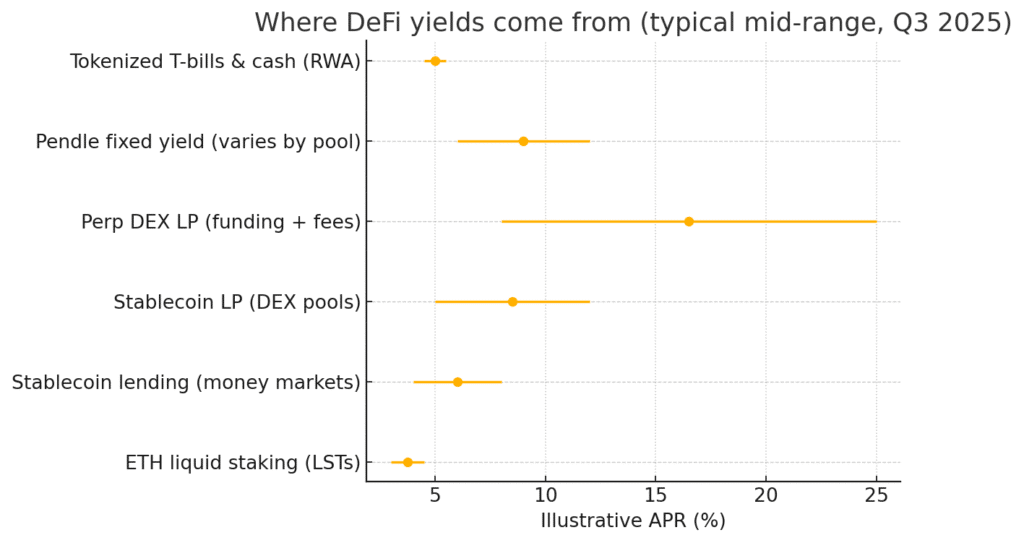
Note: mid‑range APRs are illustrative as of Q3 2025. Always check live rates in app dashboards.
Security And Regulation in 2025
Losses rose again. CertiK’s mid‑year data show crypto losses of about $2.47 billion in the first half of 2025, already above all of 2024. Most came from hacks and account takeovers. Strong key hygiene and strict approval control remain vital.
Use grew too. DeFi TVL set a three‑year high near $153 billion in late July. Restaking and ETH strength helped. Builders should still treat headline TVL as unstable and follow per‑protocol metrics. (CoinDesk)
Policy shifted. On February 25, the SEC dropped its investigation into Uniswap Labs with no enforcement action. On August 5, SEC staff also published a statement that, in its view, certain liquid staking activities do not involve an offer or sale of securities.
These two moves reduced specific clouds over leading platforms. Keep in mind that staff statements are not formal rules. Future leadership could revise them.
Order‑flow fairness stayed in focus. Recent surveys on MEV map how builders extract value by reordering transactions. The literature also reviews mitigation paths across L1 and L2. These lessons shape routing and shared sequencer plans across DeFi.
Real‑world assets climbed. In March, coverage showed on‑chain RWA TVL crossing $10 billion, led by tokenized Treasuries. Maker’s Spark followed with a plan to allocate up to $1 billion across BlackRock, Superstate, and Centrifuge.
Solana set records. In January, CoinDesk reported a record day near $25 billion in DEX volume, which fed LP fees across key Solana venues.
Practical Tips for Cost and Safety
- DeFi portfolio risk management tips
Cap position sizes. Split across categories. Favor audited code and live bug bounties. Use hardware keys. Rotate token approvals. - How to avoid rug pulls in DeFi
Check team history and docs. Read audits. Look for time‑locks and multisig details. Avoid new pools with opaque tokenomics. - Gas fee saving tricks on Ethereum
Batch steps. Use rollups. Avoid peak hours. Use routers that show price impact before you sign. - Cross chain DeFi yield opportunities
When possible, use native deployments. If you must bridge, pick routes with a long record, monitoring, and insurance options. - Tax reporting for DeFi earnings US
Track deposits, rewards, and fees in a ledger or app. Separate interest income from capital gains. Export clean CSVs for a CPA.
Platform playbooks
Uniswap
Start with a USDC‑USDT range. Keep the range wide. Review fees daily. Avoid volatile pairs until comfortable.
Aave
Supply USDC or DAI. If borrowing, leave a wide buffer above the liquidation line. Set alerts.
Pendle
Buy principal tokens for fixed yield. Or buy yield tokens to play higher rates. Match size to risk limits.
Curve
Pick deep stable pairs. Watch crvUSD minting and pegs. Exit early if spreads widen.
GMX
Treat LP tokens as exposure to trader PnL, funding, and fees. Size small. Track open interest and funding.
Maker and Spark
Use DSR for simple cash‑style yield. Watch how RWA allocations change returns.
Lido
Stake ETH and put the LST to work with low‑risk vaults. Avoid loops unless rules are strict.
Balancer
Use 80‑20 pools for governance tokens. Consider Boosted Pools to route idle assets into ERC‑4626 vaults.
Kamino
Use auto LP vaults on deep pairs. Lend stablecoins if rates pay for risk. Watch TVL and risk dashboards.
Frax
Use frxETH or sfrxETH for ETH yield. Review Frax V3 and Fraxtal docs to understand RWA and L2 mechanics.
Conclusion
Strong flows returned to DeFi. So did risk. A small set stands out as the top DeFi phttps://thebitjournal.com/stablecoin-in-defi-everything-you-need-to-know-in-2025/latforms for yield farming and liquidity mining. Uniswap leads DEX volume. Aave anchors lending. Pendle opens the rate curve. Maker links on‑chain money to Treasuries. Lido secures base yield on ETH. Curve and GMX reward careful LPs. Balancer, Kamino, and Frax round out the tool kit.
Keep the plan simple. Mix base staking, stable lending, and measured fee flow. Add rate tools in small size. Review often. Income follows users and risk control, not hype.
Frequently Asked Questions About Top DeFi Platforms for Yield Farming
What makes a platform one of the best DeFi platforms today?
Scale, safety work, and clear use. Deep liquidity and steady fees help.
Is yield farming the same as staking?
No. Staking secures networks. Farming pays for market making or lending.
Are stablecoin pools safer than volatile pairs?
Often yes, but smart contract and peg risk still matter.
How much yield is realistic in 2025?
Base yields are mid‑single digits. Higher rates need higher risk.
How should beginners start?
Begin with Aave or DAI savings. Then add a small stable LP. Review weekly.
Glossary
- APY: A way to compare annual return across products.
- Impermanent loss: Loss that can occur when LP asset prices move apart.
- Maximal extractable value (MEV): Profit from reordering or inserting transactions in a block.
- Overcollateralized loan: A loan that needs more collateral value than the loan.
- Peg: The target price for a stable asset.
- Restaking: Using staked assets to secure extra services for more yield.
- Slippage: The gap between expected price and execution.
- Stablecoin: A token that targets a fixed value, often one US dollar.
- TVL: Total value locked in a protocol.
- Yield tokenization: Splitting an asset into principal and yield parts for trading.
Summary
This article ranks and explains the Top DeFi Platforms for yield farming and liquidity mining in 2025. It covers Uniswap, Aave, Pendle, Maker’s Spark, Lido, Curve, GMX, Balancer, Kamino, and Frax. Each profile shows how yield forms, who it fits, and key risks. A compare table maps chains, yield sources, and risk notes. A visual chart outlines typical APR ranges by strategy. The security section cites 2025 data on hacks and losses, fresh TVL highs, and policy moves, including the SEC dropping its Uniswap probe and clarifying views on liquid staking. The plan section shows how to build a simple, safer stack across base staking, lending, stable LP fees, and fixed‑rate tools. Practical tips address fees, bridges, rug‑pull checks, and basic US tax tracking.