



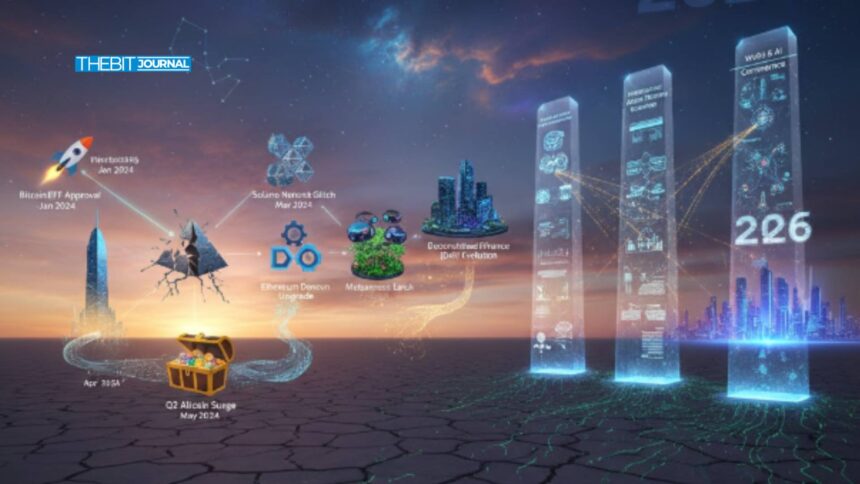

By late 2025, it is clear that this was not just another bullish cycle. It was a structural year, packed with crypto moments that pushed digital assets deeper into mainstream finance. Bitcoin broke psychological barriers, lawmakers finally put real rules around stablecoins, DeFi derivatives went into overdrive, tokenized treasuries went from niche to normal, and a record-breaking hack reminded everyone that security is still the weak link.
For investors, builders, and policymakers, these crypto moments were less about hype and more about signals. They showed where capital is moving, what kind of infrastructure is maturing, and where the risks are quietly piling up.
Bitcoin’s institutional era: From speculative bet to reserve asset
One of the defining crypto moments of the year was Bitcoin clearing the 100,000 dollar mark and then pushing to an all-time high above 123,000 dollars in mid-July. Multiple data providers recorded that spike, with Bitcoin briefly trading above 123,000 dollars before cooling slightly.
This was not just a blow off top. It happened as spot Bitcoin ETFs attracted billions in inflows and as large corporates and funds began treating BTC as a long term treasury asset rather than a trading toy. Analysts noted that flows into ETFs and corporate treasuries drove a significant share of demand, not retail mania alone.
Another of the year’s pivotal crypto moments came on March 6, when the United States established a Strategic Bitcoin Reserve through executive order. The order instructed the Treasury to consolidate forfeited government-held BTC into a formal reserve and to manage it as a national asset.
Taken together, these two developments signaled that Bitcoin has entered an institutional phase. Price action mattered, but the deeper story was that governments and large financial players now treat BTC as part of the long term architecture of global markets.
The GENIUS Act: Stablecoins step into regulated money
Another cluster of crypto moments revolved around stablecoins and payment rails. On July 18, the GENIUS Act was signed into law in the United States, creating the first full federal framework for payment stablecoins.
The law requires that qualifying stablecoins are fully backed by cash or short-term Treasuries, subjects issuers to the Bank Secrecy Act, and sets transparency and disclosure rules around reserves and redemptions.
Markets reacted immediately. On the same day, global crypto market capitalization briefly crossed 4 trillion dollars for the first time, helped by renewed inflows into majors like Bitcoin and Ether.
These regulatory crypto moments matter for two reasons. First, they give banks, payment companies, and fintechs a clearer legal path to integrate stablecoins into everyday payments and settlement. Second, they push “offshore” issuers to match regulated standards or risk being sidelined from the largest capital markets.
Real-world asset tokenization moves past the experiment phase
Tokenized treasuries and other real world assets (RWAs) turned from a niche narrative into a measurable market. Estimates suggest that the value of tokenized RWAs on public blockchains climbed from roughly 8–9 billion dollars at the start of 2025 to over 30 billion dollars by mid year, representing several hundred percent growth in three years.
One of the standout crypto moments in this sector was the expansion of a major tokenized U.S. Treasury fund to multiple chains, including BNB Chain, with more than 2.5 billion dollars in assets and daily tokenized yield to qualified investors.
Banks and asset managers are weaving these instruments into their own plumbing, using cross chain messaging and oracle infrastructure to bring tokenized treasuries, private credit, and even equity like instruments closer to DeFi liquidity pools. RWAs are no longer just a slide in a conference deck. They pay yield, sit on balance sheets, and show up in institutional reports.
These developments qualify as structural crypto moments because they tie blockchain to the largest market of all: traditional fixed income and credit.
On chain perps and the rise of Hyperliquid style DEXs
Derivatives trading delivered another set of headline crypto moments. In October, on chain perpetual futures platforms collectively crossed 1 trillion dollars in monthly volume for the first time, with some data sources putting the total even higher, near 1.2–1.3 trillion dollars.
Within that surge, newer perpetual DEXs achieved depth and speed that began to rival centralized exchanges. Hyperliquid, for example, processed hundreds of billions of dollars in monthly trades across the autumn period and at one point captured a double-digit share of the on-chain perp market.
These crypto moments show that leverage and complex positioning are no longer confined to custodial venues. As incentives, points programs, and airdrop expectations pulled traders on chain, open interest climbed and execution quality improved. That shift matters for risk, since more systemic leverage now resides in composable DeFi stacks that can feed back into lending, liquidity pools, and collateral markets in real time.
Ethereum upgrades: Pectra and Fusaka
Ethereum’s roadmap also delivered several important crypto moments. On May 7, the Pectra upgrade went live on mainnet. Among other changes, it increased the maximum effective validator balance from 32 ETH to 2,048 ETH while keeping the minimum at 32 ETH. This adjustment lets large operators consolidate stake and reduces validator count, which eases network load and improves efficiency.
Pectra also expanded data capacity for “blobs,” helping rollups lower fees and improving the economics for layer 2 scaling. That set the stage for the next milestone, the Fusaka upgrade scheduled for early December, whose headline feature, PeerDAS, will let validators verify only portions of data instead of entire blobs. PeerDAS is expected to cut bandwidth needs and reduce costs for both validators and rollups.
In combination with growing spot Ether ETF inflows and deeper use of ETH in RWA and DeFi collateral stacks, these technical crypto moments confirm Ethereum’s position as the main settlement layer for much of the on chain economy.
Solana’s reliability pivot and the Firedancer narrative
Solana’s story in 2025 was about moving past an outage reputation. Network health reports show that recent incidents look more like localized slowdowns rather than full chain restarts, helped by upgrades such as priority fees, local fee markets, and networking improvements.
The launch and gradual rollout of the Firedancer client created some of the more technical crypto moments of the year. A second high-performance validator client reduces single-client risk and is designed to increase throughput and resilience. Combined with rising DeFi TVL, payments integrations, and meme coin-driven activity, Solana shifted its narrative from “fast but fragile” toward “fast and increasingly robust.”
For traders and developers, these are practical crypto moments. Fewer whole chain incidents mean less downtime for trading bots, games, and consumer apps that rely on predictable block times and low fees.
Security shock: Bybit hack and a record year for thefts
Not every milestone in 2025 was positive. Chainalysis estimated that over 2.17 billion dollars in crypto had been stolen by mid July, already surpassing the total for all of 2024, with a single exchange hack accounting for the majority of those losses.
On February 21, hackers drained roughly 1.4 to 1.5 billion dollars in digital assets from a major exchange in what analysts describe as the largest single crypto exchange theft in history. Law enforcement and multiple intelligence-linked reports later tied the operation to North Korea-aligned actors, highlighting how state-backed groups now treat crypto infrastructure as a strategic target.
These darker crypto moments served as a hard reminder that security still lags adoption. They pushed regulators, insurers, and exchanges to revisit custody models, third party wallet dependencies, and disclosure standards. They also reinforced one uncomfortable truth: as token values rise, incentives for increasingly sophisticated attacks rise with them.
Why these crypto moments matter for 2026 and beyond
Taken together, the year’s most important crypto moments point in a clear direction. Bitcoin is becoming a macro asset with real policy and treasury relevance. Stablecoins are moving into a regulated tier closer to banking and payments. RWAs are tying blockchain rails to traditional yield. DeFi derivatives are reaching volumes that can influence broader market structure. Ethereum and Solana are hardening as core infrastructure. At the same time, record breaking hacks show that operational risk has not caught up.
For investors and builders, the signal inside these crypto moments is straightforward. Policy and plumbing are catching up to speculative narratives. The projects that treat regulation, security, and user experience as first-class priorities are more likely to survive the next cycle, while those that rely on hype alone will find it harder to compete in a market that now expects institutional-grade behavior.
Frequently Asked Questions
What was the single most important of the 2025 crypto moments?
The most influential of the 2025 crypto moments was arguably the combination of the GENIUS Act and the 4 trillion dollar market cap milestone, because together they showed that regulation and growth can move in the same direction rather than in conflict.
How did the GENIUS Act affect stablecoins in practice?
The GENIUS Act turned several large stablecoins into explicitly regulated payment instruments by requiring full reserve backing, transparency, and compliance with anti money laundering rules. This shifted their perception from offshore trading chips to credible settlement tools.
Why is the Bybit hack considered one of the defining crypto moments of the year?
The Bybit hack became one of the defining crypto moments because it was the largest exchange theft on record and was tied to state-linked actors, highlighting how geopolitical risk and cybercrime intersect with digital asset infrastructure.
What do on chain perps mean for traditional exchanges?
The surge in on-chain perp volume shows that traders are comfortable shifting leverage to non-custodial venues when execution and incentives are competitive. Centralized exchanges remain important, but they can no longer assume a monopoly on derivatives liquidity.
How should long term investors view these crypto moments?
Long term investors can view these crypto moments as proof that digital assets are weaving into the fabric of global finance, but they should also treat security, jurisdiction, and counterparty risk as core parts of any investment thesis. Regulation and technology are maturing, but they are not finished.
Glossary of key terms
Stablecoin
A digital asset designed to maintain a stable value, usually pegged to a fiat currency like the U.S. dollar and backed by reserves such as cash or short term Treasuries.
GENIUS Act
A United States federal law that establishes a regulatory framework for payment stablecoins, including reserve, licensing, and compliance requirements for issuers.
Real world asset (RWA) tokenization
The process of putting claims on traditional assets such as treasuries, credit, or real estate onto a blockchain as transferable tokens.
Perpetual futures (perps)
Derivative contracts that track an underlying asset without a fixed expiry date, using funding payments between traders to keep prices close to spot. These have become one of the largest product categories in crypto trading.
PeerDAS
A data availability technology in Ethereum’s Fusaka upgrade that allows validators to verify only parts of transaction data rather than full blobs, reducing bandwidth demands and improving scalability.
Firedancer
An independent high performance validator client for Solana, designed to increase throughput and network resilience by avoiding reliance on a single client implementation.
References/Sources