











Blockchain in Web3 Ecosystem sits at the core of the new internet. It lets users own data, money, and digital goods. It links many networks into one open market. It also turns code into services that anyone can verify.
This article follows a simple flow. First, it defines Web3 and why blockchain matters. Then it explains the stack and shows key platforms. Next, it gives a step-by-step path to build a decentralized Web3 ecosystem. It closes with security, rules, and a short checklist. The goal is clarity, not hype.
What Is A Web3 Ecosystem And Why Blockchain Matters

A Web3 ecosystem is a set of open networks, tools, and apps that work together. Blockchain is the trust layer. It records state and transfers value without a central owner. Smart contracts add rules. Users hold keys. Assets and identity move across apps. This is the practical role of blockchain in Web3.
Key ideas
- Users control private keys.
- Value moves peer to peer.
- Smart contracts enforce rules.
- Open standards connect apps.
Web3 Vs Web2 Blockchain
Web2 runs on company servers and platform accounts. Web3 runs on public networks and wallets. Here is a quick view.
| Feature | Web2 Approach | Web3 Approach |
| Identity | Platform accounts | Wallets and keys |
| Data | Company databases | Public chains or decentralized storage |
| Payments | Card networks | Crypto rails and stablecoins |
| Interop | Closed APIs | Open standards and bridges |
| Governance | Company terms | Tokens and on-chain votes |
How The Web3 Stack Fits Together
Settlement Layer Secures The Ledger
The settlement layer is the source of truth. It orders transactions and locks them with consensus so many parties agree on one history. Strong finality protects assets and reduces rollback risk. Teams pick a base chain by security, fees, and finality time.
Execution Layer Runs Smart Contracts
The execution layer turns ideas into code that anyone can verify. Contracts hold funds, apply rules, and trigger actions. Standards like ERC-20 and ERC-721 make tokens and NFTs work across apps. Small, well tested contracts cut bugs and costs.
Scaling Increases Speed And Cuts Costs
Scaling handles heavy traffic so apps stay fast and cheap. Rollups bundle many transactions. Sidechains process activity off the base chain. Data layers lower storage costs. Planned exits and limits keep users safe when fees spike.
Interop Moves Assets And Messages Across Chains
Interoperability links separate networks into one market. Bridges and cross-chain messaging move tokens and data with clear proofs. Rate limits and pause switches help contain incidents. With strong interop, users carry identity and value across many apps.
Data Layers Store Files And Index On-Chain Events
Not all content fits on a blockchain. Storage networks keep large files. Indexers organize events for fast search and analytics. Hashes prove a file is the same even when stored off chain. This mix keeps costs low and performance high.
Access Layers Give Users Wallets And Gateways
Access layers make Web3 usable. Wallets hold keys, sign actions, and show balances. Gateways help users find apps and understand fees and risks. Simple onboarding and recovery raise trust and cut support load.
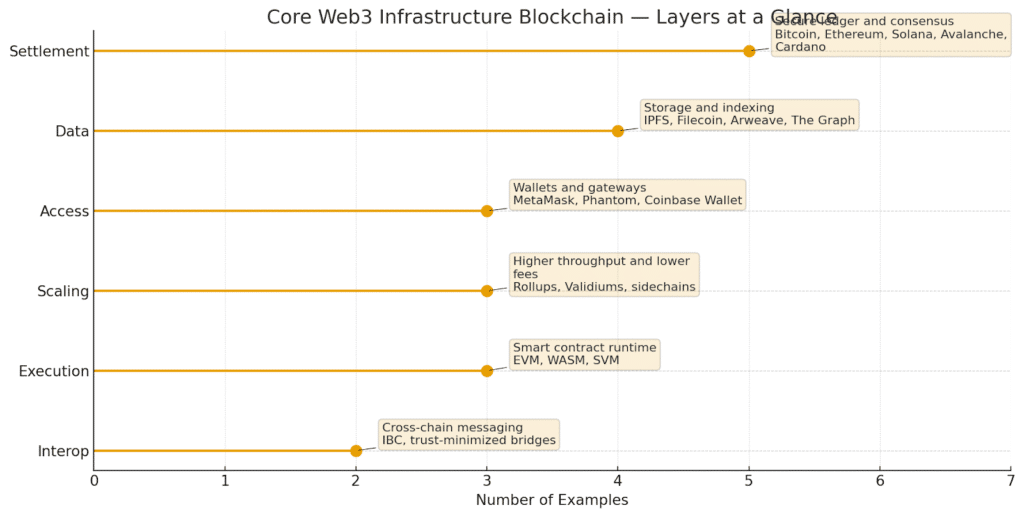
Core Web3 Infrastructure Blockchain
| Layer | Purpose | Examples |
| Settlement | Secure ledger and consensus | Bitcoin, Ethereum, Solana, Avalanche, Cardano |
| Execution | Smart contract runtime | EVM, WASM, SVM |
| Scaling | Higher throughput and lower fees | Rollups, Validiums, sidechains |
| Interop | Cross-chain messaging | IBC, trust-minimized bridges |
| Data | Storage and indexing | IPFS, Filecoin, Arweave, The Graph |
| Access | Wallets and gateways | MetaMask, Phantom, Coinbase Wallet |
Notable Web3 Platforms And Protocols
The landscape includes Ethereum with scaling networks like Polygon, Arbitrum, and Optimism. High-throughput chains such as Solana, Avalanche, and Near power fast apps. Polkadot and Cosmos focus on multi-chain systems. Bitcoin anchors settlement with a growing set of Layer 2 apps. For content, builders use IPFS and Filecoin. The Graph provides indexing. Chainlink supplies data feeds. DeFi activity often centers on Uniswap, Aave, and Curve. NFT markets are led by OpenSea and Magic Eden.
Smart Contracts In The Web3 Ecosystem
Smart contracts turn code into services that anyone can verify. They power tokens, payments, remittances, trading, lending, staking, insurance, games, subscriptions, and access control. Strong practice keeps them safe and efficient. Ship minimal logic first. Add upgrades with care. Use audits and bug bounties to catch flaws early. This is the smart contracts Web3 ecosystem in action.
Interoperability: Linking Chains And Apps
No single chain does it all. Blockchain interoperability Web3 connects systems so value can move. Assets travel across chains. Liquidity reaches more users. Developers reuse proven parts. Teams should choose low-trust bridges, add rate limits and circuit breakers, and test failure paths with caps before launch.
Where Blockchain Helps Today
Payments And Stablecoins
Stablecoins bring fast settlement and global reach. Fees are often lower than legacy rails. That helps small purchases and cross-border payouts. They suit e-commerce, creator income, payroll, and remittance. Many wallets support them, so spending and saving feel simple.
DeFi
Users trade, lend, borrow, and earn yield on chain. Collateralized systems aim to hold a target price. Automated market makers run at all hours. Oracles feed prices. Risk controls such as caps and circuit breakers reduce shocks.
Digital Goods And Media
NFTs secure tickets, game items, and media with clear ownership. Markets run around the clock. Brands attach perks or access. Fans track provenance and rarity in a public record.
Identity And Access
A wallet works as sign-in across apps. Reusable credentials let users prove facts without sharing raw data. Passkeys and social recovery make accounts easier to keep safe. Teams can gate features by token or credential.
Supply Chains And Records
Time-stamped events track goods as they move. Partners share a single source of truth. Audits get faster. Recalls target the right lots. Buyers trust claims when data is open and consistent.
Decentralization And Why It Matters
Blockchain decentralization Web3 lowers platform risk. There is no single gatekeeper. Censorship resistance rises, since changes need broad agreement. Rules are clear and open for anyone to verify. If trust breaks, forks act as a safety valve and the network can choose a new path. Good design starts with a plan to hand off control over time. Public governance rules, open licenses, and roadmaps show how power shifts to the community. Clear metrics like validator counts and token distribution help track progress.
Scalability: Getting To Mass Use
People need fast, low-cost transactions to use Web3 each day. Blockchain scalability for Web3 relies on rollups that batch activity, parallel execution that processes more operations, data availability layers that cut costs, and light clients or stateless wallets for mobile. Developers should set fee targets for core actions, pick scaling that matches the use case, monitor capacity, and stage upgrades so users stay safe and informed.
Security And Regulatory Context
Growth brings new risks and new rules. Smart contract bugs remain a top cause of loss. Bridges and cross-chain tools add attack surface. Social scams still hit users hard, so clear UX and education matter as much as code.
Regulation is maturing. The EU’s MiCA sets rules for stablecoins and crypto services. Many regions apply Travel Rule-style requirements to providers. Spot crypto ETFs in major markets opened new paths for mainstream exposure. Good hygiene helps: run audits and public bounties, use multisig or threshold keys for treasuries, add proof of reserves where relevant, and publish plain-language risk labels.
Common Risks And Practical Mitigations
| Risk Area | What Can Go Wrong | Practical Mitigation |
| Smart contract bugs | Funds locked or lost | Formal audits, bug bounties, staged rollouts |
| Key management | Keys stolen or lost | Hardware modules, multisig, threshold wallets |
| Bridge exploits | Cross-chain theft | Low-trust bridges, rate limits, circuit breakers |
| Price oracles | Bad data or manipulation | Medianized feeds, multiple sources |
| UX pitfalls | Wrong address, fee shocks | Human-readable names, warnings, simulations |
| Compliance gaps | Fines or shutdowns | Travel Rule tools, KYC where needed, geo-controls |
Build A Decentralized Web3 Ecosystem: Step-By-Step
- Design The Developer Experience: Publish clear docs, quick starts, and sample apps. Offer public support channels. Keep FAQs up to date.
- Stand Up The Infrastructure: Choose a base chain and node providers. Pick the execution runtime. Add scaling, storage, indexing, and monitoring.
- Map The Application Layer: Track teams across DeFi, NFTs, identity, gaming, and enterprise. Fill gaps with grants and co-builds.
- Plan Growth: Run hackathons. Fund pilots. Form partnerships that add users and volume. Share case studies.
- Align Strategy And Governance: Set a long-term roadmap. Define treasury controls. Publish decisions and KPIs in public.
The Role Of Blockchain In Web3, Summed Up
- The role of blockchain in Web3 is to secure state, enforce rules, and enable digital ownership.
- Web3 infrastructure blockchain supplies settlement, execution, scaling, interop, data, and access.
- Blockchain decentralization Web3 reduces single-point failure and opens markets.
- Web3 use cases blockchain span payments, DeFi, NFTs, identity, and supply chains.
- Blockchain and decentralized applications deliver services people can verify.
- Web3 vs Web2 blockchain is open networks vs closed platforms.
- Blockchain scalability for Web3 relies on rollups and modular designs.
- Smart contracts Web3 ecosystem turns code into reliable services.
- Blockchain interoperability Web3 links chains so assets and messages can flow.
- Challenges of blockchain in Web3 include security, UX, and changing rules.
Conclusion
Blockchain in Web3 Ecosystem gives people and firms real control online. It replaces closed platforms with open networks. It powers markets that run all day. It also comes with work to do: scale, safety, and simple UX. With careful design and clear rules, teams can ship useful products today.
The next wave blends Web3 with Web2. Apps will hide complexity and keep the benefits of openness. Users will sign in with wallets as easily as email. Payments will settle in seconds. Data will move across apps by default. Builders who master the stack, embrace audits, and plan for policy will lead.
FAQs About Blockchain in Web3 Ecosystem
What Is Web3 In Simple Terms
Web3 is the internet with ownership. Users hold assets and identity in wallets. Apps plug into open networks that anyone can use.
Why Do Smart Contracts Matter
They enforce rules on chain. They hold funds and run logic without a middleman. Anyone can read the code and check the behavior.
How Is Web3 Different From Web2
Web2 stores key data with companies. Web3 stores critical state on public networks. Users keep keys and can move across apps at will.
What Risks Should New Users Know
Key loss, phishing, and fake sites. Use hardware wallets, verify addresses, and start small. Double-check URLs before any transfer.
Is Web3 Legal
Most regions have rules for crypto assets and services. Teams should follow local laws and publish clear risk disclosures.
Glossary
- Blockchain: Shared ledger that records transactions and state.
- Smart Contract: Code on a chain that enforces rules.
- Wallet: Tool that holds keys and signs transactions.
- Rollup: Scaling method that batches many transactions.
- Bridge: Software that moves assets and messages across chains.
- Oracle: Service that brings external data on chain.
- Stablecoin: Token designed to hold a steady price.
- TVL: Total value locked in DeFi contracts.
- Travel Rule: Standard for sharing sender and receiver data between providers.
- MiCA: EU framework for crypto assets and services.
Summary
Blockchain is the base layer of Web3. It secures assets, identity, and data on open networks. The stack includes settlement chains, smart contracts, scaling, interop, storage, and wallets. Major use cases are payments, DeFi, NFTs, identity, and supply chains. Decentralization reduces platform risk. Scalability comes from rollups and modular designs. Key risks include contract bugs, bridge exploits, and poor UX. Mitigations include audits, multisig, circuit breakers, and clear onboarding. Regulation is maturing. Teams that focus on security, clarity, and real utility can launch durable products in the Blockchain in Web3 Ecosystem while meeting user and policy needs.