













AI-powered blockchain protocol Qubic has claimed to have briefly seized majority control of Monero’s network in what it described as a successful “Monero attack,” sparking fresh debate over the security of proof-of-work blockchains.
On an X post and blog publication, Qubic claimed that it had reached over 51 percent of the hashrate in Monero, capable of controlling the validation of transactions among other changes on the blockchain. The group referred to the Monero hack as an experiment in order to assist the privacy-oriented network in preventing future attacks.
Qubic has reached over 51% of Monero's hashrate, effectively giving it control of the network.
Qubic chose not to launch the takeover yet, proving a powerful theory by action.
But this story isn’t over yet. What's next for Qubic and the future of PoW chains?
Article below⏬ pic.twitter.com/JqQNqpy95j
— Qubic (@_Qubic_) August 12, 2025

Qubic decided not to initiate the takeover, yet, which confirmed one of the strong theories via practice, the protocol stated. But this story isn’t over yet..
Security Concerns Raised by Monero Attack
A 51% attack is a means of attacking the blockchain so that one controls most of the computing power making it possible to tamper with transactions or even spend coins twice. Although not common in large networks, the vulnerability has in the past been used against ETH Classic, Verge, and Bitcoin gold. The Monero attack supposedly now puts a high-profile privacy chain on the discourse.
Qubic, where proof-of-work mining appears to drive its AI model, has seen its own token QUBIC increase 25 percent over the last 24 hours to a $342 million market valuation, CoinGecko data show. The XMR of Monero dropped by 6 percent in the same duration to make it have a market valuation of 4.75 billion dollars.
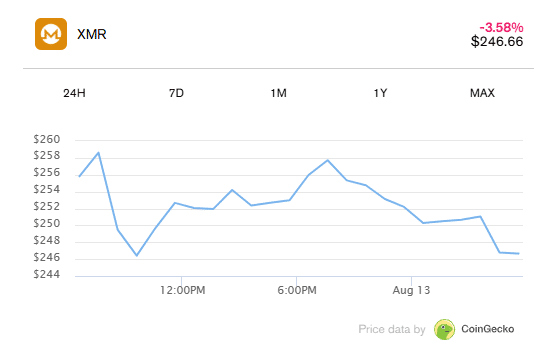
Although Qubic argues that the Monero hack was indeed suffered, blockchain security analysts are still split on the issue of whether this attack succeeded or not.
Experts Question Qubic’s Monero Attack Claims
According to AMLBot, a blockchain compliance company, it saw no sign of a verified attack, in the form of large-scale blockchain rewriting, though it did seem that the attack was still in progress at the time. The lack of independent verify was also indicated by Horizen Labs.
James Shuman, head of security at Horizen Labs, told Decrypt that Qubic had claimed to briefly overtake the majority of hashrate, and that a few trackers indicated above-average orphaning and short reorganizing. But there’s no confirmed double-spend or proof of sustained consensus control in the Monero attack.
Qubic pseudonymous member Retrodrive responded by arguing that the evidence was on-chain and easy to verify, stating that its pool had mined 63 of 122 blocks in a four-hour window (more than their own threshold of a majority control).
Financial Costs of Sustaining Monero Attack

Signs of disruption were reported by some analysts. Nikita Zhavoronkov, CEO of blockchain explorer Blockchair, told that data indicated that Monero had chain reorganizations of as many as six blocks deep within the past 24 hours. He called the Monero attack a successful 51% attack- low impact and not long lasting, but still real.
The leader Qubic, Eugene Ivanchenko, who went by the alias Come-from-Beyond, justified the Monero attack as a defensive measure, which would make the network resistant to the attacks of government agencies.
It is costly to continue controlling the majority of proof-of-work blockchain. Ledger CTO Charles Guillemet described the cost of such dominance as worth 75 million dollars a day, over Monero. Although it may be quite profitable, it is life-threatening to the violation of the trust toward the network literally overnight, Guillemet cautioned.
Qubic Eyes Greater Miner Profitability Control
Qubic proposed that it could be even more profitable to its miners and exclude other non-Qubic miners should it continue to control Monero hashrate after the Monero attack.
The attack has also brought back fears of centralization that exists in the process of proof-of-work mining. According to Shuman, the more critical issue is the mining economics, instead of a single actor.
He added that by overpaying the miners, a highly funded player may centralize the proof-of-work through off-chain incentives. The fact that only one pool can even claim a majority control should awaken a desire to diversify the hashpower.
Qubic declared the Monero attack a kind of watershed moment in its blog post and added that it was proud that a $300 million market cap AI protocol managed to effectively dominate a $6 billion market cap privacy giant. These consequences of this event will be felt across the crypto industry, the post concluded.
Conclusion
Based on the latest research, Monero attack claims remain contested, with Qubic asserting network dominance and experts urging caution over proof-of-work vulnerabilities. While evidence points to possible short-term control, the high costs and lack of independent verification leave uncertainty. The event underscores urgent calls for decentralization and stronger blockchain security safeguards.
For more expert reviews and crypto insights, visit our dedicated platform for the latest news and predictions.
Follow us on Twitter and LinkedIn, and join our Telegram channel to be instantly informed about breaking news!
Summary
Qubic claims to have gained majority control of Monero’s hashrate in a self-described 51% “Monero attack,” sparking industry-wide debate. Although Qubic refers to it as a protective experiment, the experts are skeptical, referring to zero confirmed double-spends or prolonged control. The move highlights proof-of-work vulnerabilities, with potential costs estimated at $75 million daily, raising urgent concerns over network centralization and long-term blockchain security.
FAQs
1. What is a 51% attack?
It’s when one entity controls over half a blockchain’s hashrate, enabling potential transaction manipulation.
2. Did Qubic take over Monero?
Qubic claims yes, but experts say there’s no independent proof of a sustained attack.
3. Why did Qubic do it?
To test Monero’s defenses against possible future threats, according to Qubic.
4. What’s the risk of such attacks?
They can damage trust, centralize control, and drive away miners.
Glossary Of Key Terms
51% Attack – Control of over half a blockchain’s hashrate, enabling transaction manipulation.
Hashrate – Total computing power securing a blockchain.
Proof-of-Work (PoW) – Mining-based system to validate transactions.
Monero (XMR) – Privacy-focused cryptocurrency with hidden transactions.
Qubic – AI-driven proof-of-work blockchain protocol.
Mining Pool – Group of miners sharing rewards.
Centralization Risk – Too much control in one entity’s hands.
Reference